
OPEN CHRONICLE | GLOBAL NEWS DESK | UNITED STATES | BREAKING NEWS
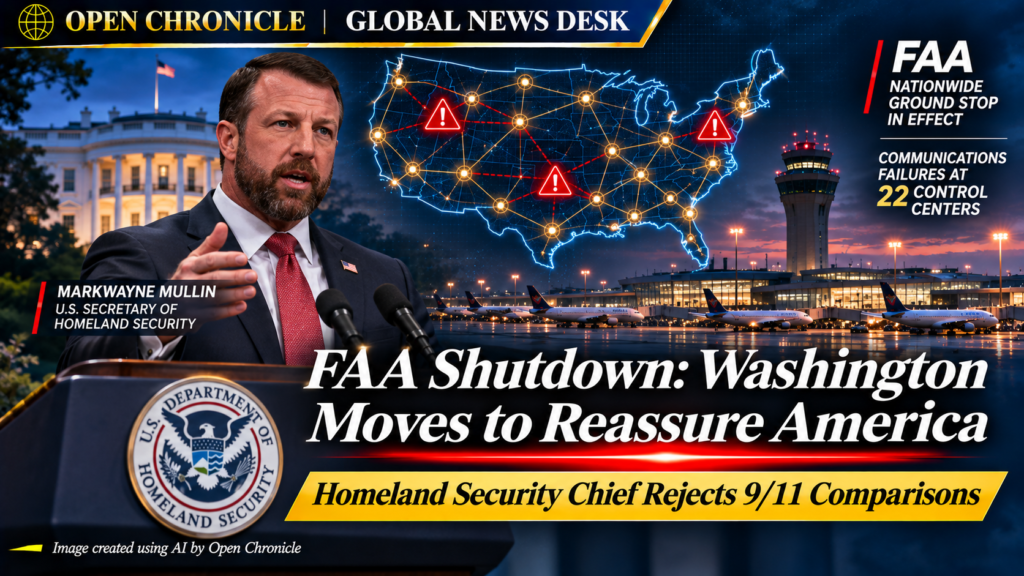
Homeland Security Secretary Markwayne Mullin has sought to reassure Americans that the nationwide suspension of flight departures is not a repeat of the September 11 terrorist attacks. As the Federal Aviation Administration investigates serious communications failures affecting its 22 regional air traffic control centers, the disruption is raising concerns about aviation safety, aging infrastructure and international flights, including services from Portugal.
By Open Chronicle News Desk
November 13, 2026 | Breaking News & Analysis
Washington moves to calm fears over nationwide flight shutdown
US Homeland Security Secretary Markwayne Mullin has sought to reassure the American public following the Federal Aviation Administration’s extraordinary decision to suspend flight departures across the United States.
Speaking to journalists at the White House, Mullin rejected comparisons between the current aviation emergency and the terrorist attacks of September 11, 2001, which led to the closure of American airspace.
His intervention came as the FAA maintained a nationwide ground stop following serious communications problems affecting the country’s regional air traffic control network.
The decision has disrupted airport operations across the United States and raised questions about the reliability of infrastructure responsible for managing one of the world’s busiest aviation systems.
Mullin indicated that departing aircraft would remain grounded until further notice, while federal authorities continued investigating the technical difficulties.
The administration’s message was intended to distinguish a precautionary response to an operational failure from the national security emergency that followed the 2001 attacks.
However, the full cause and extent of the communications failure had not been established in the initial information available.
The absence of a confirmed technical explanation means the investigation remains central to understanding the incident.
1. Why the Homeland Security Secretary addressed the nation
The scale of the FAA’s decision prompted immediate concern among travelers and aviation observers.
A nationwide ground stop is an exceptional measure.
Most disruptions affecting American aviation are limited to particular airports, regions or weather conditions.
A restriction covering departures throughout the country signals that aviation authorities consider the underlying problem serious enough to require coordinated action.
Mullin’s remarks sought to prevent speculation about a possible security emergency.
The comparison with September 11 is particularly sensitive because that event resulted in the unprecedented closure of American airspace and the diversion of aircraft.
Friday’s incident, by contrast, has been attributed by officials to communications problems affecting air traffic control operations.
That distinction is fundamental.
The FAA’s decision was presented as a safety precaution while technicians investigated the malfunction.
It was not announced as a response to a confirmed terrorist attack.
Nevertheless, Mullin’s reassurance should not be interpreted as a complete technical explanation of the failure.
Establishing the cause remains the responsibility of the investigating authorities.
2. All departing aircraft ordered to remain on the ground
The FAA ordered aircraft scheduled to depart from American airports to remain on the ground until further notice.
The restriction was imposed because of serious communications difficulties affecting the systems used to manage aircraft movements across the national airspace.
A ground stop prevents additional aircraft from entering the affected traffic system while operational conditions are assessed.
It is a preventive measure designed to maintain safety when normal coordination cannot be guaranteed.
Importantly, the suspension of departures does not mean that every aircraft already airborne was ordered to land immediately.
Aircraft already in flight remain subject to instructions from aviation authorities and the procedures applicable to their routes.
International operations may also require individual assessments.
The precise treatment of each flight depends on its location, destination and the instructions issued by the relevant air traffic control authorities.
The FAA’s initial measures therefore need to be understood as restrictions on departures rather than evidence of a complete loss of control over American airspace.
3. Communications failures affect 22 regional control centers
Transportation Secretary Sean Duffy identified communications problems affecting the United States’ 22 regional air traffic control centers.
These facilities coordinate aircraft traveling between airports across large sections of American airspace.
They form a critical part of the National Airspace System.
Regional controllers manage aircraft separation, route coordination and the transfer of responsibility between different controlled areas.
Reliable communications are essential for these operations.
If the systems used to exchange information become unreliable, controllers may face difficulties coordinating traffic safely and efficiently.
Duffy said FAA technicians were investigating the malfunction.
The initial information did not establish whether the disruption resulted from a single shared technical failure or several related problems.
That distinction will be important in determining how the incident developed and whether the existing contingency arrangements performed as intended.
The investigation will also need to establish which communications systems were affected and how normal operations can be safely restored.
4. Flight tracking reports raise questions about aircraft movements
Flight tracking platforms have reportedly shown unusual aircraft movements during the disruption, including planes returning toward departure airports and others flying holding patterns near destinations.
Such movements can occur for several reasons.
Aircraft may return to their origin because of operational restrictions, weather, technical problems or changes in air traffic management.
Holding patterns may be used when aircraft must wait for landing clearance or when traffic conditions require delays.
The presence of these movements on a flight tracking platform does not, by itself, establish that every affected aircraft was responding to the FAA communications failure.
Individual flight circumstances would need to be confirmed with airlines or aviation authorities.
Nevertheless, the reported movements illustrate the complexity of managing aircraft already in operation while a nationwide departure restriction is in force.
Air traffic controllers must continue coordinating aircraft safely even when additional departures are suspended.
The immediate priority remains maintaining orderly traffic flows and ensuring that crews receive the information needed to complete their flights.
5. America’s busiest aviation network faces disruption
The United States operates one of the largest and most complex aviation networks in the world.
According to the figures cited in the reporting supplied to Open Chronicle, the FAA manages an average of more than 45,000 flights each day, serving approximately 2.9 million airline passengers.
The scale of those operations means that a nationwide ground stop can produce consequences far beyond the airports where aircraft are initially delayed.
Airlines depend on carefully coordinated schedules involving aircraft availability, crew assignments, maintenance requirements and connecting passengers.
When departures are suspended, these arrangements begin to unravel.
Aircraft scheduled to operate several services may remain at their departure airports.
Crews can reach the limits of their permitted working hours.
Passengers may miss domestic and international connections.
Airport gates can become congested as aircraft wait for permission to depart.
The effects may continue after the technical problem has been resolved because airlines must gradually restore their operating schedules.
Reporting during Friday’s disruption indicated thousands of flight delays and cancellations. The Wall Street Journal reported more than 10,000 affected flights by the early evening, although the figures continued changing as the situation developed.
6. Portugal’s TAP flights enter the international equation
The disruption is also relevant to travelers departing from Portugal.
According to the information supplied to Open Chronicle, at least eight TAP Air Portugal flights had departed Portuguese airports for the United States on Friday.
The reported destinations included New York’s John F. Kennedy International Airport, Newark Liberty International Airport, Washington Dulles, Boston and Miami.
These services illustrate the international consequences of an aviation emergency originating in the United States.
A nationwide restriction on American departures can complicate aircraft rotations, connecting services and the return journeys of aircraft operating transatlantic routes.
However, the FAA indicated that international arrivals would be assessed individually.
The fact that a flight departed Portugal does not establish that it was subsequently diverted, delayed or prevented from landing.
Individual flight outcomes must be verified through the airline and relevant airport authorities.
Passengers should therefore distinguish between the nationwide restriction on US departures and the operating status of a particular international flight.
7. A September communications failure offers a possible warning
Aviation specialists cited by the Associated Press have compared Friday’s disruption with a regional communications failure that affected hundreds of flights in the northeastern United States in September.
The earlier incident was geographically limited.
Friday’s disruption, by contrast, affected the national air traffic control network.
The comparison raises questions about whether recurring weaknesses exist in the communications infrastructure used by air traffic controllers.
However, similar operational symptoms do not necessarily establish the same technical cause.
Investigators will need to determine whether Friday’s failure involved equipment, telecommunications connections, shared infrastructure or another component of the air traffic management system.
The possibility that aging technology contributed to the disruption has been raised by aviation experts, but it remains a hypothesis rather than a confirmed finding.
8. Aging infrastructure and a $42.5 billion modernization challenge
The aviation emergency has intensified scrutiny of the federal government’s air traffic control modernization program.
Congress approved $12.5 billion for the initiative in 2025.
The project includes replacing aging copper communications lines with fiber optic connections and gradually upgrading outdated radio systems at airports across the country.
Transportation Secretary Sean Duffy has warned that an additional $30 billion will be necessary to complete the modernization.
The White House has begun seeking congressional support for that investment.
The Cost of Modernizing America’s Air Traffic Control
Funding approved by Congress in 2025.
Additional investment sought to complete modernization.
Approved funding plus the additional amount requested.
Funding Distribution
29.4%
70.6%
Congress approved $12.5 billion in funding for air traffic control modernization in 2025. Transportation Secretary Sean Duffy has identified an additional $30 billion requirement to complete the program. The combined $42.5 billion figure represents approved funding plus the additional amount being sought. It does not mean that the full amount has been authorized by Congress, nor does it represent a confirmed final project cost.
SOURCE & METHODOLOGY:
Associated Press reporting, November 13, 2026, citing US Department of Transportation statements. Percentages represent each funding component as a proportion of the combined $42.5 billion figure, rounded to one decimal place.
The modernization program is intended to improve the reliability and performance of essential aviation infrastructure.
However, replacing systems while maintaining continuous operations presents significant engineering and organizational challenges.
New equipment must function alongside existing infrastructure.
Controllers and technical personnel require training.
Communications networks must be tested before older systems can be retired.
Friday’s emergency demonstrates the importance of these investments, although the precise relationship between the outage and aging equipment remains unconfirmed.
9. Is there evidence of a cyberattack or deliberate sabotage?
The nationwide scale of the disruption has prompted questions about whether the communications failure could have been caused by malicious activity.
Mullin said authorities had found no indication of an attack or an immediate threat to the United States.
The initial assessment therefore pointed toward a telecommunications problem rather than a confirmed national security incident.
Nevertheless, the technical investigation was continuing, and the absence of an identified malicious actor does not constitute a complete explanation of the malfunction.
Authorities must determine the origin of the failure before drawing definitive conclusions.
The Associated Press reported that officials had not established the cause and were also examining whether the aviation disruption might be connected to other recent technology problems.
There is currently no verified basis for attributing the incident to a foreign government, a criminal organization or a coordinated attack.
The distinction between a possible line of investigation and an established fact is particularly important in a case involving critical national infrastructure.
10. What the White House and Congress must now confront
The immediate challenge for the administration is restoring reliable air traffic control communications.
The longer-term challenge concerns the condition of America’s aviation infrastructure.
Congress may demand answers about the systems affected, the effectiveness of backup arrangements and the progress of the modernization program.
The incident could also influence the debate over additional federal investment.
Supporters of increased funding may argue that Friday’s disruption demonstrates the consequences of postponing infrastructure improvements.
Other lawmakers may seek more detailed information about project management, procurement and whether previous investments have delivered measurable results.
The central question is not simply the amount of money required.
It is whether the United States can build an air traffic control system capable of maintaining safe operations when individual components fail.
11. What happens next?
The FAA must establish the technical cause of the communications breakdown and determine when normal operations can safely resume.
Airlines will then need to recover from accumulated delays and cancellations.
International carriers, including TAP Air Portugal, must coordinate with American airports and air traffic authorities to manage affected services.
Federal officials will also face questions about the reliability of backup communications and whether similar disruptions could occur again.
For passengers, the most important distinction remains between the status of the national air traffic system and the status of an individual flight.
A nationwide ground stop can affect different flights in different ways, particularly when international services are involved.
Official airline information and FAA operational notices remain the appropriate sources for determining whether a particular service is operating.
Conclusion | A technical crisis, not another September 11
Markwayne Mullin’s intervention at the White House was intended to reassure Americans during an extraordinary disruption to national aviation.
The Homeland Security Secretary rejected comparisons with the September 11 terrorist attacks and emphasized that authorities were dealing with a telecommunications problem.
The FAA’s decision to suspend departures was taken as a precaution while technicians investigated the communications failure affecting regional air traffic control centers.
The disruption has nevertheless exposed the vulnerability of a system essential to transportation, commerce and public safety.
It has also renewed attention to the billions of dollars required to modernize American aviation infrastructure.
The consequences extend beyond the United States, affecting international airline operations and raising concerns among passengers traveling from countries including Portugal.
The immediate priority is restoring safe flight operations. The larger challenge is ensuring that a technical failure cannot again bring departures across the world’s busiest aviation system to a standstill.
Open Chronicle will continue monitoring the FAA investigation, statements from federal authorities and the operational consequences for domestic and international aviation.
Sources and Further Reading
Flights Halted Across the United States
Reporting on the FAA nationwide ground stop, the communications failure affecting regional control centers and the government’s response.
FAA Ground Stop and Federal Security Statements
Continuing coverage of Markwayne Mullin’s reassurances, operational restrictions, international arrivals and the investigation.
Nationwide Flight Disruption and Operational Impact
Reporting on flight delays, cancellations, telecommunications infrastructure and the operational consequences for airlines.
National Airspace System Status
Official information on airport restrictions, ground stops, traffic management and delays. This page provides operational updates rather than an archived explanation of the incident.
Travel Alerts and Flight Information
Official airline information for passengers checking changes to international services. This general resource does not independently confirm the status of the flights mentioned.
This article was prepared on November 13, 2026, during an active nationwide aviation disruption. Federal officials described a telecommunications failure and reported no indication of a malicious attack at the time of their statements. The technical cause remained under investigation. Information concerning individual international flights requires confirmation from airlines and aviation authorities. Flight disruption figures and operational restrictions may change.