
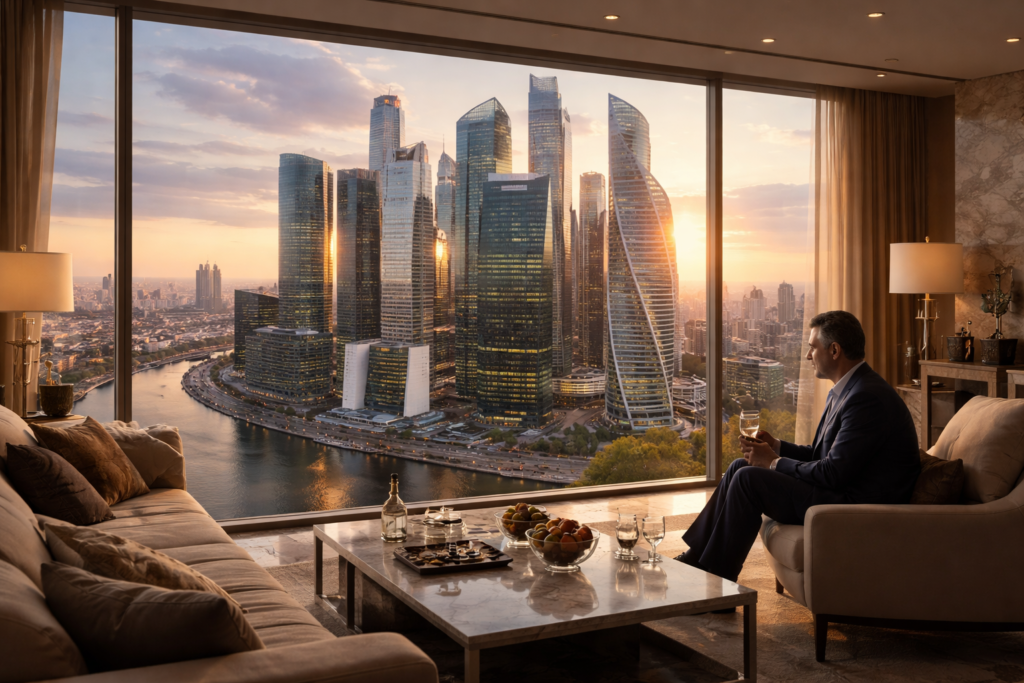
Image Credentials: Image Title: BASHAR AL-ASSAD’S LIFE AFTER THE FALL Source: (sora.openai) Date: January 2026. Attribution: This image was created using AI-generated imagery (sora.openai) and does not depict a real-world scene.
By Open Chronicle News Desk
The skyline of Moscow’s prestigious financial district, known as Moscow City, is a jagged glass-and-steel testament to modern Russian ambition. Somewhere within these gleaming towers, amidst three floors of interconnected luxury apartments, lives a man who once commanded a nation with an iron fist. Bashar al-Assad, the deposed president of Syria, now spends his days in what intelligence analysts call a “gilded cage.”
Thirteen months after the sudden collapse of his regime on December 8, 2024, the former ophthalmologist has traded the presidential palace of Damascus for a high-security skyscraper. According to investigative reports from Die Zeit and local Russian leaks, the Assad family owns at least 20 apartments in the capital, purchased through shell companies and relatives like Iyad Makhlouf over the previous decade as an insurance policy against the very revolution that eventually unseated them.
A Sudden Departure
The fall was swifter than many anticipated. As the rebel coalition led by Hay’at Tahrir al-Sham (HTS) reached the gates of Damascus in late 2024, Assad reportedly abandoned his inner circle, including his brother Maher, to board a Russian military transport at the 11th hour. While the streets of Homs and Hama celebrated, the Assads were landing at Hmeimim Airbase before being spirited away to Moscow.
Life in the “Gilded Cage”
Life in exile for the 60-year-old former dictator is characterized by extreme seclusion and enforced silence. The Kremlin, under Vladimir Putin, has granted Assad “humanitarian asylum” but with a heavy price: a total ban on political activity and media appearances.
Sources close to the family describe a surreal existence. While his wife, Asma, has reportedly recovered from a recurrence of leukemia following experimental treatments in Moscow, and his daughter Zein has been seen at elite Moscow gyms, Bashar remains largely indoors. Reports suggest he has returned to his first passion, ophthalmology, taking refresher courses and studying Russian, though he is forbidden from seeing patients or making public statements. When he isn’t studying, he reportedly occupies his time with high-stakes online gaming, a digital escape from a reality where he is no longer a sovereign but a guest of the state.
The Diplomatic Stalemate
The new interim government in Damascus, led by Ahmed al-Sharaa, has repeatedly demanded Assad’s extradition to face trial for war crimes. However, Russia’s Ambassador to Iraq, Elbrus Kutrashev, reiterated in late 2025 that Moscow has no intention of surrendering him, citing “humanitarian reasons” and personal orders from President Putin.
For the Kremlin, Assad is a “fragmented presence”, a reminder of a strategic alliance that defined Russian foreign policy for a decade, now reduced to an “irrelevant guest” whose utility has expired. As the “Lion of Damascus” watches the Moscow River freeze from his skyscraper window, he remains a living ghost of a regime that shaped the 21st-century Middle East.
Bibliography
Assad, Hafez. “Family Evacuation Narrative.” Video posted from Moscow, February 2025.
BBC News. “Bashar al-Assad and family given asylum in Moscow, Russian media say.” December 8, 2024. Accessed January 22, 2026.
Deeb, Kefah Ali, Andrea Backhaus, and Lea Frehse. “Baschar al-Assad in Moskau: Der stumme Schlächter.” Die Zeit, October 8, 2025.
Israel Hayom. “The wife, son, and money: Assad’s new life in Moscow.” February 14, 2025.
The Guardian. “Assad family live in Russian luxury as Bashar ‘brushes up on ophthalmology’.” December 15, 2025.
The Moscow Times. “Syria’s Assad Shunned by Kremlin in Isolated but Luxurious Moscow Exile.” December 15, 2025.
Wikipedia contributors. “Fall of the Assad regime.” Wikipedia, The Free Encyclopedia. Last modified December 2025.