
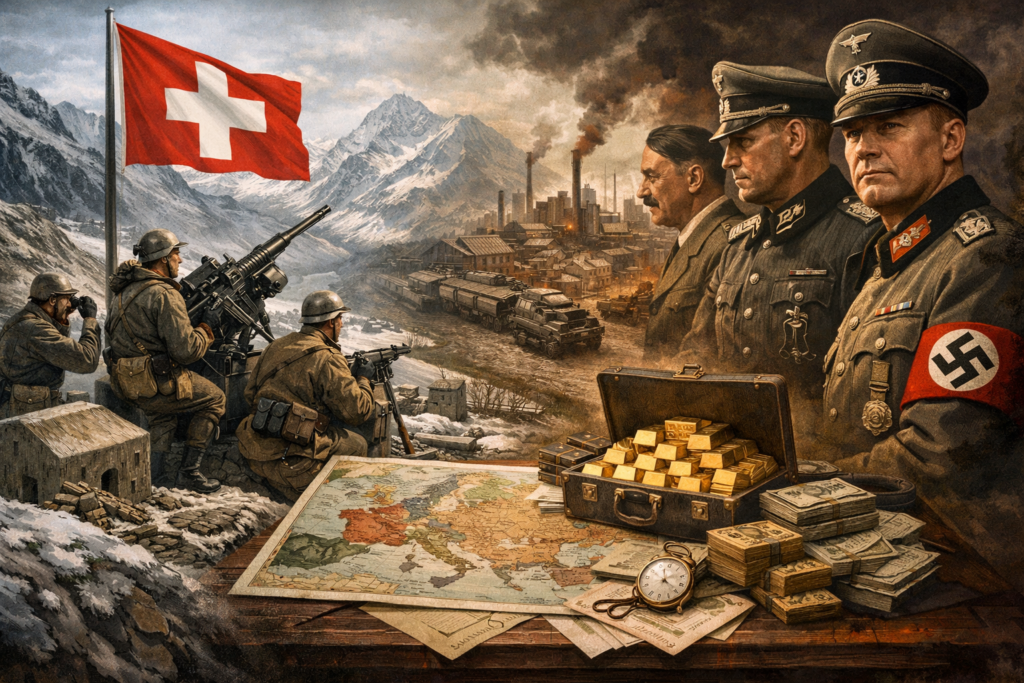
Image Credentials: Image Title: Why the Nazis Never Crossed the Swiss Border Source: (sora.openai) Date: January 2026. Attribution: This image was created using AI-generated imagery (sora.openai) and does not depict a real-world scene.
By Open Chronicle History Desk
At the height of World War II, a map of Europe showed a continent bleeding under the shadow of the Swastika. From the Atlantic coast of France to the gates of Moscow, sovereign nations had fallen like dominoes. Yet, in the very heart of this “New Order” sat a small, defiant, and remarkably untouched enclave, Switzerland.
For decades, the standard narrative of Swiss survival was one of pure, idealistic neutrality, a diplomatic “magic shield.” However, modern historical analysis from the Open Chronicle History Desk reveals a far more complex and pragmatic reality. The Nazis didn’t respect Swiss neutrality out of a sense of international law; they respected it because the cost of violation was too high, and the benefits of a “free” Switzerland were too great to ignore.
The “National Redoubt”: A Poison Pill
The Swiss military leadership, led by General Henri Guisan, knew they could not win a conventional border war against the Wehrmacht. Their solution was the Réduit National (National Redoubt).
Instead of trying to defend every inch of Swiss soil, the plan called for the army to retreat into the impenetrable heart of the Alps. They rigged every major tunnel, bridge, and mountain pass with explosives. The message to Hitler was clear: You may take our cities, but we will blow up the vital Alpine rail links between Germany and Italy, and we will fight a guerrilla war from the peaks that will bleed your divisions for years. To a German High Command already stretched thin on the Eastern Front, Switzerland was a “poison pill” not worth swallowing.
The Golden Safe-Haven
While the military prepared for war, the banks prepared for business. Switzerland served as the primary “launderer” for Nazi Germany. Cut off from global markets, the Third Reich needed a way to convert looted gold, taken from the treasuries of occupied nations and the victims of the Holocaust, into usable foreign currency.
Swiss banks provided the Reich with the Swiss Franc, a hard currency that allowed Germany to purchase vital war materials like tungsten, oil, and rubber from other neutral nations like Portugal and Spain. By invading Switzerland, the Nazis would have destroyed their own financial lifeline to the outside world.
“Neutral” but Productive
There is a saying that during the war, “Switzerland worked for Germany six days a week and prayed for the Allies on the seventh.” While technically neutral, the Swiss industrial machine was deeply integrated into the German war effort.
Swiss factories produced high-precision timing devices for bombs, anti-aircraft guns, and world-class optics for German tanks and snipers. Under the threat of invasion and economic blockade, Switzerland maintained a policy of “parity,” which in practice meant feeding the German military machine to ensure the country’s own survival.
The Diplomatic “Black Hole.”
Berlin also valued Switzerland as a hub for espionage and back-channel diplomacy. It was the one place where German intelligence could rub shoulders with Allied spies, and where Red Cross initiatives could be managed. It served as a “pressure valve” for the Axis, providing a neutral ground for the exchange of prisoners and the communication of diplomatic feelers that would have been impossible elsewhere.
Operation Tannenbaum: The Plan That Never Was
Hitler personally loathed the Swiss, once describing the country as a “pimple on the face of Europe” and its people as “renegade Germans.” He even authorized Operation Tannenbaum, a detailed invasion plan involving several German and Italian divisions.
The plan was shelved not because of a change of heart, but because of timing. By the time France fell and Switzerland was fully surrounded in 1940, the Luftwaffe was busy with the Battle of Britain. By 1941, the focus had shifted to the Soviet Union. Switzerland simply never rose to the top of the priority list before the tide of the war turned against the Reich.
Verdict of History
The survival of Switzerland during WWII was not a miracle of diplomacy, but a masterclass in “armed neutrality.” It was a delicate, often morally murky balancing act between military deterrence and economic cooperation. The Nazis didn’t “respect” Switzerland; they simply calculated that an independent, cooperative, and heavily armed Switzerland was more useful than a conquered, rebellious, and destroyed one.
From the Archives: Open Chronicle History Desk Revisiting the turning points that shaped our world.