
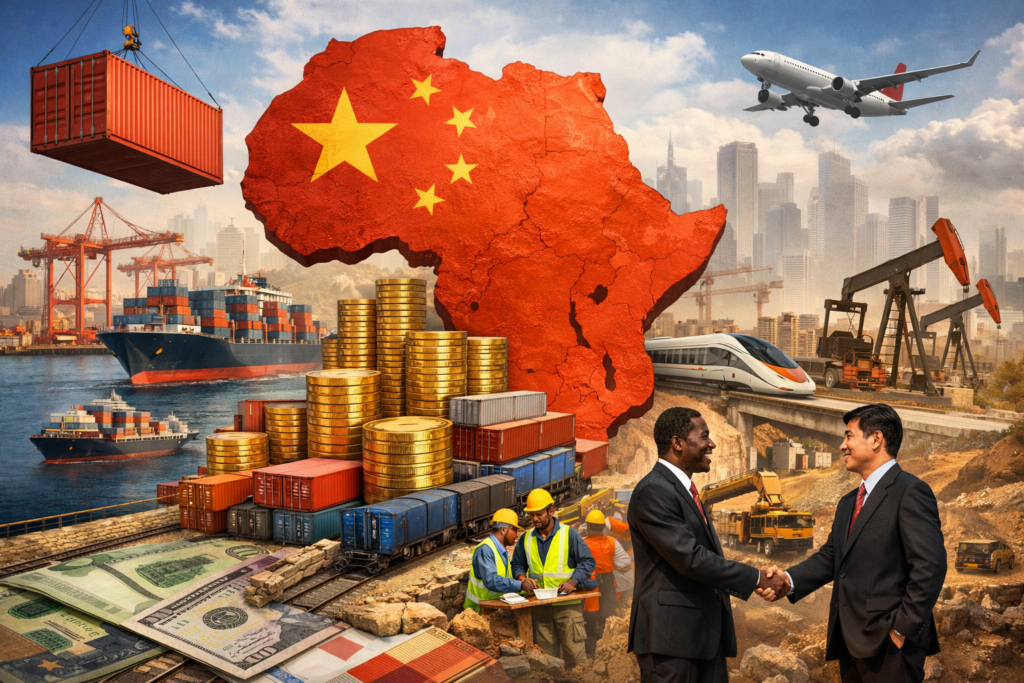
Image Credentials: Image Title: China-Africa Trade Surplus Hits Record $102 Billion as Beijing Diversifies Away from the West Source: (sora.openai) Date: January 2026. Attribution: This image was created using AI-generated imagery (sora.openai) and does not depict a real-world scene.
By Open Chronicle News Desk
BEIJING / NAIROBI – China’s economic footprint across the African continent has reached a historic milestone, with the trade surplus in favor of Beijing hitting a record $102 billion. The figures, released by the General Administration of Customs, underscore a dramatic strategic realignment as the world’s second-largest economy navigates intensifying trade friction with the United States and the European Union.
The record surplus is part of a broader trend that saw China’s total bilateral trade with Africa surge to an all-time high of $346 billion in 2025. While total trade volume grew by 18.4% year-on-year, the widening gap highlights a structural imbalance: a massive influx of Chinese-manufactured goods into African markets, contrasted by a slower growth in African exports to China.
The Export Engine: Green Tech and Machinery
Analysts note that the surge was fueled primarily by a 25.8% jump in Chinese exports to the continent. Dominating the shipments were high-value “New Three” products, electric vehicles, lithium batteries, and solar panels—alongside heavy construction machinery and telecommunications equipment. Solar panel exports alone saw a staggering 60% increase, reflecting Africa’s rapid push toward an energy transition supported by affordable Chinese technology.
Africa’s Resource Dilemma
Conversely, African exports to China remain heavily reliant on raw materials, including crude oil from Angola and Nigeria, as well as copper, cobalt, and iron ore from the Democratic Republic of the Congo and South Africa. While China has implemented “zero-tariff” policies for 100% of products from 33 least-developed countries (LDCs) in Africa to encourage agricultural imports like coffee and nuts, these have yet to balance the sheer scale of industrial imports.
Strategic Pivot Amid Trump Tariffs
The “pivot to the Global South” is widely viewed as a direct response to renewed trade pressure from Washington. With U.S. tariffs on Chinese goods reaching historic highs under the Trump administration, Beijing has successfully redirected its excess industrial capacity toward emerging markets in Africa and Southeast Asia.
“China is effectively weathering the storm in the West by leaning on the rest of the world,” said a senior economist at the Davos 2026 summit. “Africa is no longer just a source of minerals; it is now a critical safety valve for Chinese industry.”
Challenges Ahead for 2026
Despite the growth, the widening $102 billion deficit has sparked concern among African policymakers regarding local industrialization. Leaders from the African Continental Free Trade Area (AfCFTA) are reportedly pushing for more Chinese private sector investment in local manufacturing hubs to move away from the “resources-for-infrastructure” model and toward a more symmetrical partnership.
As 2026 begins, the China-Africa relationship remains the cornerstone of South-South cooperation, although the pressure to address the “trade-finance gap” is likely to dominate diplomatic agendas in the coming months.