
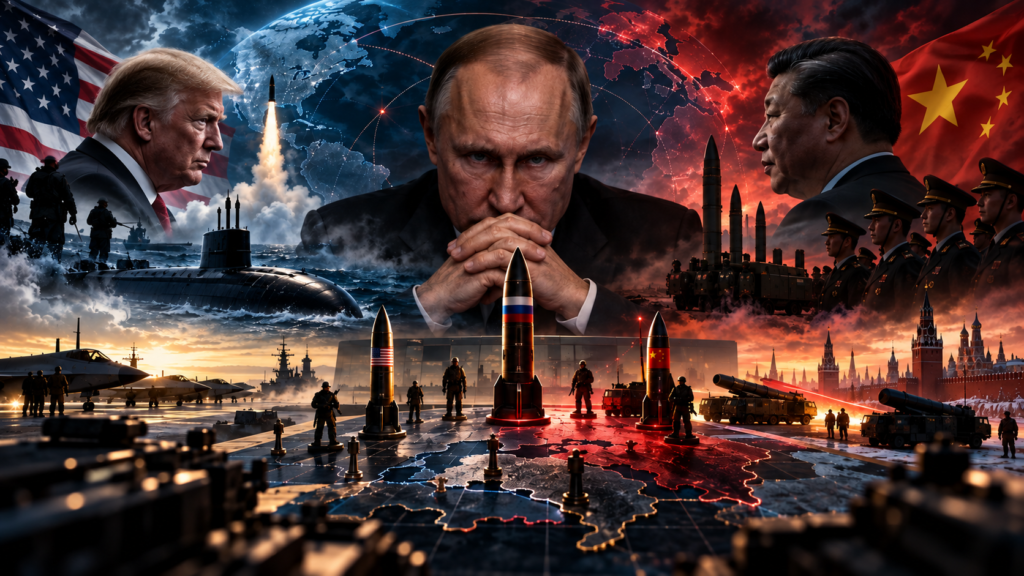
Vladimir Putin’s most disturbing nuclear statement was made years before the invasion of Ukraine. In 2026, with arms control deteriorating, Russia’s nuclear doctrine broadened and confrontation with NATO intensifying, the question is no longer simply what Putin meant. It is how nuclear weapons have become embedded in Russia’s strategy for preventing defeat, controlling escalation and preserving great power status.
By The Grand Strategy Institute Research Division
Grand Strategy Analysis | 30 September 2026
There are political statements designed to survive the moment in which they are spoken.
Vladimir Putin produced one of them in 2018.
Discussing the possibility of nuclear war and Russia’s retaliatory doctrine, the Russian president contemplated a scenario in which enemy missiles were detected heading towards Russian territory.
Russia would retaliate.
The consequences would be catastrophic.
And then Putin posed the question that has followed discussions of Russian nuclear strategy ever since:
“What need will we have for a world if there was no Russia?”
The sentence is frequently circulated today without its original context.
That context matters.
Putin was not announcing that Russia intended to launch an unprovoked nuclear attack. He was describing the logic of nuclear retaliation and arguing that Russia would respond to a confirmed nuclear attack even if the consequences were catastrophic.
In one sense, this was an expression of the terrible logic that has sustained nuclear deterrence for generations.
If an adversary believes it can destroy you without suffering unacceptable destruction itself, deterrence fails.
A credible nuclear power must therefore convince an adversary that retaliation remains possible even under the most catastrophic circumstances.
But Putin’s formulation went beyond the technical language of deterrence.
It transformed the survival of the Russian state into a question about the value of the world itself.
Eight years later, that distinction matters enormously.
Russia’s nuclear weapons are no longer discussed only in theoretical scenarios involving an intercontinental surprise attack.
They have become deeply embedded in the confrontation surrounding Ukraine, NATO, Belarus, Kaliningrad and the future European security order.
The statement from 2018 has therefore acquired a second life.
Not because it proves that Putin wants nuclear war.
It does not.
But because it captures something fundamental about the role nuclear weapons occupy in Russian grand strategy.
Russia’s nuclear arsenal is not merely a weapon of last resort. It is the ultimate guarantee that Russia cannot be strategically ignored, conventionally overwhelmed or existentially defeated without imposing potentially catastrophic risks on its adversaries.
The Original Statement Was About Retaliation
The distinction between retaliation and first use is essential.
Putin’s 2018 argument described Russia detecting an incoming nuclear attack.
Russian warning systems would establish that missiles were travelling towards Russian territory.
Russia would then launch its response.
The logic was therefore recognisable as retaliatory deterrence.
An adversary must know that even a devastating first strike cannot guarantee immunity from retaliation.
This principle formed one of the foundations of strategic deterrence during the Cold War.
The paradox is straightforward and terrifying.
Nuclear weapons deter partly because everyone understands what would happen if deterrence failed.
Their destructive power makes nuclear war extraordinarily costly.
Their deterrent credibility nevertheless requires governments to convince adversaries that under certain circumstances they would use them.
Putin’s statement belongs inside that paradox.
But Russian nuclear policy has evolved significantly since 2018.
2022 Changed the Meaning of Russian Nuclear Signalling
Russia’s full scale invasion of Ukraine fundamentally changed the environment in which Moscow’s nuclear arsenal operates.
The war created a dangerous strategic configuration.
A nuclear superpower launched a major conventional war against a neighbouring non-nuclear state while that state received increasingly sophisticated military assistance from nuclear armed powers and their allies.
The United States and NATO did not enter the war directly.
But Western weapons, intelligence, financing and training became central to Ukraine’s capacity to resist Russia.
That created an increasingly important strategic boundary.
How much Western involvement could occur before Moscow considered NATO effectively involved in the conflict?
Russia repeatedly used nuclear signalling around that question.
Putin and other Russian officials reminded Western governments of Russia’s nuclear capabilities.
Strategic forces conducted exercises.
Nuclear capable systems featured prominently in military signalling.
Russian doctrine itself changed.
Moscow subsequently stationed nonstrategic nuclear weapons in Belarus.
None of those developments, individually or collectively, demonstrates that Russia had decided to initiate nuclear war.
But they performed a strategic function.
They reminded NATO that direct military confrontation with Russia carried escalation risks fundamentally different from Western interventions against non-nuclear adversaries.
Nuclear weapons created a ceiling above the conventional conflict.
Nuclear Weapons Have Already Influenced the War
One of the most important questions surrounding Ukraine is not simply why Russia took particular actions.
It is why NATO did not take others.
NATO did not impose a no-fly zone over Ukraine.
Alliance combat formations did not enter Ukraine to fight Russian forces directly.
American aircraft did not systematically attack Russian military positions.
Western governments instead developed an extensive system of indirect military support while attempting to avoid direct NATO-Russia war.
There were multiple reasons for this restraint.
But nuclear escalation was one of the most important.
This demonstrates an uncomfortable reality about nuclear deterrence.
Russia did not need to detonate a nuclear weapon for its arsenal to affect the war.
The weapons influenced political decisions simply by existing.
This is deterrence operating through the possibility of escalation.
Russia Changed the Doctrine
In November 2024, Putin approved a revised version of the Fundamentals of the State Policy of the Russian Federation in the Area of Nuclear Deterrence.
The document expanded important elements of Russia’s declared nuclear framework.
The revised doctrine identifies nuclear weapons as instruments for deterring aggression against Russia and its allies and for protecting Russian sovereignty and territorial integrity.
It also broadened the circumstances relevant to possible nuclear employment.
Among the most consequential provisions is the declaration that aggression against Russia by a non-nuclear state with the participation or support of a nuclear armed state may be treated as a joint attack.
The doctrine also identifies a conventional attack against Russia or Belarus that creates a critical threat to sovereignty or territorial integrity among the circumstances under which nuclear use could be considered.
Other provisions address ballistic missile attack warnings, attacks involving weapons of mass destruction, threats to systems necessary for nuclear retaliation and large scale aerospace attack.
The significance is political as well as military.
Moscow was adapting its declaratory policy to an environment in which Russia could confront a non-nuclear adversary extensively supported by nuclear powers.
Ukraine itself does not possess nuclear weapons.
Its principal Western supporters do.
The doctrine therefore complicates any assumption that Russian nuclear deterrence applies only to a direct nuclear attack.
That does not mean every conventional attack automatically crosses the nuclear threshold.
It does not.
Doctrine establishes a framework of possibilities.
Political leaders still make the ultimate decision.
But ambiguity itself can serve deterrence.
The Nuclear Threshold Is Supposed to Be Dangerous
Perfectly clear nuclear thresholds can create a strategic problem.
If an adversary knows precisely what it can do without provoking nuclear retaliation, it can attempt to operate immediately below that threshold.
Ambiguity complicates the calculation.
Would a major conventional strike against Russian strategic infrastructure trigger nuclear escalation?
What about an attack affecting early warning systems?
What if strategically important military formations were destroyed?
What if Russian territory were threatened?
What if NATO forces entered the conflict directly?
What if Russia concluded that Kaliningrad was being isolated?
Moscow benefits from Western decision makers having to ask those questions.
That does not mean Russia wants them tested.
Quite the opposite.
The strategic purpose of the threat is ideally to ensure that the experiment never occurs.
Kaliningrad Has Brought the Question Back
On 30 September 2026, Russian nuclear signalling again focused international attention on the Baltic.
Moscow warned that it could employ the full range of available military capabilities, including nuclear weapons, if NATO attempted to isolate Kaliningrad.
Kaliningrad occupies an extraordinary strategic position.
The Russian exclave lies between Poland and Lithuania, both NATO members.
It hosts significant Russian military capabilities and provides Moscow with an important position on the Baltic Sea.
Russia has accused NATO of developing capabilities that could threaten or blockade the territory.
NATO rejects that interpretation and describes its posture as defensive.
The significance of the Russian warning lies in its connection between nuclear deterrence and a concrete geographical flashpoint involving Russian and NATO territory.
This is precisely the type of environment in which escalation management becomes extraordinarily important.
Not because either side necessarily seeks nuclear war.
But because each side may interpret its own actions as defensive while seeing the other’s actions as offensive.
The Most Dangerous Nuclear War May Be One Nobody Intended
Popular culture often imagines nuclear war as a deliberate decision.
A leader decides to destroy an adversary.
Missiles launch.
Civilisation ends.
Strategic reality can be considerably more complicated.
Escalation may instead emerge from a sequence of decisions that individually appear rational.
A military exercise.
A deployment.
A warning.
A counterdeployment.
An aircraft interception.
A missile alert.
An attack on radar.
A cyber incident.
A misunderstood intelligence report.
A conventional strike against a dual-use system.
A commander believing an adversary is preparing something larger.
Each side interprets its own behaviour as defensive.
Each interprets the other’s behaviour as potentially offensive.
The resulting process is the security dilemma operating under nuclear conditions.
That is why miscalculation matters so much.
Russia Still Possesses the World’s Largest Nuclear Inventory
The material foundation behind Russia’s nuclear rhetoric remains enormous.
At the beginning of 2026, Russia was estimated to possess approximately 5,420 nuclear warheads in its total inventory.
Around 4,400 were estimated to form the military stockpile.
Approximately 1,796 were estimated to be deployed.
The United States possessed an estimated total inventory of approximately 5,042 nuclear warheads, including a military stockpile of roughly 3,700.
Together, Russia and the United States still possess the overwhelming majority of the world’s nuclear weapons.
The Federation of American Scientists estimates that the two countries account for approximately 86 percent of the global nuclear inventory.
These are not simply larger versions of conventional bombs.
They form entire strategic systems.
Russia maintains nuclear capabilities across land, sea and air.
Intercontinental ballistic missiles.
Ballistic missile submarines.
Strategic bombers.
Nonstrategic nuclear weapons.
Early warning systems.
Command and control infrastructure.
Hardened facilities.
Mobile missile systems.
The purpose is not merely destructive capacity.
It is survivability.
Russia must maintain sufficient capability to retaliate even after suffering a devastating attack.
That is what gives second-strike deterrence credibility.
Strategic and Nonstrategic Nuclear Weapons Are Different
One of the most important distinctions concerns strategic and nonstrategic nuclear weapons.
Strategic forces are principally associated with long-range attacks against an adversary’s homeland, nuclear forces, command infrastructure and other targets central to national survival.
Nonstrategic nuclear weapons are generally associated with shorter range systems and potential theatre employment.
But the terminology can create a dangerous misunderstanding.
A weapon described as tactical or nonstrategic remains a nuclear weapon.
Its use would cross a threshold that has remained unbroken in warfare since 1945.
The political, military and psychological consequences would be enormous.
And once that threshold was crossed, predicting what happened next would become exceptionally difficult.
The central problem is escalation control.
Can Nuclear War Remain Limited?
Military strategists have studied this question for decades.
Could a state use a single nuclear weapon to compel an adversary to stop?
Could it demonstrate resolve without provoking strategic retaliation?
Could nuclear escalation be controlled?
Could adversaries exchange limited nuclear strikes and then negotiate?
Theories exist.
Confidence does not.
Once nuclear weapons are used, leaders would be making decisions under extraordinary pressure with incomplete information.
Command systems could be damaged.
Communications could fail.
Casualties could be enormous.
Political pressure for retaliation could intensify.
Each side might fear that delaying action would leave its remaining nuclear forces vulnerable.
A weapon intended as a warning could therefore become the first step in an escalation sequence its user never intended.
This is why simplified descriptions of a Russian strategy of using nuclear escalation automatically to force de-escalation should be treated carefully.
Russian military thinking has examined the use of nuclear capabilities for deterrence, escalation management and war termination.
But assuming that Moscow possesses a reliable formula for limited nuclear use would go much further than the evidence permits.
Any such strategy ultimately contains an enormous assumption:
that the adversary will respond as expected.
There is no modern nuclear battlefield experience capable of proving that assumption.
Belarus Changes the Geography
The deployment of Russian nonstrategic nuclear weapons to Belarus adds another dimension.
Belarus is geographically much closer to several NATO members than many traditional Russian nuclear deployment areas.
Poland.
Lithuania.
Latvia.
The wider Baltic region.
Russian and Belarusian forces have also conducted nuclear-related military exercises.
The purely military significance should not be exaggerated.
Russia already possesses multiple systems capable of striking European targets from Russian territory.
But the political and strategic significance is substantial.
Belarus extends the visible geography of Russian nuclear deterrence westward.
It also ties the Belarusian state more deeply into Russia’s strategic military architecture.
Arms Control Is Disappearing at Exactly the Wrong Moment
The strategic environment changed again on 5 February 2026.
New START expired.
For the first time in more than half a century, the United States and Russia were no longer bound by a bilateral legally binding agreement limiting their strategic nuclear forces.
New START had limited each side to 1,550 deployed strategic warheads and 700 deployed strategic delivery vehicles.
But numbers were only part of its importance.
Arms control also creates information.
Notifications.
Data exchanges.
Inspections.
Verification.
Predictability.
Those mechanisms help governments understand what an adversary is doing.
And understanding matters because uncertainty can become dangerous during crises.
Russia suspended important elements of treaty implementation in 2023 amid the confrontation surrounding Ukraine.
The United States subsequently adopted reciprocal measures.
The treaty formally expired in February 2026.
Both sides have so far shown elements of restraint around the former central limits.
But informal restraint is not the same thing as a legally binding, verifiable arms control regime.
The architecture has weakened precisely when geopolitical rivalry has intensified.
The Return of Unconstrained Nuclear Competition
The expiration of New START does not automatically mean that another nuclear arms race has begun.
Both Russia and the United States face industrial, financial and technical constraints.
Both already possess extraordinarily large arsenals.
Both retain powerful second-strike capabilities.
But the strategic direction is troubling.
Russia is modernising its nuclear forces.
The United States is modernising its nuclear triad.
China is rapidly expanding its arsenal.
At the beginning of 2026, China was estimated to possess approximately 620 nuclear warheads.
That remains far below the inventories maintained by Russia and the United States.
But its trajectory matters enormously.
It introduces a strategic problem that the central Cold War arms control architecture was never designed to manage.
The nuclear system is increasingly shaped by three major powers rather than two.
Washington must consider Moscow.
Moscow must consider Washington.
Both must increasingly consider Beijing.
Beijing must calculate against both.
The mathematics of deterrence becomes considerably more complicated.
From Mutual Vulnerability to Multipolar Deterrence
The Cold War nuclear balance was terrifying but conceptually more concentrated.
Two superpowers dominated the system.
The United States.
The Soviet Union.
The contemporary nuclear environment is different.
Nine states possess nuclear weapons.
Russia and the United States still dominate numerically.
China is expanding.
India and Pakistan maintain their own nuclear competition.
North Korea possesses an increasingly significant arsenal.
Britain and France retain independent nuclear forces.
Israel maintains longstanding nuclear ambiguity.
Regional crises can therefore interact with global deterrence.
Ukraine.
Taiwan.
The Korean Peninsula.
South Asia.
The Baltic.
The Middle East.
Nuclear risk is no longer contained inside one strategic relationship.
Putin’s Statement Reveals Something Deeper About Russian Strategy
This brings us back to the original sentence.
Why does it remain so powerful?
Because it expresses more than nuclear doctrine.
It expresses a conception of Russia’s place in the international system.
Putin’s political rhetoric consistently presents Russia not merely as another state but as an independent centre of global power.
A sovereign great power.
A nuclear superpower.
A permanent member of the United Nations Security Council.
A state that expects to participate in defining the international order.
From this perspective, Russia’s nuclear arsenal performs a function beyond military defence.
It guarantees status.
Russia’s economy is smaller than those of the United States, China or the European Union.
Its population is much smaller than China’s or India’s.
Its conventional military has absorbed immense costs in Ukraine.
But no adversary can contemplate the existential destruction of the Russian state without confronting the nuclear question.
That provides Moscow with something conventional power alone cannot guarantee.
A strategic veto over its own destruction.
Nuclear Weapons Compensate for Conventional Vulnerability
This has long been an important element of Russian strategy.
The Soviet Union possessed enormous conventional forces.
Post-Soviet Russia inherited a radically weakened state.
Its military deteriorated during the 1990s.
NATO expanded.
American precision strike capabilities advanced.
Moscow consequently placed renewed emphasis on nuclear deterrence as the ultimate guarantee against militarily superior adversaries.
That logic has not disappeared.
If anything, the Ukraine war may reinforce it.
Russia has demonstrated substantial capacity for prolonged conventional warfare.
But the conflict has also demonstrated the extraordinary material costs of industrial war.
Against NATO as a whole, Moscow would confront an alliance with vastly greater aggregate economic and technological resources.
Nuclear weapons transform that conventional calculation.
They communicate a simple warning:
Even if an adversary believes Russian conventional forces can be defeated, it cannot safely assume that such a conflict would remain conventional.
That is an extraordinarily powerful deterrent.
But Deterrence Can Become Coercion
There is an important distinction between deterring an attack and using nuclear risk to influence another state’s behaviour.
Deterrence says:
Do not attack us.
Coercion can say:
Do not prevent us from doing something elsewhere.
The Ukraine war has made this distinction central.
Western governments and analysts have argued that Moscow has employed nuclear rhetoric partly to discourage deeper Western intervention.
Russia argues that its warnings respond to Western escalation and threats to Russian security.
The same nuclear capability can therefore be interpreted very differently.
From Moscow, the signalling may be presented as defensive.
From Kyiv and NATO capitals, it may appear coercive.
Understanding that disagreement is essential.
Strategic stability depends partly on understanding how an adversary interprets its own behaviour, not merely how we interpret it.
The Paradox of Successful Nuclear Threats
There is another difficulty.
If nuclear signalling successfully restrains an adversary, it can create an incentive to use nuclear signalling again.
Imagine Moscow issues a warning.
A Western government subsequently decides against a particular action.
Was the warning responsible?
Perhaps.
Perhaps not.
But Russian decision makers might conclude that it worked.
That creates reinforcement.
The more effective nuclear rhetoric appears to be, the more attractive it may become as an instrument of statecraft.
And the more frequently it is employed, the greater the problem of maintaining credibility.
This creates a potential credibility trap.
A threat that is repeatedly issued but never intended to be carried out may eventually stop being believed.
Yet a threat repeatedly made may also create pressure to demonstrate that it was not empty.
There Is Also a Cry-Wolf Problem
The opposite danger exists.
Excessive nuclear rhetoric can weaken deterrence.
If every development is described as potentially nuclear, adversaries may gradually discount the warnings.
The signal becomes noise.
This creates a delicate strategic problem for Moscow.
Russia wants NATO to take escalation seriously.
But it does not want NATO to conclude that nuclear warnings are merely routine political theatre.
For nuclear coercion to retain credibility, some uncertainty about actual use must remain.
This is why nuclear statements deserve careful analysis without automatically being interpreted literally.
Putin Is Not the Nuclear Command System
Another analytical mistake is to reduce Russian nuclear strategy entirely to the personality of Vladimir Putin.
Russia has institutions.
Military doctrine.
Early warning systems.
Command structures.
Strategic forces.
General Staff procedures.
Political and military chains of authority.
Putin occupies the decisive political position within that system, but Russian nuclear deterrence cannot be understood simply through speculation about an individual leader’s psychology.
The strategically useful questions concern capabilities, doctrine, command arrangements, declared thresholds and observable behaviour.
That distinction becomes especially important during crises.
Nuclear analysis must examine systems as well as leaders.
The Ultimate Danger Is Misperception
Russia does not need to desire nuclear war for nuclear war to become possible.
Neither does NATO.
The more dangerous mechanism is interaction.
Moscow fears NATO intervention.
NATO fears Russian aggression.
Russia increases readiness.
NATO increases readiness.
Russia interprets NATO deployments as evidence of possible offensive preparation.
NATO interprets Russian deployments as evidence of possible aggression.
Both sides believe they are deterring the other.
Both become more prepared to fight.
This is the central paradox of deterrence.
Measures designed to prevent war can, under the wrong conditions, create mechanisms through which war becomes more likely.
Kaliningrad Could Become a Laboratory of Escalation
The Baltic region therefore deserves particular attention.
Kaliningrad is separated geographically from mainland Russia.
NATO territory surrounds its land approaches.
Russia views the exclave as strategically vital.
NATO members view Russian military capabilities located there as a potential threat.
The Baltic Sea has become strategically more important following Finland and Sweden’s accession to NATO.
Military exercises occur in relatively close proximity.
Aircraft encounter one another.
Naval forces operate through constrained waters.
Electronic warfare and hybrid activity complicate attribution and interpretation.
Nuclear rhetoric has now become explicitly connected to the region.
This does not mean war over Kaliningrad is inevitable.
It does not mean Moscow or NATO has decided to initiate one.
It means that the region combines many of the characteristics that make escalation management difficult.
Geographical compression.
Military proximity.
Political symbolism.
Alliance commitments.
Nuclear capability.
Short decision times.
That combination deserves serious strategic attention.
The World After New START Is More Dangerous
The disappearance of legally binding US-Russian strategic arms limitations occurs when political relations between the two countries are exceptionally poor.
That removes another layer of predictability.
Arms control is sometimes misunderstood as an expression of trust.
Its greatest strategic value may appear precisely when trust is absent.
Adversaries negotiate verification because they do not trust one another.
They exchange information because uncertainty is dangerous.
They establish communication mechanisms because misunderstanding can escalate.
They limit particular capabilities because unconstrained competition can become expensive and destabilising.
Arms control does not eliminate rivalry.
It attempts to make rivalry survivable.
The Most Important Nuclear Weapon Is the One Never Fired
This remains the central truth of nuclear strategy.
A nuclear arsenal can influence international politics for decades without a single weapon being detonated in war.
Its effectiveness is partly measured through events that never occur.
An attack that is not launched.
An intervention that is reconsidered.
A strike that is not ordered.
A crisis that stops short of direct war.
This makes nuclear deterrence extraordinarily difficult to evaluate.
How do we prove that deterrence worked?
We observe the absence of an event.
But we cannot know with certainty why that event did not occur.
That ambiguity lies at the heart of the nuclear age.
Strategic Assessment
The Grand Strategy Institute assesses that Putin’s 2018 statement should not be interpreted as evidence that Russia seeks global nuclear destruction.
Its original context concerned retaliatory deterrence.
But the statement remains strategically important because it captures a broader principle underlying Russian nuclear strategy:
the destruction or existential defeat of the Russian state must be made prohibitively dangerous for any adversary.
Since 2022, nuclear signalling has become increasingly visible in Russia’s confrontation with the West.
The revised 2024 doctrine broadened the declared circumstances relevant to nuclear deterrence.
Russian nonstrategic nuclear weapons in Belarus extended the visible geography of Moscow’s nuclear posture.
The expiration of New START removed the last legally binding bilateral treaty limiting US and Russian strategic nuclear forces.
The confrontation surrounding Kaliningrad demonstrates that nuclear signalling remains an active component of Russian crisis diplomacy.
None of this establishes that Russian nuclear use is imminent.
Nor does it establish that Moscow has decided to employ nuclear weapons in Ukraine or against NATO.
The more important conclusion is subtler.
Nuclear weapons are becoming increasingly entangled with conventional confrontation.
That makes escalation management more difficult.
And the international system in which that escalation must be managed is becoming more complicated at precisely the same moment.
The old bilateral US-Soviet nuclear balance has given way to an emerging multipolar nuclear environment.
Russia and the United States still dominate.
China is expanding.
Regional nuclear powers retain their own deterrence relationships.
Arms control is weakening.
Military technology is accelerating.
Decision times may become shorter.
The number of actors capable of influencing nuclear stability is increasing.
The result is not necessarily an approaching nuclear war.
It is a nuclear system with more variables, more interactions and fewer institutional constraints.
The Question Behind the Question
Putin asked what purpose the world would have for Russia if Russia itself ceased to exist.
Nuclear strategy forces a different question.
How far can states push confrontation when the price of miscalculation may be the destruction of the very states they are trying to defend?
Nuclear deterrence has coincided with the absence of direct great power war for generations, although historians and strategists continue to debate how much credit nuclear weapons deserve for that outcome.
The same system that may help prevent war also contains the capacity for catastrophic destruction if deterrence fails.
That contradiction cannot simply be solved technologically.
More accurate missiles do not solve it.
Better satellites do not solve it.
Artificial intelligence does not solve it.
Missile defence does not eliminate it.
The problem ultimately concerns political judgement.
Knowing when to signal.
Knowing when to respond.
Knowing when not to respond.
Understanding what an adversary considers existential.
Maintaining communications during crisis.
And ensuring that leaders retain sufficient time and reliable information to distinguish an actual attack from an error.
In 2018, Putin’s statement sounded like a chilling philosophical expression of nuclear deterrence.
In 2026, it sounds different.
The war in Ukraine continues.
NATO and Russia confront one another across an expanded alliance frontier.
Kaliningrad has returned to the centre of escalation rhetoric.
Russian nuclear weapons are stationed in Belarus.
China’s arsenal is expanding.
And New START has expired.
The sentence therefore matters not because it tells us that nuclear war will happen.
It matters because it reminds us what ultimately stands behind the confrontation between Russia and the West.
For decades, nuclear strategy has depended upon a paradox:
The weapons must remain credible enough to be feared, yet controlled enough never to be used.
The danger begins when either side loses confidence in the second half of that equation.
Key Findings
Fifteen findings on Russian nuclear doctrine, deterrence, escalation risk and the changing strategic environment surrounding Russia, NATO and the global nuclear balance.
Sources and Further Reading
Primary documentation and specialist research used to examine Russian nuclear doctrine, strategic deterrence, nonstrategic nuclear weapons, global nuclear inventories and the changing arms control environment.
Fundamentals of the State Policy of the Russian Federation in the Area of Nuclear Deterrence
The revised nuclear deterrence framework approved by Presidential Decree No. 991 on 19 November 2024. It provides the primary documentary basis for understanding Russia’s officially declared nuclear doctrine, the threats against which deterrence is directed and the circumstances under which nuclear employment may be considered.
SIPRI Yearbook 2026: World Nuclear Forces
The principal quantitative reference used for estimates of Russian, American and Chinese nuclear inventories. SIPRI estimates a global inventory of 12,187 warheads in January 2026, including 5,420 attributed to Russia, 5,042 to the United States and 620 to China.
The Expiration of New START
Analysis of the consequences of New START’s expiration on 5 February 2026 and the transition from legally binding strategic limits to an informal and unverified period of restraint between Washington and Moscow.
Russian Military Thought and Doctrine Related to Non-strategic Nuclear Weapons
Detailed research into Russian thinking about nonstrategic nuclear weapons, deterrence, coercion, escalation management and war termination. Particularly useful for distinguishing official doctrine from simplified descriptions of Russian nuclear strategy.
Russia’s Nuclear Weapons
A concise reference examining Russia’s nuclear forces and the November 2024 revision of its declaratory policy, including the expanded circumstances under which the Russian president could authorise nuclear employment.
Status of World Nuclear Forces
Independent estimates of the world’s nuclear inventories and their composition. FAS estimates that Russia and the United States together possess approximately 86 percent of the global nuclear inventory and 83 percent of warheads currently held in military stockpiles.
Nuclear force estimates should be understood as assessments rather than exact public inventories. Governments disclose different levels of information concerning operational warheads, reserve stockpiles, retired weapons and nonstrategic nuclear forces. The Grand Strategy Institute therefore distinguishes between officially declared doctrine, treaty data and independent estimates when assessing nuclear capabilities and strategic posture.
The Grand Strategy Institute
Continue Exploring Strategic Analysis
Return to The Grand Strategy Institute for strategic assessments, long-form analysis and research examining geopolitics, military affairs, international security, emerging technologies and the changing international order.
← Back to The Grand Strategy Institute