
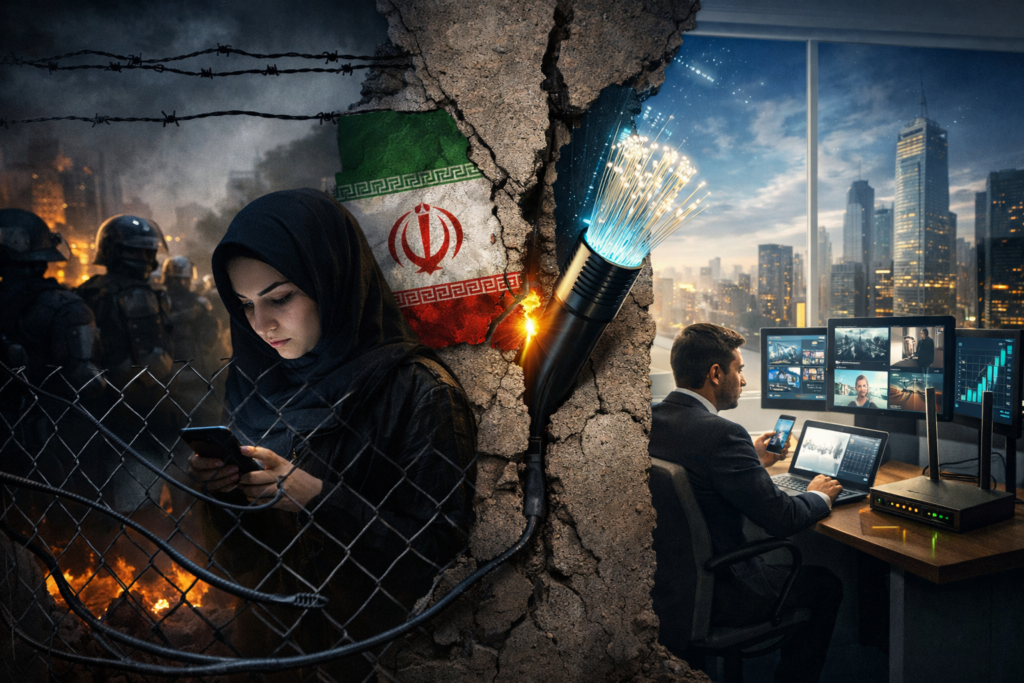
Image Credentials: Image Title: Digital Iron Curtain: Iran Implements Tiered Internet Model Amid Nationwide Blackout Source: (sora.openai) Date: January 2026. Attribution: This image was created using AI-generated imagery (sora.openai) and does not depict a real-world scene.
By Open Chronicle News Desk
TEHRAN — Iran has entered a new and more restrictive phase of digital isolation as the government rolls out a “tiered internet” model during the country’s most severe communications blackout to date. Following weeks of escalating protests over hyperinflation and economic collapse, the regime has transitioned from temporary shutdowns to a structural reconfiguration of the nation’s connectivity, effectively creating a “two-tier” system of information access.
The nationwide blackout, which began on January 8, 2026, has seen global connectivity plummet to near zero. However, unlike previous “kill switch” events, this disruption appears to be the deployment of a long-planned “Absolute Digital Isolation” strategy. According to reports from digital rights watchdog Filterwatch and investigative findings, the regime is moving to make international internet access a “governmental privilege” reserved for a vetted elite.
Under this new framework, the vast majority of the population is restricted to the National Information Network (NIN), a domestic intranet entirely disconnected from the World Wide Web. This state-run platform hosts government-approved messaging apps, search engines, and services, allowing the state to monitor all domestic traffic while blocking external communication. Meanwhile, a “whitelisted” tier of the global internet is reportedly being maintained for security forces, high-ranking officials, and specific state-linked businesses.
The technical center of this new “Barracks Internet” is believed to be a massive, subterranean data center located in Pardis IT Town, northeast of Tehran. Technical analysts note that the shutdown was executed through a phased operation: beginning with selective throttling on January 5, followed by a “digital curfew” on January 6, and culminating in a near-total collapse of IPv6 traffic just hours before the full blackout on January 8.
Human rights organizations warn that this “digital iron curtain” is being used to shield a lethal crackdown. With the country largely offline, reporting on casualties has been severely hampered. Preliminary estimates from rights groups suggest thousands may have been killed or detained during the unrest, but the “web of impunity” created by the blackout prevents independent verification of the scale of the violence.
As the outage persists, the economic toll is mounting. Domestic business representatives have described a deepening recessionary pressure, with digital transactions and logistics companies like Tipax reporting a near-total halt in operations. Despite the costs, government spokespersons have signaled that the restrictions may remain in place until at least late March, framing connectivity not as a right, but as a security-dependent concession.