
Image: from Yahoo News X@YahooNews
By Open Chronicle News Desk
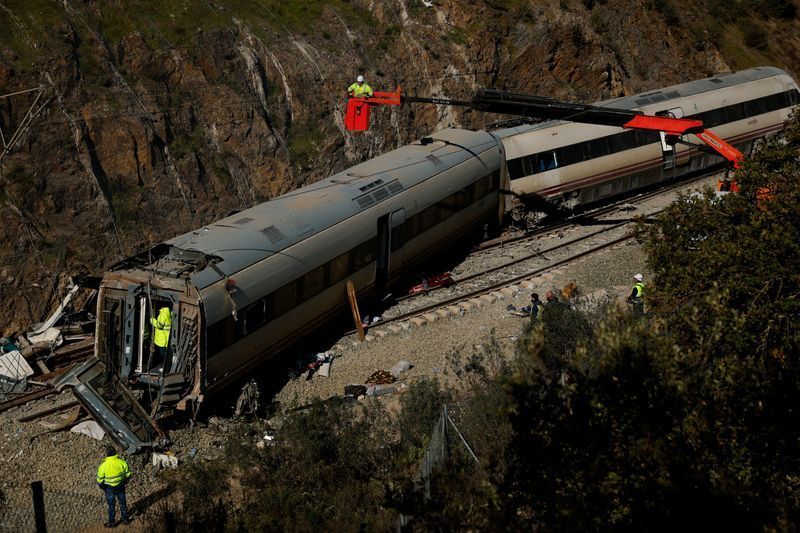
The investigation into the Adamuz rail disaster, Spain’s deadliest train crash in over a decade, has reached a critical turning point. A preliminary report released by the Commission for the Investigation of Railway Accidents (CIAF) suggests that a pre-existing fracture in the track was the catalyst for the catastrophic collision between an Iryo high-speed train and a Renfe service.
The Sequence of Failure
The incident occurred at approximately 19:45 local time on Sunday, roughly an hour into the Iryo train’s journey from Málaga to Madrid. According to the CIAF findings, the disaster unfolded in the final stages of the train’s passage:
-
Initial Signs: Carriages two, three, and four of the Iryo train showed specific grooves on their wheels, indicating contact with a damaged rail.
-
The Tipping Point: Carriage five displayed a groove on its outer edge. This suggests the rail was already tilting outward by the time this carriage passed.
-
The Derailment: Carriage six suffered a complete derailment due to a “complete lack of continuity” in the track.
-
The Impact: The final three carriages (six through eight) veered off their path and collided with a Renfe train bound for Huelva.
What caused the high-speed train crash in Spain?
Was this track imported?
When you look at the broken metal, you can see clean sharp edges.
This is a fresh break, as no rust is present on the grey edges of the metal.
Th track is too brittle and appears to be 'glass hard' pic.twitter.com/QO7CixgnGH— We Shuggie's View of China (@WeShuggie) January 23, 2026
Evidence of Progressive Damage
Spanish Transport Minister Óscar Puente confirmed that investigators found distinct notches on the wheels of multiple trains. This evidence is crucial because it tracks the deterioration of the rail in real-time.
The report notes that three separate trains passed over the same section of track at 17:21, 19:01, and 19:09. All three showed similar geometric patterns of damage on their wheels. This data supports the “working hypothesis” that the track was cracking and deforming in the hours leading up to the 19:45 crash.
A “Hidden” Threat
During a press conference on Friday, Minister Puente emphasized the difficulty of preventing such an event. If the fracture occurred in the mere hours or minutes before the derailment, it might have been impossible to detect using standard maintenance schedules.
“These notches in the wheels and the deformation observed in the track are compatible with the fact that the track was cracked,” the CIAF preliminary report stated.
Historic Context
The Adamuz disaster marks a somber milestone for Spain’s rail network. It is the country’s most significant rail tragedy since the 2013 Santiago de Compostela derailment in Galicia, which resulted in 80 deaths and 140 injuries. While the CIAF stresses that these findings are currently a hypothesis requiring further calculation, the focus has firmly shifted toward infrastructure integrity and the rapid detection of steel fatigue.