
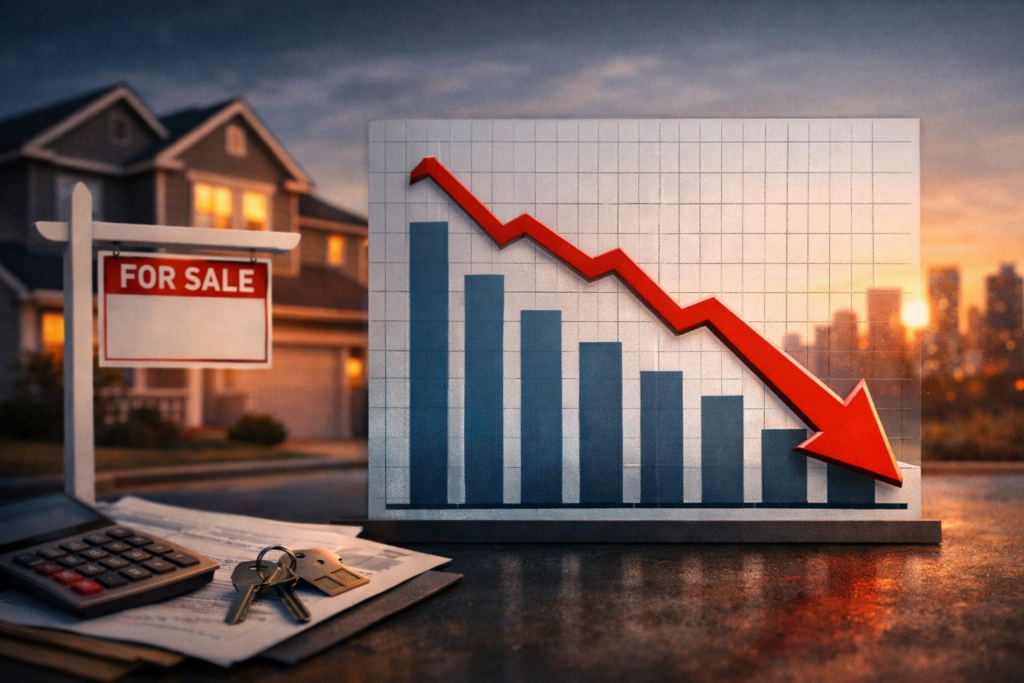
Image Credentials: Image Title: U.S. Existing Home Sales Plunge in December, Signaling Market Cool-Down Source: (sora.openai) Date: January 2026. Attribution: This image was created using AI-generated imagery (sora.openai) and does not depict a real-world scene.
By Open Chronicle News Desk with Agencies
WASHINGTON, D.C. — The U.S. residential real estate market faced an unexpected setback at the close of 2025. According to data released on Wednesday by the National Association of Realtors (NAR), pending home sales, a leading indicator of future completed transactions, plunged by 9.3% in December, marking the lowest level in five months.
The sharp decline caught economists by surprise, as consensus projections had anticipated a modest 0.4% increase. Instead, the pending home sales index dropped to 71.8 points, reflecting a growing caution among American consumers despite a slight easing in mortgage rates toward the end of the year.
Inventory Crisis and the “Lock-In” Effect
A primary driver for the stagnant market is a severe shortage of available properties. The inventory of existing homes for sale stood at approximately 1.18 million units in December, the lowest level recorded throughout 2025.
Market analysts point to a persistent “lock-in effect” as a major hurdle. Millions of current homeowners are holding onto mortgages with rates below 5% and are hesitant to sell only to re-enter a market where current borrowing costs remain significantly higher. This scarcity of options has stifled liquidity, leaving potential buyers with few choices and further driving up prices in some regions.
A Market in Transition
While the used-home market struggles with supply, the new-home segment has seen a relatively broader offering. This asymmetry is distorting the U.S. housing landscape, shifting demand toward new constructions but failing to address the structural bottleneck in the existing home market.
“The decision to buy has lost momentum in the face of limited inventory,” noted industry analysts. “Consumers are increasingly choosing to postpone negotiations when they find few options, particularly in a climate where the labor market and future income are under closer scrutiny.”
As the market enters 2026, the real estate sector remains highly sensitive to adjustments in interest rates and consumer confidence. Experts suggest that without a meaningful increase in supply or a more significant decline in financing costs, the pace of negotiations for existing homes is likely to remain restrained in the coming months.