
Image: from Hrvatska X@Hrvatska69
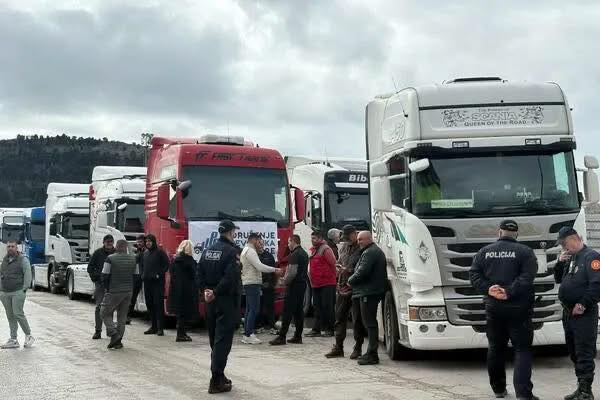
BELGRADE — Freight transport across the Western Balkans ground to a halt on Monday, January 26, 2026, as hundreds of truck drivers from Serbia, Bosnia and Herzegovina, North Macedonia, and Montenegro launched a coordinated blockade of border crossings into the European Union.
The protest, which began at noon local time, is a direct response to the EU’s new Entry/Exit System (EES) and the strict enforcement of the 90/180-day stay rule. Protesters have parked heavy lorries across key freight terminals, effectively cutting off major transit corridors that link the EU to Turkey and the Middle East.
The “90-Day” Conflict
At the heart of the dispute is the Schengen Area’s limit on short-term stays. Under current rules, non-EU nationals can only stay within the bloc for 90 days in any 180-day window. While previously managed via manual passport stamps, the newly implemented biometric EES automatically tracks every entry and exit.
Hauliers argue that for professional drivers making frequent cross-border trips, this limit is exhausted by mid-year.
-
Mass Deportations: Regional associations claim that since the system’s full rollout, hundreds of drivers have been deported or banned from the EU for “overstaying” while simply performing their jobs.
-
Economic Threat: “Ninety days in six months is simply not enough for someone who does this for a living,” stated Neđo Mandić, spokesperson for the Serbian Association of International Road Hauliers. “Our drivers cannot cover their costs, and companies are being forced to shut down.”
#BREAKING #EU JUST IN: Truck drivers from Bosnia and Herzegovina and Serbia will block all cargo border crossings to Schengen countries on January 26, citing problems with the Entry/Exit System (EES).
They say Brussels has ignored calls to simplify border procedures. pic.twitter.com/uugqC6sZed
— The National Independent (@NationalIndNews) January 13, 2026
Key Borders Affected
The blockades have caused massive tailbacks at major checkpoints, including:
-
Horgoš and Kelebija (Serbia–Hungary)
-
Batrovci (Serbia–Croatia)
-
Gradina (Serbia–Bulgaria)
-
Gevgelija (North Macedonia–Greece)
-
Svilaj (Bosnia–Croatia)
While passenger cars and “essential” cargo (such as live animals and medicines) are reportedly being allowed through in some areas, the vast majority of commercial trade has stopped.
EU Response
The European Commission stated on Monday that it is “closely monitoring” the situation and is in contact with regional partners. However, officials noted that while they are reviewing potential “flexibility” for professional categories like drivers or athletes, the core Schengen legislation remains unchanged.
Logistics experts warn that if the blockade continues for the planned seven days, it could lead to severe supply chain disruptions in Italy, Austria, and Germany, particularly in the automotive and textile sectors.