
Image: from Robert Musella X@xrobertm
By Open Chronicle Business Desk
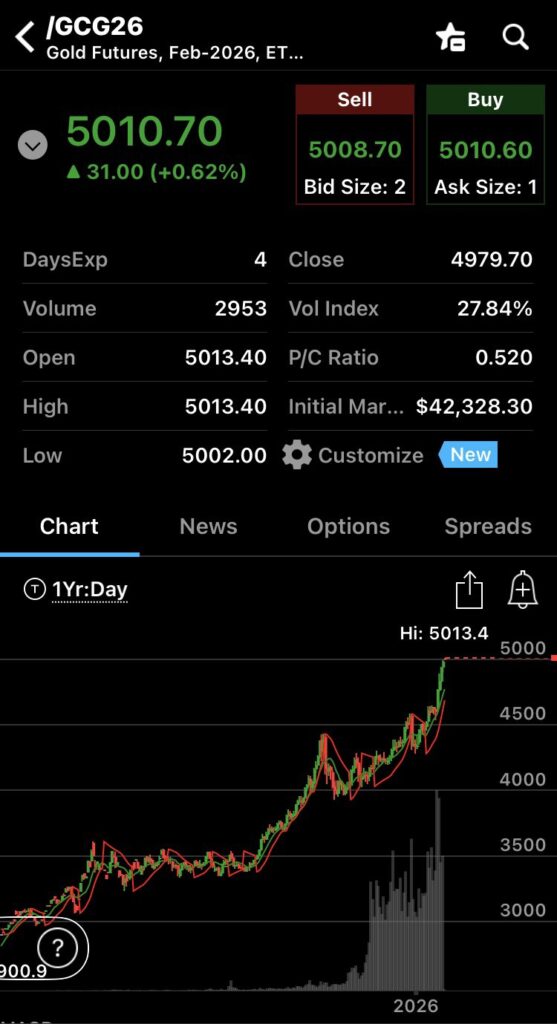
LONDON — Gold prices achieved a historic, psychologically significant milestone on Monday, January 26, 2026, surpassing $5,000 per ounce for the first time. The surge, reported by Eastern Eye and other major financial outlets, reflects deep-seated market anxiety over the Trump administration’s aggressive trade policies, looming tariff threats, and the future of the U.S. Federal Reserve.
Spot gold reached an intraday high of $5,111.07 as investors worldwide shifted away from traditional currencies and bonds toward the “safe-haven” metal. The rally, which saw gold gain over 17% in the first few weeks of 2026 alone, has redefined the global commodity landscape.
Gold just crossed $5,000. OMG!
This move wasn’t driven by inflation prints or rate cuts.
It reflects something deeper:
– Governments are issuing debt faster than credibility.
– Central banks are choosing assets over assurances.
– Real yields fail to preserve purchasing power.… pic.twitter.com/SZkTlXbUQS— CRYPTO ATTACKS || DAO (@CryptoAttackDao) January 26, 2026
Drivers of the 2026 Gold Rush
Financial analysts point to a “perfect storm” of geopolitical and economic triggers that forced the breach of the $5,000 barrier:
-
Tariff Volatility: President Trump’s recent threat of 100% tariffs on Canadian goods and renewed tensions over Greenland have unhinged global markets. On Monday, additional threats to raise duties on South Korean autos and pharmaceuticals from 15% to 25% further fueled the flight to safety.
-
Pressure on the Fed: The Federal Reserve begins a two-day policy meeting today (Tuesday, Jan 27). While rates are expected to remain steady, markets are pricing in a shift. Wall Street expects up to 150 basis points in cuts through the remainder of 2026, as the White House intensifies pressure on Chair Jerome Powell to ease monetary policy.
-
The “Debasement Trade”: Growing U.S. fiscal concerns and a potential government shutdown, sparked by Senate Democrats blocking a DHS funding bill following the Minneapolis shootings, have led investors to doubt the long-term stability of the U.S. dollar and government bonds.
-
Central Bank Diversification: Central banks, particularly in the BRICS bloc, continue to “ditch the dollar,” moving record portions of their reserves into bullion to hedge against U.S.-led sanctions and trade wars.
Silver Follows the Lead
The precious metals rally was not limited to gold. Silver futures saw even more explosive growth, jumping 6.5% to hit a record high of $117 per ounce before settling near $110. Analysts at Bank of America suggest that industrial demand—driven by AI infrastructure and solar energy—combined with the safe-haven rush could push silver toward $125 by the spring.
Market Outlook: $6,000 in Sight?
The institutional outlook has shifted dramatically in the wake of the $5,000 breach. Goldman Sachs has lifted its December 2026 gold target to $5,400, while a growing minority of analysts, including those at Metals Focus, now openly discuss a $6,000 gold scenario if geopolitical tensions in the Middle East and the Arctic continue to escalate.
“We are witnessing a historic global wealth re-pricing,” noted one analyst from The Economic Times. “Gold is no longer just a hedge; it is becoming the primary anchor for investors who see the traditional rules of global trade being rewritten in real-time.”