
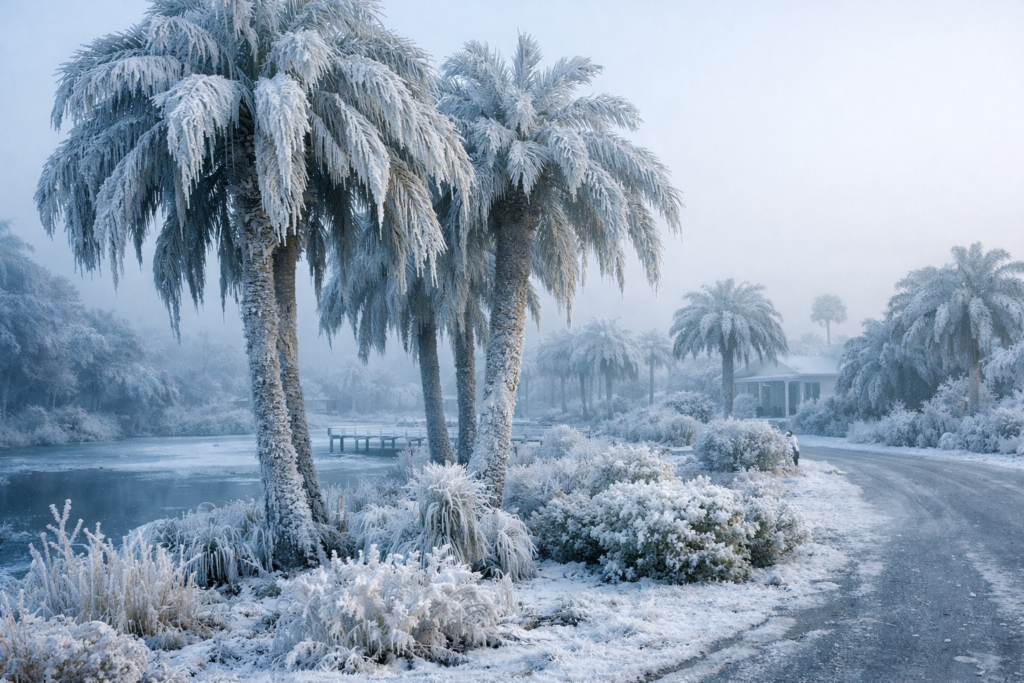
Image Credentials: Image Title: Historic Arctic Blast Shatters Decades-Old Records as Frost Grips Florida Source: (sora.openai) Date: February 2026. Attribution: This image was created using AI-generated imagery (sora.openai) and does not depict a real-world scene.
By Open Chronicle Staff
VERO BEACH, Fla. — Florida’s reputation as a winter sanctuary was put on ice Tuesday as a relentless Arctic surge continued to shatter historic cold records across the peninsula. From the Panhandle down to the Florida Keys, residents awoke to a landscape of frost and frozen palm trees in what meteorologists are calling one of the most significant freeze events in the state’s modern history.
For the third consecutive day, Vero Beach broke its daily record low, dipping to 31 degrees on the morning of February 3. This follows a bone-chilling weekend where temperatures in Fort Pierce plummeted to 23 degrees, toppling a record that had stood since 1909.
Congratulations, Florida. You're officially colder than ALASKA.
Yes, really.
(The air mass over Florida right now is legitimately an Arctic air mass. It was over the Chukchi Sea north of Alaska about a week ago. Prior to that, Siberia and the Bering Strait.) pic.twitter.com/xJWyspCZCv
— MyRadar Weather (@MyRadarWX) January 16, 2026
“Iguanas Falling from Trees”
The cold has triggered a unique biological phenomenon in South Florida: the “falling iguana” alert. As temperatures drop below 50 degrees, the non-native reptiles become paralyzed by the chill and lose their grip on tree branches, tumbling to the sidewalks below.
HISTORIC COLD: Check on your Florida friends. The entire peninsula is under Extreme Cold Warnings. 🥶
Temperatures are dropping to levels not seen since 1989 in some areas.
Yallbot is tracking this rare freeze LIVE on YouTube & X.#FLwx #FloridaFreeze #ColdWave pic.twitter.com/Mfu09ik57H
— YallBot (@OfficialYallbot) February 1, 2026
In response to the sheer volume of immobilized reptiles, the Florida Fish and Wildlife Conservation Commission (FWC) issued an emergency executive order. The directive allows residents to capture and transport the stunned iguanas to designated drop-off sites—one office in Sunrise, Florida, reportedly received more than 1,000 iguanas in a single weekend.
Florida freeze 🥶 A rare blast of cold shattered records across the Sunshine State on Sunday, dropping temperatures to record lows in cities like Miami, Orlando, and Jacksonville. https://t.co/Jp4MPXD42A pic.twitter.com/CinPKr0Blw
— AccuWeather (@accuweather) February 2, 2026
Snow in the South
Icicles formed in Lakeland, Florida as freezing temperatures swept across the state this weekend. An arctic blast tightening its grip on the East Coast has prompted Extreme Cold Warnings for parts of Florida through Monday morning.
— Breaking911 (@Breaking911) February 2, 2026
While Florida is famous for its beaches, northern and central regions saw a rarer sight: snowflakes. Light flurries were documented as far south as Tampa and Naples, while cities like Jacksonville and Gainesville reported brief accumulations of sleet and snow—a surreal rarity for a state where the average February high typically hovers in the 70s.
The “bomb cyclone” responsible for the cold has also wreaked havoc on Florida’s vital agricultural sector. Farmers from Hillsborough to Highlands County worked through the night, deploying irrigation sprays to create protective ice layers over citrus groves and strawberry patches in a desperate bid to mitigate millions of dollars in potential crop losses.
A Fractured Winter
The National Weather Service in Melbourne confirmed that records were tied or broken at every official climate observation site in their jurisdiction, including Orlando and Daytona Beach. Central Florida officials declared “Impact Weather” alerts as the freeze disrupted travel and strained the state’s energy grid.
Though a brief “moderating trend” is expected to bring temperatures back above freezing by Wednesday, meteorologists warn that the reprieve may be short-lived. A secondary cold front is projected to sweep through the state on February 5, ensuring that Florida’s winter coats won’t be returning to the closet just yet.