
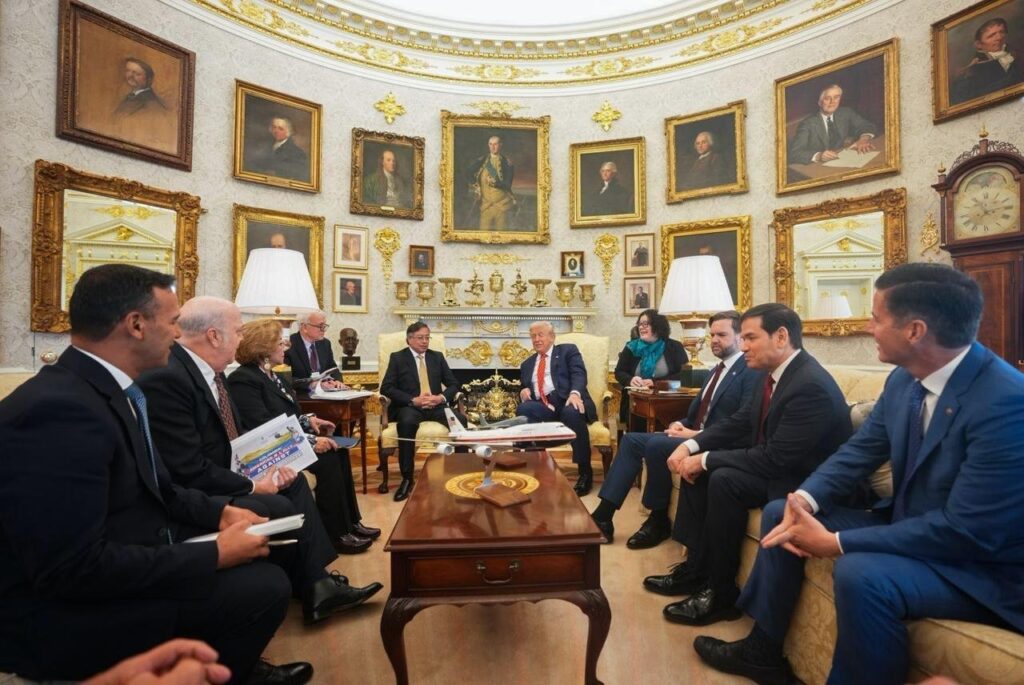
Image: from Emeka Gift Official X@EmekaGift100
By Open Chronicle Staff
WASHINGTON, D.C. — In a dramatic reversal of months of bellicose rhetoric, President Donald Trump and Colombian President Gustavo Petro met at the White House on Tuesday, establishing a fragile truce centered on the regional war against drug trafficking.
The meeting, described by both leaders as surprisingly cordial, marks a significant cooling of tensions that had pushed the two nations to the brink of a diplomatic rupture following the U.S. military’s capture of Venezuelan leader Nicolás Maduro in early January.
🚨 LATER TODAY: President Trump meets PRIVATELY with Colombia’s Gustavo Petro — zero fluff, straight talk on crushing drug trafficking and expanding trade.
Relentless. Focused. Always working for the American people. 🇺🇸🔥 pic.twitter.com/k9NKeMH2nx— TRUE EARTH NEWS (@TENNEWS_) February 3, 2026
From “Targeting” to Talking
The path to the Oval Office was paved with hostility. Only weeks ago, President Trump had suggested it “would be a good idea” to target the Colombian leadership like the operation that seized Maduro and his wife, Cilia Flores, on drug trafficking charges. Petro, Colombia’s first leftist president, had responded by putting his nation’s military on high alert to defend sovereign soil.
“He and I weren’t exactly the best of friends, but I wasn’t insulted because I never met him. I didn’t know at all,” Trump told The Hill following the meeting, adding that the two ultimately “got along very well.”
As a symbol of this newfound rapport, Petro emerged from the White House holding a red “Make America Great Again” hat, a gift from Trump. Petro characterized the session as “optimistic and constructive,” a stark contrast to his previous denunciations of U.S. immigration policy and the “extraordinary rendition” of Maduro.
The War on Narcotics
The primary focus of the bilateral talks was a renewed commitment to thwarting illicit drug trafficking. Despite Trump’s earlier accusations that Petro was personally profiting from cocaine manufacturing, the two leaders agreed to align their strategies to disrupt the flow of narcotics into the United States.
The discussions also touched upon the personal stakes for the Colombian leader. In October, the U.S. imposed significant sanctions on Petro and his family members, measures that were a central point of contention during Tuesday’s late-morning meeting. While no immediate lifting of sanctions was announced, the inclusion of the topic in the official agenda suggests a potential opening for future negotiations.
A Fractured Region
The “thaw” in D.C. comes at a critical time for South American stability. With Maduro awaiting trial in the United States, the traditional power balance in the Andes has been upended. Colombia, historically Washington’s closest ally in the region, had drifted away under Petro’s administration, particularly as he criticized the U.S. “War on Drugs” as a failure.
However, the reality of U.S. military reach, demonstrated by the Jan. 3 operation in Venezuela, appears to have shifted the calculus in Bogotá. By easing his rhetoric and traveling to Washington, Petro is seeking to protect Colombia’s sovereignty through diplomacy rather than defiance.
For Trump, the cooperation of Colombia is essential to fulfilling his campaign promise to “crush” the cartels. Whether this “optimistic” tone can survive the complex realities of coca production and regional politics remains to be seen. Still, for one morning in Washington, the threat of conflict was replaced by the signature of a red hat.