
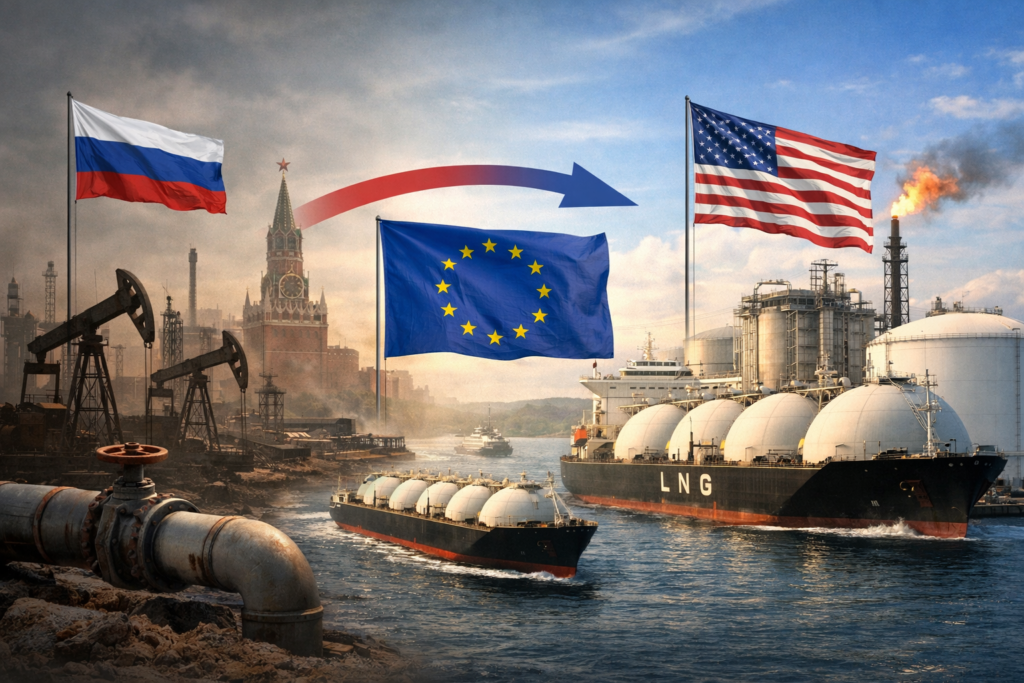
Image Credentials: Image Title: Europe’s Energy Paradox: Dependency Shifts from Moscow to Washington as US LNG Imports Soar Source: (sora.openai) Date: January 2026. Attribution: This image was created using AI-generated imagery (sora.openai) and does not depict a real-world scene.
By José Carlos Palma* | Friday, February 6, 2026
BRUSSELS — The European Union’s long-standing quest for energy independence has hit a new geopolitical snag. While the bloc has successfully moved to sever its ties with Russian energy, fresh data reveals that Europe is rapidly replacing its old reliance on Moscow with an even more dominant dependency on American liquefied natural gas (LNG).
According to the latest figures from the Institute for Energy Economics and Financial Analysis (IEEFA) and market trackers, the United States supplied approximately 60% of the European Union’s LNG imports in January 2026. This surge marks a significant jump from 53% just a year ago, underscoring Washington’s role as the continent’s primary energy guarantor.
The shift is most pronounced in Western Europe. In the United Kingdom, US gas now accounts for a staggering 90% of all gas imports, up from 77% in early 2025. Belgium has seen a similar trend, with LNG imports, primarily through the Zeebrugge terminal, rising by 72% in January compared to the previous year.
“Europe has effectively traded one dependency for another,” warned Ana Maria Jaller-Makarewicz, an energy analyst at IEEFA. “While the pivot away from Russia was a security necessity, the current level of reliance on a single seller creates a major strategic vulnerability, especially as transatlantic relations face new tensions.”
The data arrives at a sensitive moment for the EU-US relationship. Concerns in Brussels have been heightened by President Donald Trump’s recent diplomatic maneuvers, including his renewed interest in “acquiring” Greenland and threats of punitive tariffs against European nations that resist American trade demands.
EU Energy Commissioner Dan Jørgensen described the situation as a “wake-up call.” Speaking to reporters in Brussels, Jørgensen noted that the bloc is now actively pursuing diversification deals with Canada, Qatar, and North African nations to avoid being “caught in a vice.”
Despite the strategic risks, US LNG has been vital in keeping European homes warm during a particularly cold start to 2026. However, this security comes at a premium. Experts point out that American LNG remains the most expensive option for European buyers, a cost that continues to weigh on the continent’s industrial competitiveness.
Under a trade agreement reached last summer, the EU committed to spending $750 billion on US energy products by 2028. While the European Commission maintains that the current situation is “not comparable” to the previous reliance on Russian pipelines, critics argue that the lack of a diverse supplier base leaves the European economy exposed to American political shifts.
As the EU prepares for a total ban on Russian gas by 2027, the challenge for Brussels is no longer just finding fuel, but ensuring that the next chapter of European energy security doesn’t come with “Made in the USA” strings attached.
The Grand Strategy Institute
Continue Exploring Strategic Analysis
Return to The Grand Strategy Institute for strategic assessments, long-form analysis and research examining geopolitics, military affairs, international security, emerging technologies and the changing international order.
← Back to The Grand Strategy Institute