
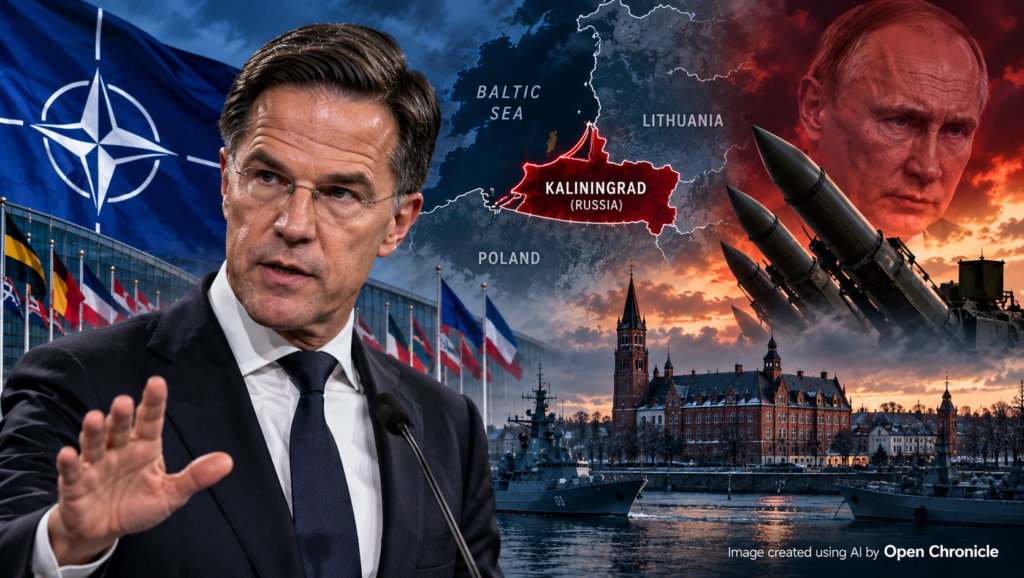
NATO Secretary General Mark Rutte has played down Russia’s warning that nuclear weapons could be used if the Alliance attempted to isolate Kaliningrad, arguing that Moscow understands it cannot prevail in a confrontation with NATO. Rutte nevertheless said the Alliance had formally responded to the Russian message and called on the Kremlin to end its nuclear threats.
By Open Chronicle with agencies | October 1, 2026
BRUSSELS — NATO Secretary General Mark Rutte has dismissed Russia’s latest nuclear warning over Kaliningrad, saying he does not consider Moscow’s threat credible while stressing that the Alliance remains prepared to respond to Russian pressure.
Rutte made the comments while speaking to journalists on September 30 on the sidelines of the Euronews Defence & Space Summit 2026 in Brussels.
His remarks followed reports that Moscow had privately warned NATO that Russia could resort to nuclear weapons if Alliance members attempted to isolate Kaliningrad, the heavily militarised Russian territory situated between Poland and Lithuania.
Both countries are NATO members.
“I don’t take this that serious”
Asked whether NATO believed there was a genuine possibility that Russia could use nuclear weapons against Alliance members, including the Baltic states, Rutte rejected that assessment.
“Putin knows that he can never win from NATO. So I don’t take this that serious,” Rutte said.
He nevertheless acknowledged that NATO considered the Russian communication serious enough to require a direct response.
Rutte said the Alliance had made clear to Moscow that NATO is defensive and that Russia should stop issuing nuclear threats.
He also renewed NATO’s call for Russia to end its war against Ukraine.
NATO responded directly to Moscow
Rutte declined to disclose details of the reported Russian communication, saying he was not authorised to make its contents public.
He confirmed, however, that NATO had responded directly and clearly.
The NATO chief characterised Russia’s nuclear rhetoric as inappropriate and unhelpful, while reiterating that the Alliance does not represent an offensive threat to Russia.
His comments reflect NATO’s effort to balance two messages: publicly rejecting Russian attempts at nuclear intimidation while maintaining that threats involving nuclear weapons cannot simply go unanswered.
Russian warning focuses on Kaliningrad
Russia reportedly delivered its warning through a diplomatic note in which Moscow accused NATO of pursuing what it described as a “dangerous and reckless course.”
According to reports based on the document, Russia warned that attempts to isolate Kaliningrad could create a significant risk of direct military confrontation.
Moscow reportedly said it was prepared to employ its entire arsenal in such circumstances, explicitly including nuclear weapons.
Kaliningrad has long occupied a particularly sensitive position in relations between Russia and NATO.
The Russian territory is geographically separated from the rest of the country and sits on the Baltic Sea between Lithuania and Poland.
Its location makes the region strategically important to Moscow while placing it directly alongside NATO territory.
Rutte says Putin is trying to divide NATO
Rutte placed the nuclear warning within what he described as a broader Russian strategy designed to divide NATO members and distract Western governments from supporting Ukraine.
“What Putin tries to do… is to divide us and lose the focus on Ukraine. We will not,” Rutte said.
He argued that Russian hybrid activity in Europe should result in stronger rather than weaker support for Kyiv.
“So every hybrid whatever happens in Europe will be met with more support for Ukraine, not less support for Ukraine,” he added.
The NATO secretary general also stressed that member countries need to continue strengthening their own military capabilities.
European governments increasingly concerned about hybrid threats
The confrontation over Kaliningrad comes amid mounting European concern about suspected Russian hybrid operations.
European governments have attributed a range of hostile activities to actors linked to Moscow, including sabotage, arson, cyberattacks and interference with critical infrastructure.
Russia has rejected many Western allegations concerning such operations.
The Baltic region has become particularly sensitive because NATO and Russian forces operate relatively close to one another while governments across northern and eastern Europe strengthen military preparedness.
Kaliningrad’s geographical position adds another layer of strategic complexity.
Any serious confrontation affecting access to the territory could involve NATO members Poland and Lithuania directly, creating the possibility of rapid escalation between Russia and the Alliance.
Lithuania strengthens infrastructure near Kaliningrad
Lithuania is simultaneously preparing additional protection for critical infrastructure close to the Russian exclave.
Enhanced security measures are being designed for the planned Gizai power substation, located approximately 30 kilometres west of Kaliningrad.
Plans include reinforced fencing intended to withstand a vehicle carrying explosives, sensors capable of detecting possible underground tunnels and concrete barriers designed to protect transformers from drone attacks.
The measures illustrate how lessons from the war in Ukraine are increasingly influencing infrastructure protection elsewhere in Europe.
Drones, sabotage and attacks against energy infrastructure have become central considerations in European security planning.
Baltic security takes on growing importance
NATO has substantially increased its attention to the Baltic region as relations with Russia have deteriorated.
Poland and the Baltic states have strengthened their military capabilities, while other NATO members have expanded deployments, exercises and surveillance activities across the Alliance’s northeastern flank.
Russia, in turn, has repeatedly accused NATO of increasing military pressure close to its borders.
The two sides therefore offer fundamentally different interpretations of the changing security environment.
NATO maintains that its military posture is defensive and designed to protect member states.
Moscow portrays the Alliance’s expanding military activity as a threat to Russian security.
Nuclear rhetoric remains part of the confrontation
Russia’s latest warning adds another episode to the nuclear signalling that has accompanied the confrontation between Moscow and Western governments during the war in Ukraine.
Rutte’s response indicates that NATO does not intend to allow such warnings to alter its support for Kyiv or its military posture along the Alliance’s eastern flank.
At the same time, NATO’s decision to respond formally demonstrates that the Alliance is not ignoring Moscow’s nuclear language.
For Rutte, the central message is that Russia cannot use nuclear threats or hybrid operations to divide NATO.
The result is an increasingly stark strategic confrontation around the Baltic region, where military deployments, infrastructure protection, hybrid warfare concerns and nuclear deterrence are becoming progressively more interconnected.