
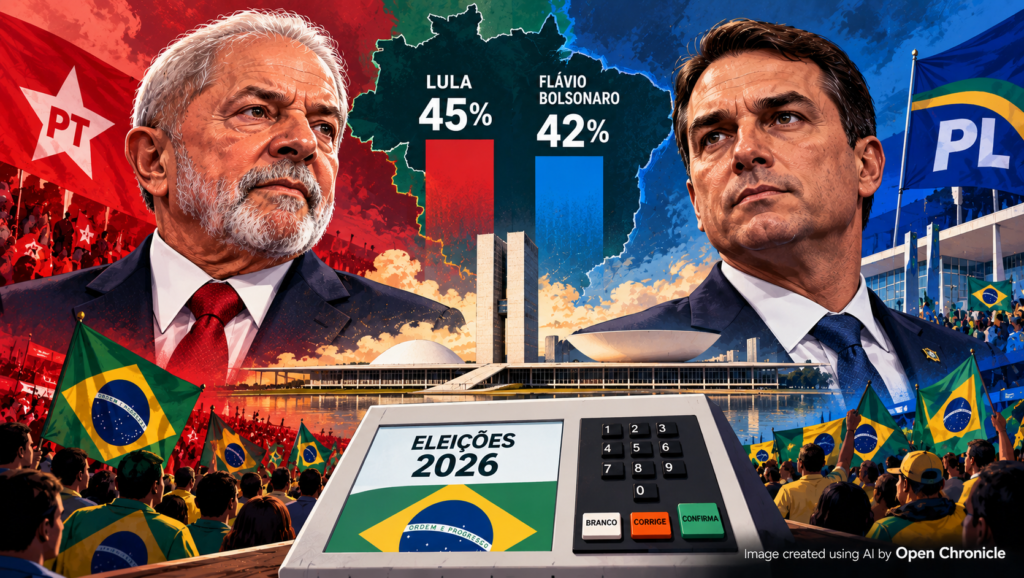
President Luiz Inácio Lula da Silva holds a narrow numerical lead over Senator Flávio Bolsonaro in the latest AtlasIntel first round poll, but a simulated runoff shows the two effectively tied. With Brazilians voting on October 4, the presidential contest remains highly competitive.
By Open Chronicle with agencies | October 1, 2026
BRASÍLIA — Brazil’s presidential election has entered its final days with President Luiz Inácio Lula da Silva and Senator Flávio Bolsonaro dominating the race, while polling indicates that a possible second round contest between them remains too close to separate statistically.
The latest AtlasIntel survey conducted for Bloomberg gives Lula 45.3 percent of first round voting intentions and Bolsonaro 42.2 percent. The survey questioned 5,005 voters between September 23 and 28 and has a margin of error of one percentage point.
Brazilians will vote in the first round on October 4. If no candidate receives more than half of valid votes, the two leading candidates will advance to a second round on October 25.
Lula leads first round, but race remains close
The latest AtlasIntel figures place Lula 3.1 percentage points ahead of Bolsonaro in the first round.
Behind the two leading candidates, Renan Santos registers 5.2 percent, Augusto Cury 2 percent, Ronaldo Caiado 1.8 percent and Romeu Zema 0.9 percent in the same survey.
The figures reinforce a pattern that has emerged during the closing stages of the campaign: Lula retains a numerical advantage in several first round surveys, but Bolsonaro has established himself as his principal challenger.
Other recent polls have produced somewhat different figures, reflecting differences in methodology and sampling, but several have also shown a close contest between the two leading candidates.
Runoff scenario is effectively tied
The picture becomes even tighter when voters are asked about a direct contest between Lula and Bolsonaro.
AtlasIntel gives Bolsonaro 47.7 percent and Lula 47.6 percent in a simulated second round.
The difference is just 0.1 percentage point and is well inside the poll’s one point margin of error. The result therefore represents a statistical tie rather than evidence that either candidate holds a meaningful advantage.
The previous AtlasIntel survey produced a similarly close result, with Lula at 47.7 percent and Bolsonaro at 47.4 percent.
The polling series therefore suggests that the direct contest has remained highly competitive rather than showing a decisive shift toward either candidate.
Other polls reinforce picture of a competitive election
AtlasIntel is not alone in finding a close race.
Recent national surveys from several polling organisations show different numerical results but generally indicate a competitive contest between Lula and Bolsonaro.
A Meio/Ideia survey placed Lula at 39.4 percent and Bolsonaro at 38.4 percent in the first round, while its second round simulation showed Lula at 48.5 percent and Bolsonaro at 48 percent.
Quaest produced a 42 percent to 42 percent tie in one second round scenario, while BTG/Nexus recorded Lula at 46 percent and Bolsonaro at 44 percent. RealTime Big Data placed Bolsonaro at 45 percent and Lula at 44 percent in its runoff simulation. Differences in all of those second round examples were within their respective margins of error.
Taken together, the surveys describe an electorate divided almost evenly between the two principal political camps.
Flávio Bolsonaro emerges as principal challenger
Flávio Bolsonaro entered the race as the leading candidate associated with the political movement built around his father, former President Jair Bolsonaro.
His candidacy has consolidated a substantial portion of Brazil’s conservative electorate and transformed what initially appeared likely to be another campaign centred on Lula into a close contest.
Flávio Bolsonaro has attempted to present himself as a pro business candidate while retaining the political identity and electoral base associated with his father.
The campaign has also unfolded against the backdrop of legal and political controversies surrounding the Bolsonaro family.
Jair Bolsonaro is not a candidate in the 2026 election.
Banco Master investigation weighs on campaign
The Banco Master scandal has become another source of uncertainty during the final phase of the election.
The investigation has attracted attention because of connections involving political figures and institutions across Brazil and has affected the wider campaign environment.
Flávio Bolsonaro has denied wrongdoing amid scrutiny of alleged financial crimes connected to his relationship with banker Daniel Vorcaro.
The scandal has complicated a campaign already shaped by intense political polarisation.
With relatively few undecided voters remaining, developments during the final days could still influence a close contest.
Economy remains central to Lula’s reelection campaign
Economic conditions remain one of the major issues facing voters.
Brazil’s unemployment rate fell to 5.3 percent in the three months through August, according to the country’s statistics agency IBGE, representing the lowest rate for that period under the current methodology.
Informal employment nevertheless remains substantial, accounting for approximately 37.5 percent of the workforce.
Lula’s government has sought to emphasise employment and social policies while responding to pressure from households concerned about living costs and debt.
Economic frustration remains politically important despite improvements in the labour market, with household finances and the cost of living continuing to influence voter perceptions.
Polarisation defines the final days
The closeness of the election reflects Brazil’s continuing political polarisation.
A recent Datafolha survey found Lula and Flávio Bolsonaro with identical rejection rates of 45 percent, illustrating the strength of both support and opposition surrounding the two leading candidates.
That creates a particularly difficult environment for either campaign to expand significantly beyond its established political base.
The first round therefore becomes important not only for determining who advances but also for measuring the remaining pool of voters who could decide a runoff.
Supporters of smaller candidates could become especially significant if the election proceeds to October 25.
October 4 will determine the next phase
The latest polling does not establish which candidate would prevail in a potential second round.
It does, however, provide a relatively clear picture of the contest entering its final days.
Lula holds a numerical advantage in the latest AtlasIntel first round survey, while Flávio Bolsonaro remains close enough to make a runoff highly competitive.
In a direct confrontation, AtlasIntel places them almost exactly level.
Brazilian voters will now determine whether the presidential election ends on October 4 or moves into a second and potentially extremely close contest three weeks later.