
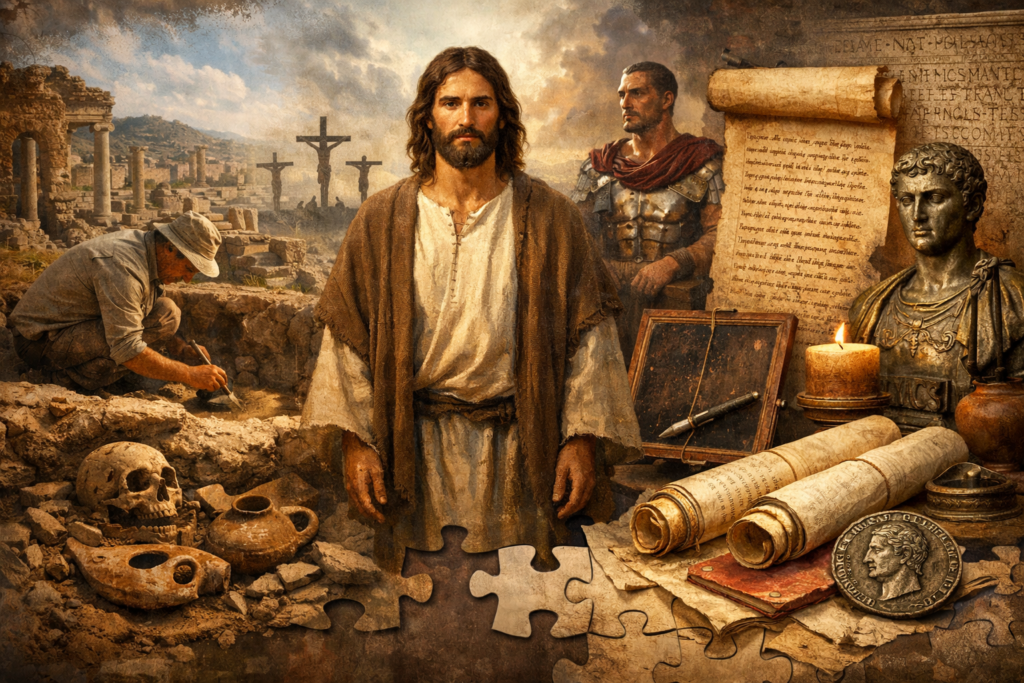
Image Credentials: Image Title: The Unveiling of History: Modern Archaeology and the Historical Jesus Source: (sora.openai) Date: January 2026. Attribution: This image was created using AI-generated imagery (sora.openai) and does not depict a real-world scene.
By Open Chronicle History | Friday, February 6, 2026
Archaeology, Roman Records, and the Historical Puzzle
Few questions in classical historiography are as enduring and as fascinating as this one. Did Jesus of Nazareth truly exist as a historical figure, or is he merely a theological construction shaped by later belief?
The answer given by modern academic history is clear. Yes, Jesus existed.
Outside the New Testament, multiple Roman and Jewish historians and administrators refer to Jesus directly or indirectly. While no texts survive that were written in the exact year of his death, around 30 CE, the sources that emerge in the decades immediately following are regarded by the overwhelming majority of professional historians as strong and reliable evidence. They confirm that Jesus was a Jewish preacher active in Judea and that he was executed under the authority of Pontius Pilate.
Archaeology has played a decisive role in anchoring these literary sources to the physical reality of the first century. Until the middle of the twentieth century, skeptics argued that many central figures and locations in the Gospel narratives might be literary inventions. A series of discoveries radically altered that landscape.
Archaeology and the Physical World of Jesus
The Pilate Stone, 1961
For centuries, Pontius Pilate was known only through written texts, including the Gospels and Roman historians. No archaeological proof of his existence had been found.
That changed in 1961, when Italian archaeologists excavating the Roman theater at Caesarea Maritima, the administrative capital of Roman Judea, uncovered a limestone block reused in later construction.
The Latin inscription explicitly names “Pontius Pilatus, Praefectus Iudaeae”, or Pontius Pilate, Prefect of Judea.
The importance of this discovery cannot be overstated. It confirms that the man who, according to the Gospels and Tacitus, ordered the execution of Jesus was not a literary creation but a real Roman official holding precisely the title described in the texts.
The Ossuary of Caiaphas, 1990
In Jerusalem, archaeologists uncovered a family tomb containing several ossuaries, stone boxes used to store bones after decomposition. One of these ossuaries was elaborately decorated and bore the inscription “Joseph, son of Caiaphas”.
Most scholars identify this individual as Caiaphas, the high priest who presided over the trial of Jesus according to the Gospel accounts.
This find confirmed the historical existence of another central figure in the Passion narrative and provided rare material evidence of the Jerusalem priestly elite of the period.
The Pools of Bethesda and Siloam
For a long time, scholars suspected that the detailed descriptions of Jerusalem in the Gospel of John were symbolic or imprecise.
Excavations in the nineteenth and early twentieth centuries revealed the Pool of Bethesda, complete with its five porticoes, exactly as described in the text. In 2004, the Pool of Siloam, associated with the healing of the blind man, was discovered accidentally during sewer works in Jerusalem.
These discoveries demonstrate that the author possessed precise and intimate knowledge of pre-destruction Jerusalem, a city that ceased to exist in that form after the Roman conquest in 70 CE.
The Galilee Boat, 1986
On the shores of the Sea of Galilee, a fishing boat remarkably preserved in mud was uncovered and dated securely to the first century CE.
While it cannot be identified with Jesus or his disciples, it confirms that the Gospel descriptions of fishing, travel, and daily life on the lake align perfectly with the technology and vessels used at that exact time.
Physical Evidence of Crucifixion, 1968
Many critics once argued that Roman victims of crucifixion were never given proper burial and were left exposed.
In 1968, archaeologists discovered the skeleton of a man named Jehohanan in Jerusalem, dated to the first century. An iron nail, eighteen centimeters long, was still embedded in his heel bone.
This find provided the first direct physical proof of Roman crucifixion practices and confirmed that executed individuals could indeed receive burial, exactly as described in the Gospel accounts of Jesus.
Capernaum, The City of Jesus
Capernaum, a fishing village on the northwestern shore of the Sea of Galilee, has become one of the most significant archaeological sites for the study of the historical Jesus. The Gospels describe it as Jesus’s base of operations after he left Nazareth.
The House of Peter
Perhaps the most striking discovery is a modest first-century house that shows signs of having been transformed into a place of worship at a very early date.
Beneath the remains of a fifth-century Byzantine octagonal church, archaeologists uncovered a domestic structure whose walls bore graffiti in Greek, Syriac, and Aramaic. These inscriptions include references to “Lord”, “Christ”, and “Peter”.
Unlike neighboring houses, this dwelling was carefully maintained and plastered, suggesting deliberate preservation by early Christians who identified it as the house of Peter, where Jesus is believed to have stayed and performed healings.
The White Synagogue and Its Foundations
The prominent white limestone synagogue visible today dates to the fourth century. However, excavations beneath its floor revealed the foundations of an earlier structure built from local black basalt.
These basalt foundations correspond to a first-century synagogue and are almost certainly the very place where Jesus taught and where the healing of the centurion’s servant is said to have occurred.
Magdala and the World of First-Century Synagogues
In 2009, excavations in Magdala, the hometown of Mary Magdalene, uncovered another first-century synagogue.
At its center was the Magdala Stone, carved with the earliest known representation of the menorah from the Second Temple period.
This discovery shows that synagogues in the time of Jesus were not merely places of prayer but vibrant communal centers, reinforcing the Gospel depiction of Jesus traveling from town to town teaching in synagogues.
Non-Christian Written Sources
Flavius Josephus, circa 93 CE
Josephus, a Jewish Roman historian, mentions Jesus twice in his work Jewish Antiquities.
In the passage known as the Testimonium Flavianum, Josephus describes Jesus as a wise man who performed remarkable deeds and was condemned to crucifixion by Pilate. While later Christian copyists likely embellished the text, most scholars agree that its core is authentic.
Elsewhere, Josephus refers to the execution of James, whom he identifies as “the brother of Jesus, called the Christ”. This reference is widely accepted as genuine due to its casual and non-theological nature.
Tacitus, circa 116 CE
The Roman historian Tacitus, one of antiquity’s most rigorous writers, discusses the Great Fire of Rome in his Annals. He explains that Emperor Nero blamed Christians to deflect suspicion from himself.
Tacitus states plainly that “Christus” was executed during the reign of Tiberius by the procurator Pontius Pilate.
This hostile Roman testimony is especially valuable because it confirms the central facts of Jesus’s execution from an external source with no sympathy for Christianity.
Pliny the Younger, circa 112 CE
As governor of Bithynia, Pliny wrote to Emperor Trajan seeking advice on how to deal with Christians. He reports that they gathered to sing hymns to Christ “as to a god”.
While Pliny does not recount Jesus’s life, he confirms that within decades of his death, a widespread and organized movement existed centered on a real historical figure.
Suetonius, circa 121 CE
In The Lives of the Twelve Caesars, Suetonius notes that Emperor Claudius expelled Jews from Rome around 49 CE due to disturbances instigated by someone called “Chrestus”.
Most historians interpret this as an indirect reference to disputes within the Jewish community over Jesus Christ.
The Scholarly Consensus
Today, the serious academic debate is not about whether Jesus existed but about how to interpret his life and message.
Several historical criteria underpin this consensus. The criterion of embarrassment notes that the crucifixion, the most humiliating form of execution in the Roman world, would not have been invented by followers seeking to promote a false messiah. Multiple independent sources, Jewish, Roman, and Christian, converge within a relatively short time frame, which by ancient standards constitutes exceptionally strong evidence.
Conclusion: Removing the Fog of Myth
Archaeology cannot prove miracles or divine identity. That belongs to faith, not to historical method. What archaeology and ancient historiography can do is strip away the fog of myth and speculation.
When the writings of Tacitus, the Pilate Stone, the ossuary of Caiaphas, and the foundations of the Capernaum synagogue are placed side by side, a coherent picture emerges. Jesus of Nazareth fits seamlessly into the political, geographic, and social realities of first-century Judea.
He stands not outside history, but firmly within it, as one of the most well-attested figures of the ancient world.
References and Bibliography
Primary Ancient Sources
Josephus, Flavius. Jewish Antiquities. Books 18 and 20. Translated by Louis H. Feldman. Loeb Classical Library. Cambridge, MA: Harvard University Press, 1965.
Pliny the Younger. Letters. Book 10. Translated by Betty Radice. Loeb Classical Library. Cambridge, MA: Harvard University Press, 1969.
Suetonius. The Lives of the Twelve Caesars. Translated by Robert Graves. London: Penguin Classics, 2007.
Tacitus, Cornelius. The Annals. Book 15. Translated by Michael Grant. London: Penguin Classics, 2009.
Archaeology and Material Evidence
Frova, Antonio. “L’iscrizione di Ponzio Pilato a Cesarea.” Rendiconti dell’Accademia Nazionale dei Lincei (1961).
Greenhut, Zvi. “Burial Cave of the Caiaphas Family.” Israel Exploration Journal 43 (1993): 61–68.
Haas, Nicu. “Anthropological Observations on the Skeletal Remains from Giv‘at ha Mivtar.” Israel Exploration Journal 20 (1970): 38–59.
Reich, Ronny, and Eli Shukron. “The Pool of Siloam in Jerusalem of the Late Second Temple Period.” Biblical Archaeology Review 31, no. 5 (2005): 18–23.
Taylor, Joan E. Pontius Pilate and the Imperial Cult in Roman Judea. Cambridge: Cambridge University Press, 2018.
Wachsmann, Shelley. The Sea of Galilee Boat, 2000 Years Old. Cambridge, MA: Perseus Books, 1995.
Capernaum and Galilee
Corbo, Virgilio C. Capernaum I, Excavations of the Franciscan Archaeological Institute. Jerusalem: Franciscan Printing Press, 1975.
Loffreda, Stanislao. Recovering Capernaum. Jerusalem: Franciscan Printing Press, 2008.
Strange, James F., and Hershel Shanks. “Has the House Where Jesus Stayed in Capernaum Been Found?” Biblical Archaeology Review 8, no. 6 (1982): 26–37.
Magdala and Synagogue Studies
Avshalom-Gorni, Dina, and Hamoudi Najar. “The Magdala Synagogue.” Hadashot Arkheologiyot (2010).
Binder, Donald D. Into the Temple Courts: The Place of the Synagogues in the Second Temple Period. Atlanta: Society of Biblical Literature, 1999.
Historical Jesus Scholarship
Casey, Maurice. Jesus of Nazareth, An Independent Historian’s Account of His Life and Teaching. London: T&T Clark, 2010.
Crossan, John Dominic. The Historical Jesus. San Francisco: HarperSanFrancisco, 1991.
Ehrman, Bart D. Did Jesus Exist? The Historical Argument for Jesus of Nazareth. New York: HarperOne, 2012.
Meier, John P. A Marginal Jew, Rethinking the Historical Jesus. Vol. 1. New Haven, CT: Yale University Press, 1991.
Sanders, E. P. The Historical Figure of Jesus. London: Penguin Books, 1993.
Vermes, Geza. Jesus the Jew. London: Fortress Press, 1973.
New Testament and Methodology
Brown, Raymond E. An Introduction to the New Testament. New Haven, CT: Yale University Press, 1997.