
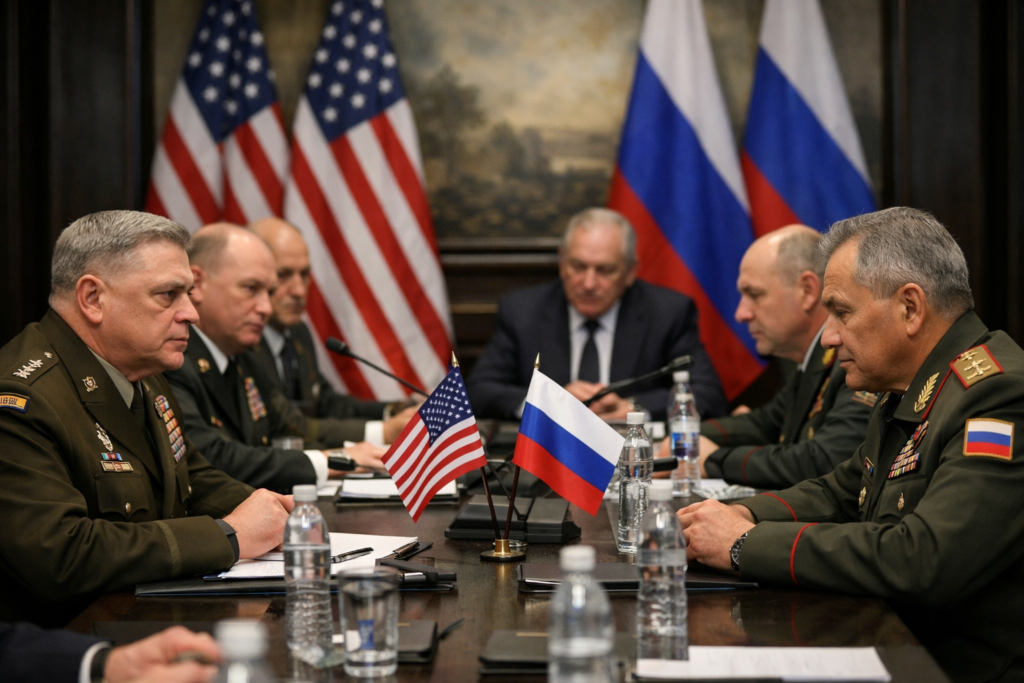
Image Credentials: Image Title: US and Russia Restore High-Level Military Hotline Following Abu Dhabi Peace Talks Source: (sora.openai) Date: January 2026. Attribution: This image was created using AI-generated imagery (sora.openai) and does not depict a real-world scene.
By Open Chronicle Staff with Agencies
ABU DHABI — In a landmark shift for global security, the United States and Russia officially agreed on Thursday to re-establish high-level military-to-military dialogue, ending a four-year communications blackout that began shortly before the 2022 invasion of Ukraine.
The breakthrough occurred on the sidelines of intensive trilateral peace negotiations in the United Arab Emirates, involving delegations from Washington, Moscow, and Kyiv. The move is being hailed by the Trump administration as a vital step toward de-escalation and “peace through strength.”
Ending the Silence The U.S. European Command (EUCOM) confirmed the agreement in a statement, noting that the restored channel will facilitate consistent contact between senior military leaders to prevent miscalculations and unintended escalations.
“Maintaining dialogue between militaries is an important factor in global stability,” the statement read. “This channel provides a means for increased transparency as the parties continue to work towards a lasting peace.”
Gen. Alexus G. Grynkewich, commander of EUCOM and NATO’s Supreme Allied Commander Europe, represented the American side in the talks. He is now authorized to maintain direct contact with Russia’s Chief of the General Staff, Valery Gerasimov. High-level communication had been largely suspended since the fall of 2021, a period during which tensions reached a boiling point ahead of the full-scale war in Ukraine.
Diplomatic Momentum in the UAE The agreement follows what officials described as “productive and constructive” progress in Abu Dhabi. These talks have been spearheaded by U.S. Special Envoy Steve Witkoff and senior adviser Jared Kushner.
While the broader peace framework remains under negotiation, the second day of the summit yielded immediate humanitarian results: a major prisoner exchange. Russian officials confirmed the return of 157 servicemen, while Ukrainian President Volodymyr Zelenskyy announced that 150 Ukrainian soldiers and seven civilians had been brought home.
A Volatile Context The restoration of military hotlines comes at a moment of extreme urgency. On the same day the agreement was reached, the New START treaty, the last remaining nuclear arms control agreement between the two superpowers, officially expired. With both nations now legally freed from warhead limits, the resumption of military dialogue is seen by analysts as a “safety net” to prevent a nuclear arms race from spiraling into direct conflict.
Despite the diplomatic progress in Abu Dhabi, the situation on the ground remains grim. Even as the deal was signed, Moscow launched a fresh wave of strikes against Ukraine’s power grid, while Kyiv continues to lobby for security guarantees that ensure any peace deal is not merely a “tactical pause” for Russian forces.
For now, the reopening of the “red phone” between the Pentagon and the Kremlin offers the first tangible sign of a cooling in the coldest of wars.