
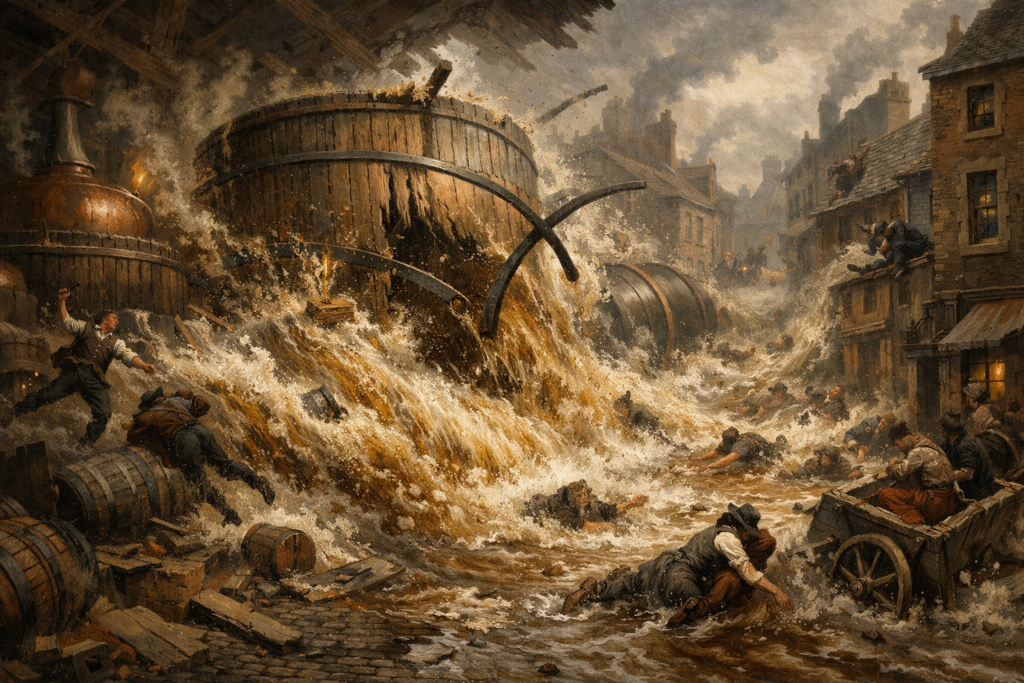
Image Credentials: Image Title: THE LIQUID AVALANCHE: THE TRAGEDY OF THE ST. GILES FLOOD. Source: (sora.openai) Date: February 2026. Attribution: This image was created using AI-generated imagery (sora.openai) and does not depict a real-world scene.
By Open Chronicle History Desk
The Pressure Cooker of Horse Shoe Brewery
In the heart of 19th-century London, Meux & Co’s Horse Shoe Brewery stood as a titan of industry. On the afternoon of October 17, 1814, the brewery’s pride, a massive, twenty-two-foot-tall wooden fermentation vat, held over 135,000 gallons of aging porter.
Though reinforced by massive iron hoops, the structural integrity of the vessel was failing under the immense internal pressure. At approximately 5:30 PM, a 700-pound iron band snapped. The failure triggered a catastrophic chain reaction, bursting neighboring vats and releasing a total volume of nearly 323,000 imperial gallons of beer into the densely packed rookery of St. Giles.
A Fifteen-Foot Wave of Porter
What followed was not a mere spill, but a literal tsunami of alcohol. A wall of dark beer, reportedly fifteen feet high, surged into the narrow streets. The sheer kinetic force of the liquid was devastating:
-
Structural Ruin: Two houses on New Street were completely leveled.
-
The Tavistock Arms: The wall of a nearby pub collapsed, trapping a teenage employee beneath the debris.
-
The Cellar Dwellings: St. Giles was an impoverished district where families lived in subterranean apartments. As the beer flooded these basements, residents had no time to flee.
The disaster claimed eight lives. The victims, mostly women and children, died from a combination of drowning, internal injuries from debris, and the sheer weight of the rushing liquid.
“Act of God”: The Legal Aftermath
In the wake of the destruction, the survivors sought justice in the courtroom. However, the legal standards of the era favored industrial growth over the safety of the impoverished. After a brief deliberation, a jury ruled the event an “Act of God.” This verdict absolved Meux & Co. of any legal or financial liability toward the victims. Adding insult to injury, the British Parliament granted the brewery a tax refund on the lost beer, ensuring the company suffered no significant financial loss while the families of St. Giles were left to bury their dead in poverty.
Survival and Chaos in the Gutters
The days following the flood were defined by a surreal mixture of mourning and opportunism. As the “liquid gold” filled the gutters and flooded basements, hundreds of locals flocked to the scene.
-
The “Clean-Up”: Some scooped beer into buckets and pots to save for consumption, an act some historians frame as desperate survival and others as public disorder.
-
The Aftermath: The stench of stale beer lingered in the district for months, a permanent reminder of the day the industrial machine literally burst at the seams.
Today, the London Beer Flood serves as a grim precursor to modern industrial safety regulations, reminding us that when the pressure of profit exceeds the strength of the vessel, the consequences are invariably paid by those at the bottom.
Bibliography
Open Chronicle History Desk. “The St. Giles Porter Disaster: A Case Study in Industrial Negligence.” Open Chronicle Archive, February 11, 2026.
Trow, M. J. The London Beer Flood of 1814. London: Historical Press, 2010.