
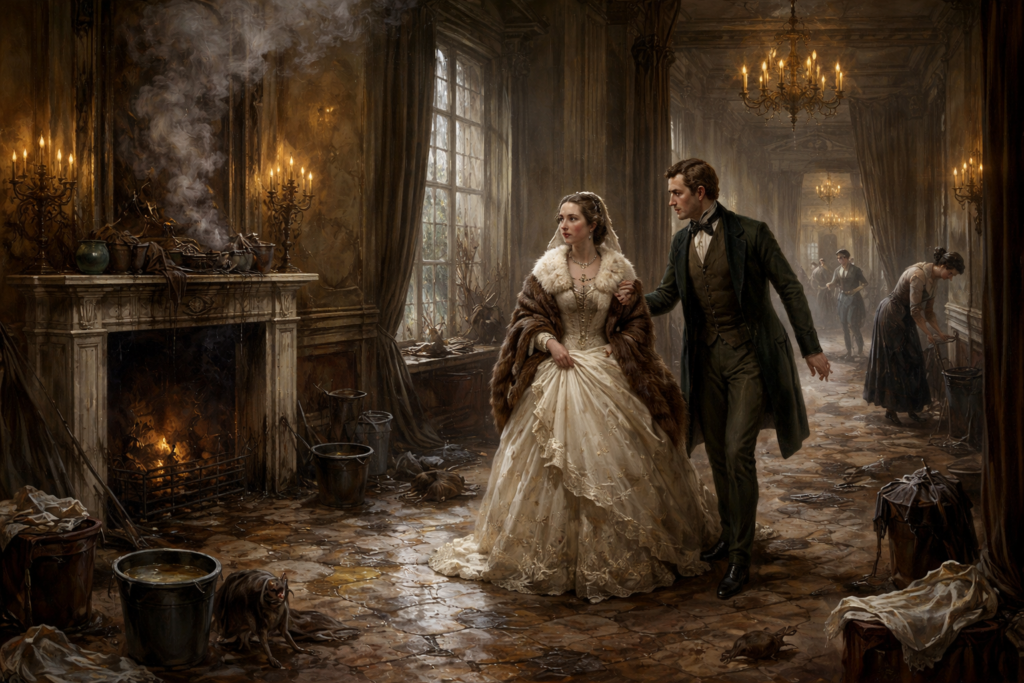
Image Credentials: Image Title: ROYAL REVOLT: WHY VICTORIA AND ALBERT DESPISED THE ‘SQUALOR’ OF BUCKINGHAM PALACE. Source: (sora.openai) Date: February 2026. Attribution: This image was created using AI-generated imagery (sora.openai) and does not depict a real-world scene.
OPEN CHRONICLE | Serving the Truth, Shaping the Future
By Open Chronicle History Staff
LONDON — It is the global symbol of the British Monarchy, a 775-room bastion of opulence and tradition. But for its first royal residents, Queen Victoria and Prince Albert, Buckingham Palace was less of a crown jewel and more of a crumbling, drafty, and “smelly” nightmare that nearly broke the spirit of the young couple.
While the public saw a glittering facade, internal records and historical accounts from the mid-19th century paint a grim picture of a palace in total disarray. When Victoria moved in shortly after her accession in 1837, she found a building that was architecturally grand but functionally catastrophic.
A Palace of “Soot and Stench”
The primary grievance for the royal couple was the sheer physical discomfort of the residence. Despite its scale, the palace was infamously cold. The chimneys were so poorly designed that they “smoked” incessantly; if a fire was lit to ward off the damp London winter, the rooms would quickly fill with thick, acrid soot, forcing the staff to dampen the flames and leave the Queen shivering in her silk gowns.
The olfactory experience was no better. The palace’s sewer system was primitive and prone to failure, leading to what contemporaries described as a “foul and stagnant” atmosphere. Ventilation was non-existent in many of the lower corridors, trapping the scents of the kitchen, the stables, and the sewers within the living quarters.
Demarcation Disasters
The “squalor” was exacerbated by a legendary lack of coordination among the palace staff. In a bizarre display of Victorian bureaucracy, “inside” staff and “outside” staff operated under strictly separate jurisdictions with no communication.
This led to the famous “dirty window” crisis: the outside staff would wash the exterior glass, only for the inside staff to leave the interior panes untouched for weeks, or vice versa. The result was a permanent layer of grime that symbolized the administrative chaos Prince Albert would eventually spend years trying to dismantle.
The “Boy Jones” and Missing Security
Perhaps most alarming for the young Queen was the total lack of security. The palace was so porous that a teenager named Edward Jones, later dubbed “the Boy Jones” by the press, managed to break in multiple times. Jones was famously discovered hiding under the Queen’s sofa, sitting on the throne, and even stealing her private portraits. The fact that an intruder could live undetected within the halls for days underscored Victoria’s feeling that the palace was a “vulnerable cage.”
Albert’s Great Reform
It was Prince Albert who eventually spearheaded the “Great Cleaning” of Buckingham Palace. Viewing the residence as a reflection of the nation’s efficiency, he reorganized the household staff, overhauled the heating and drainage systems, and commissioned the iconic East Front, the famous balcony wing, to provide more space for their rapidly growing family.
Though they eventually made it a home, Victoria and Albert’s early years at the palace were defined by a struggle against filth and negligence. Their shared hatred for the “London house” is credited with driving their desire to build private sanctuaries like Osborne House and Balmoral, places where the chimneys actually drew, the windows were clean, and the air was finally fresh.
Bibliography
- Bondeson, Jan. Queen Victoria’s Stalker: The Strange Story of the Boy Jones. Stroud, Gloucestershire: Amberley Publishing, 2011.
- HistoryExtra. “Queen Victoria and Prince Albert: Why They Hated Buckingham Palace.” HistoryExtra. February 11, 2026. https://www.historyextra.com/period/victorian/queen-victoria-prince-albert-buckingham-palace-why-they-hated-it/.
- Royal Collection Trust. “Letter from Queen Victoria to Prince Albert Regarding His Upcoming Visit to Switzerland and Italy.” Royal Archives. Accessed February 11, 2026. https://www.rct.uk/group/381/content/collections/royal-archives/prince-alberts-family-papers/letter-from-queen-victoria-to-prince-albert-regarding-his-upcoming-visit-to-switzerland-and-italy.
- The Royal Family. “Timeline: Queen Victoria and Prince Albert.” Last modified 2026. https://www.royal.uk/timeline-queen-victoria-and-prince-albert.