
Image: from Andy X@AndCav4
By Open Chronicle Staff February 12, 2026
LAMPUNG, Indonesia — In a bold shift toward “universal defense,” Indonesia has successfully tested the use of civilian toll roads as emergency landing strips for its fighter jets. The landmark trial, conducted on Wednesday, signals a strategic evolution for the world’s largest archipelago as it seeks to transform its vast island network into a series of unsinkable “aircraft carriers.”
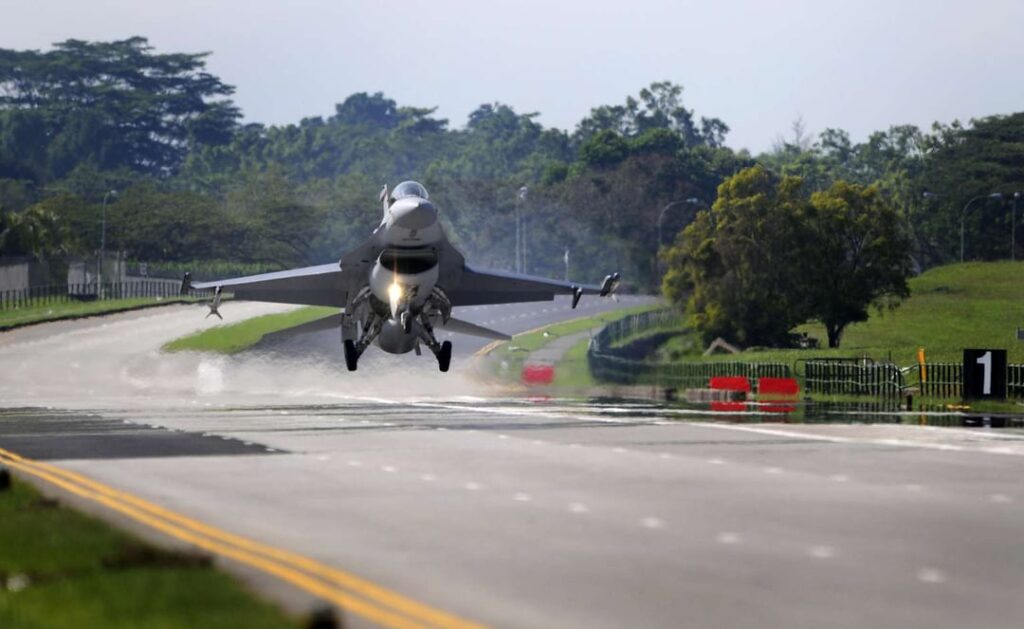
The exercise took place on a section of the Trans-Sumatra Toll Road in Lampung province. Under the watchful eyes of high-ranking officials, an Indonesian Air Force F-16 Fighting Falcon and an EMB-314 Super Tucano turboprop performed precision landings and take-offs on the asphalt normally reserved for passenger vehicles and cargo trucks.
“This success marks an important milestone in strengthening our national defense system,” said Deputy Defense Minister Donny Ermawan Taufanto. “Toll roads are being prepared as makeshift runways if our primary airbases are compromised or destroyed.”
"…Di beberapa tempat di Indonesia, kita akan bangun jalan tol yang juga dapat difungsikan sebagai runaway," ujar Menteri Pertahanan (Wamenhan) Donny Ermawan, dikutip dari siaran langsung Youtube Kompas TV, Rabu.
Baca selengkapnya https://t.co/h0u2YXqW1J.
~SN #JalanTol… pic.twitter.com/DDjePPb5Gk
— Kompas.com (@kompascom) February 11, 2026
A Strategic Necessity
The initiative is born from the unique geography of Indonesia. Spanning over 3,000 miles across 6,000 inhabited islands, the nation lacks the multibillion-dollar aircraft carriers used by global superpowers like the United States. Analysts suggest that converting existing infrastructure into military assets is a cost-effective alternative.
“An aircraft carrier is a high-risk, high-cost platform. If it’s struck once, it’s gone,” noted Collin Koh, a research fellow at the S. Rajaratnam School of International Studies. “Having countless highways earmarked as emergency runways across the entire archipelago makes far more strategic sense.”
The plan, articulated by Air Force Chief of Staff Marshal Tonny Harjono, aims for each of the country’s 39 provinces to eventually feature at least one 3,000-meter section of highway capable of supporting military aviation.
Precision Under Pressure
The technical challenges of the operation are significant. Standard military runways are typically 45 to 60 meters wide; however, the Indonesian toll roads used in the trial are only 24 meters wide. This narrow margin of error requires elite pilot training and specific road reinforcement.
To support this “total defense” concept, the Ministry of Defense is collaborating with the Ministry of Public Works to ensure that future road construction projects meet the necessary technical specifications, such as increased pavement thickness and the removal of overhead obstacles, to accommodate supersonic jets.
While Indonesia has maintained that this plan is not directed at any specific nation, the move comes amid heightened regional tensions in the South China Sea. By dispersing its air power across civilian infrastructure, Jakarta ensures that its air force remains resilient and “harder to target” in the event of a regional conflict.
As the F-16 roared back into the Lampung sky on Wednesday, it left behind more than just tire marks on the Trans-Sumatra asphalt; it left a clear message that Indonesia’s highways are now a frontline component of its national security.