
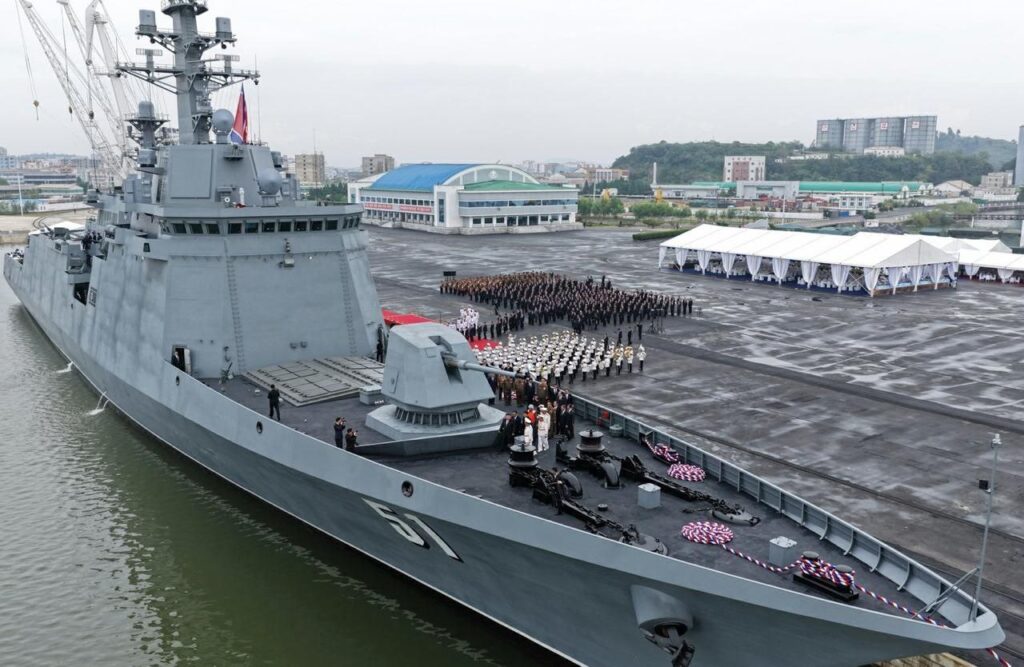
Image: from Legitimate Targets X @LegitTargets
SEOUL / PYONGYANG — February 13, 2026 By Open Chronicle Staff
The naval arms race on the Korean Peninsula has reached a fever pitch, but beneath the surface of North Korea’s propaganda lies a fleet struggling with technical failures and aging steel. As Pyongyang rushes to project power through its new Choe Hyon-class destroyers and a nascent nuclear submarine program, South Korea is solidifying its position as a global maritime elite with superior reliability and cutting-edge propulsion.
The “Miracle” of the Kang Kon
Last year, North Korean leader Kim Jong Un was reportedly “furious” following the embarrassing capsizing of the Kang Kon, the second of the nation’s 5,000-ton Choe Hyon-class destroyers, during its launch. Under intense pressure from the regime, subordinates declared the vessel operational as of June 5th.
However, international observers remain skeptical. While the 144-meter vessel is the largest surface warship North Korea has ever fielded, boasting phased-array radar and Vertical Launching Systems (VLS), the internal damage from extensive saltwater immersion is likely catastrophic.
“Until the Kang Kon is observed at sea actually engaging its weapons systems, it remains a ‘Potemkin’ ship,” noted one regional analyst. “Salt water and advanced electronics are a lethal combination for functionality.”
A Fleet in Transition
North Korea is currently attempting a massive overhaul of its naval forces, including:
-
Submarine Replacement: Phasing out 76 submarines from the 1960s/80s in favor of a dozen Chinese-modeled Type 33s.
-
Nuclear Ambitions: Attempting to build a nuclear-powered ballistic missile submarine (SSBN). Experts suggest this goal is unattainable without significant technical intervention from Russia or China, given the immense complexity of miniaturizing nuclear reactors for undersea use.
-
The Aging Guard: The remainder of the fleet consists of roughly 100 patrol boats and 2,000 amphibious craft, most of which are no longer seaworthy.
South Korea’s High-Tech Dominance
🇨🇦🇰🇷 South Korea seeks to provide Canada with a wide range of industrial benefits as part of the KSS-III CPS submarine deal. In the future, we look forward to working with Canada on Korea's ongoing nuclear-powered submarines, next-gen tanks, artillery, ships, sensors, missiles,… https://t.co/gcYGL8NYOk pic.twitter.com/7m5k3uaC7n
— Mason ヨンハク (@mason_8718) January 29, 2026
In stark contrast, South Korea has officially joined the ranks of the world’s most sophisticated navies. As the seventh nation to deploy Sea-Launched Ballistic Missiles (SLBMs), Seoul is now leveraging technology that its northern neighbor can only “crudely imitate.”
The second iteration of the KSS-III submarines represents a global first. Unlike traditional diesel-electric subs, these vessels utilize:
-
Air-Independent Propulsion (AIP): Allowing for three weeks of continuous submerged operation.
-
Lithium-Ion Batteries: Replacing old lead-acid tech for greater efficiency and duration.
-
VLS Capacity: Ten vertical launch cells carrying Hyunmoo 4-4 SLBMs with an 800-kilometer range.
The Strategic Divide
While the North focuses on “having” the technology to save face, the South focuses on it “working.” South Korea is currently developing nuclear weapons of its own, a shift from decades of restraint, and is pursuing nuclear-powered submarines with American assistance.
The current naval balance is heavily weighted toward Seoul’s reliability. While both nations possess the capacity to inflict damage, the South’s fleet, comprising 13 destroyers, 17 frigates, and 22 submarines, operates with a level of technological sophistication that North Korea’s “salt-damaged” navy cannot currently match.