
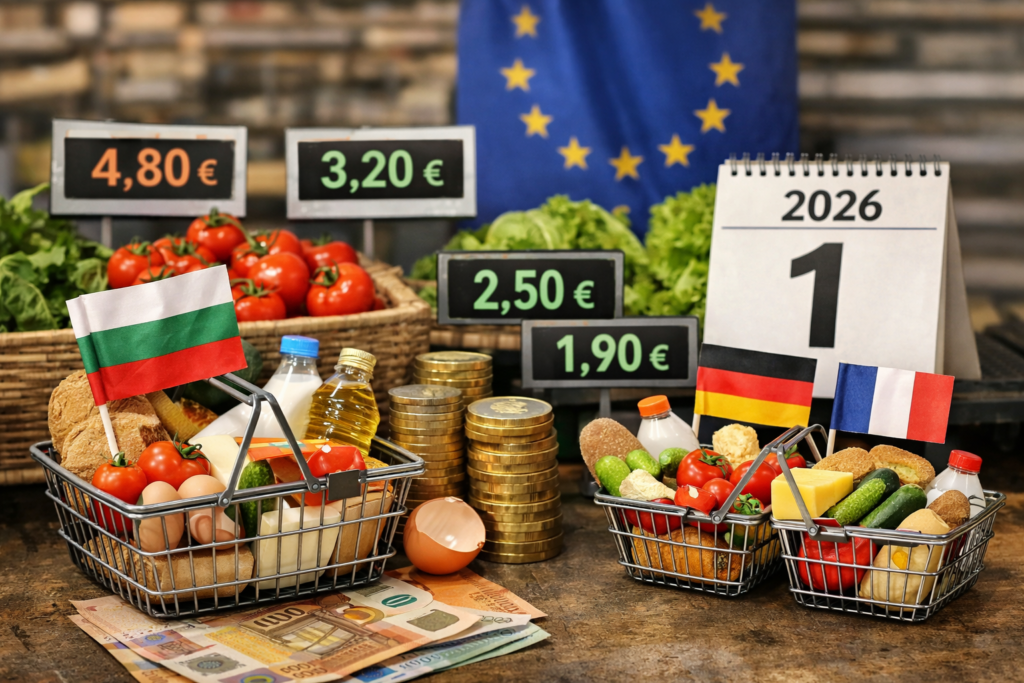
Image Credentials: Image Title: Bulgaria’s “Small Basket” Now Costs More Than in Germany and France Source: (sora.openai) Date: January 2026. Attribution: This image was created using AI-generated imagery (sora.openai) and does not depict a real-world scene.
By Open Chronicle Staff with Agencies
SOFIA – In a startling economic shift, recent data confirms that the cost of essential food items in Bulgaria has surpassed that in some of Europe’s wealthiest nations, including Germany and France. Despite Bulgaria’s landmark entry into the Eurozone on January 1, 2026, the promised price stability has been overshadowed by a surge in the cost of a “small consumer basket.”
The Price of Essentials
An analysis by the Confederation of Bulgarian Trade Unions (CITUB) reveals that five staple items, flour, rice, milk, oil, and the traditional banichka, are now more expensive in Bulgarian markets than in their Western European counterparts.
The disparity is particularly stark when examining the “small consumer basket,” which includes 21 essential items:
-
Bulgaria: €58.80
-
Romania: €47.99
While the absolute cost is high, the impact on purchasing power is even more severe. A Bulgarian worker earning the minimum wage can afford this basket only 10 times per month, the lowest ratio in the entire European Union. For comparison, a worker on a German minimum wage can afford the same basket approximately 30 times.
Structural Issues vs. Euro Adoption
Economists and trade union experts emphasize that the price hikes are not a direct result of adopting the Euro. Instead, they point to deep-seated structural issues within the domestic market:
-
Weak Competition: Domestic markets suffer from limited competition, allowing retail chains to maintain high markups.
-
Extreme Markups: CITUB reports that the gap between wholesale and retail prices in Bulgaria often reaches between 50% and 90%, far exceeding the European average of 30%.
-
Seasonal Volatility: Fresh produce has seen dramatic spikes, with cucumbers rising over 60% since last summer and tomatoes jumping 15.2% in January alone.
The “Dual Pricing” Safety Net
To combat “hidden” inflation during the currency transition, the Bulgarian government has mandated that businesses display prices in both the Bulgarian Lev (BGN) and the Euro until August 2026. However, consumer frustration is mounting.
“There are thousands of commissions supposedly monitoring prices, but nothing changes,” said one shopper in Sofia, echoing a sentiment of growing skepticism toward state oversight.
Looking Ahead
The Bulgarian Commission for Protection of Competition (CPC) is under increasing pressure to investigate whether retail chains are using the currency switch as a cover for “speculative” price increases. As the country moves toward the February 1 deadline for the Euro becoming the sole legal tender, the focus remains on whether government intervention can bridge the widening gap between stagnant wages and soaring grocery bills.