
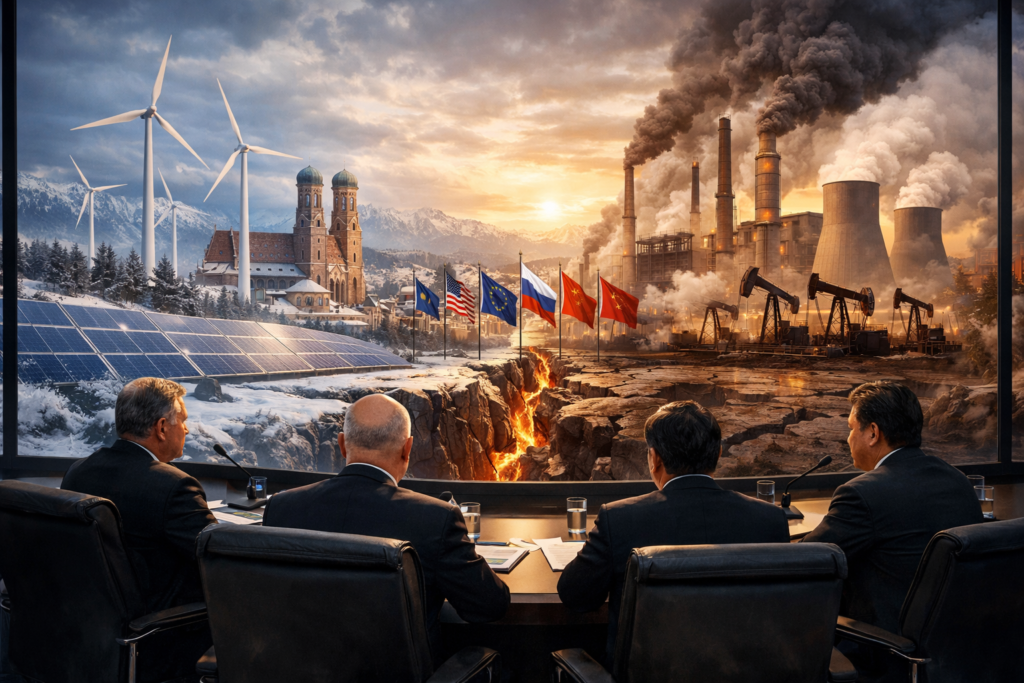
Image Credentials: Image Title: Munich 2026 Proves Energy Is the New Geopolitical Fault Line Source: (sora.openai) Date: February 2026. Attribution: This image was created using AI-generated imagery (sora.openai) and does not depict a real-world scene.
OPEN CHRONICLE | The Strategic Ledger of Global Security
By Elliot Hayes* | February 16, 2026
At this year’s Munich Security Conference, tanks and troop deployments were not the only measures of power discussed in corridors and plenary halls. The more consequential conversation, quieter yet sharper in its implications, revolved around energy. Not merely oil and gas, but supply chains, critical minerals, electricity grids, LNG terminals, and the political leverage embedded within them.
Munich 2026 made one reality unmistakable. Energy is no longer a background economic variable. It is once again a frontline instrument of geopolitical strategy.
Europe entered this decade convinced that interdependence was a stabilizing force. The theory held that deep trade ties would discourage coercion. That assumption now appears fragile. The weaponization of energy supplies in recent years has forced policymakers to confront an uncomfortable truth: dependency is rarely neutral.
The debate in Munich reflected this anxiety. Europe has reduced its reliance on Russian gas, yet it now faces a subtler dilemma. Diversification has often meant deeper reliance on US liquefied natural gas exports. That may be commercially rational, but it raises strategic questions. Can Europe afford to anchor its energy security to the domestic political currents of another democracy, even a close ally?
Energy security is no longer about avoiding a single adversary. It is about preventing structural overexposure to any one supplier.
If hydrocarbons defined the geopolitics of the 20th century, critical minerals will shape the 21st. Lithium, cobalt, nickel, rare earth elements, and copper sit at the heart of electric vehicles, renewable infrastructure, defence systems, and AI hardware.
China’s dominance in refining and processing these materials is not accidental. It is the product of decades of strategic investment. The uncomfortable implication for Western governments is that decarbonization and digital transformation depend on supply chains that are geographically concentrated and politically exposed.
Munich 2026 underscored a widening tension. Leaders want to derisk from China without triggering a spiral of economic fragmentation. Yet diversification requires time, capital, and coordination that democratic systems often struggle to sustain. Strategic patience is rarely rewarded in electoral cycles.
Another notable shift in Munich was the reframing of climate policy. For years, climate action was framed primarily as an environmental imperative. Now it is increasingly discussed as a security necessity.
Energy transition, when executed intelligently, reduces exposure to volatile fossil fuel markets and geopolitical chokepoints. Domestic renewable capacity enhances strategic autonomy. Electrification reduces vulnerability to external shocks. In this sense, decarbonization is not only about emissions, but it is also about sovereignty.
Yet the transition also introduces new vulnerabilities. Grids become cyber targets. Mineral supply chains become strategic battlegrounds. Clean energy technologies become instruments of industrial competition. The energy transition does not eliminate geopolitics. It transforms it.
The most sobering takeaway from Munich was the risk of overcorrection. Faced with the weaponization of energy, states may retreat into economic nationalism. Subsidy races, export controls, and parallel supply chains can quickly erode global efficiency.
Total self-sufficiency is an illusion. No major power can produce all the resources, technologies, and expertise required for modern energy systems. The question is not whether interdependence will exist, but whether it will be managed through trust-based alliances or hardened blocs.
Munich 2026 suggested that a new model is emerging. Not naïve globalization, yet not full decoupling. Instead, a model of selective resilience, diversified partnerships, and strategic transparency.
Energy has always been power. What has changed is the form that power takes. Pipelines, LNG terminals, mineral refineries, battery plants, and grid infrastructure now carry geopolitical weight comparable to naval bases and missile systems.
Munich did not produce a single dramatic declaration. It did something more consequential. It signaled that global leaders now recognize energy as a central axis of strategic competition.
The lesson is clear. States that treat energy policy as a domestic technical matter will find themselves strategically exposed. Those that integrate energy, climate, trade, and security into a coherent grand strategy will shape the next phase of global power politics.
Munich 2026 did not introduce a new era. It confirmed that we are already in one.
The Grand Strategy Institute
Continue Exploring Strategic Analysis
Return to The Grand Strategy Institute for strategic assessments, long-form analysis and research examining geopolitics, military affairs, international security, emerging technologies and the changing international order.
← Back to The Grand Strategy Institute