
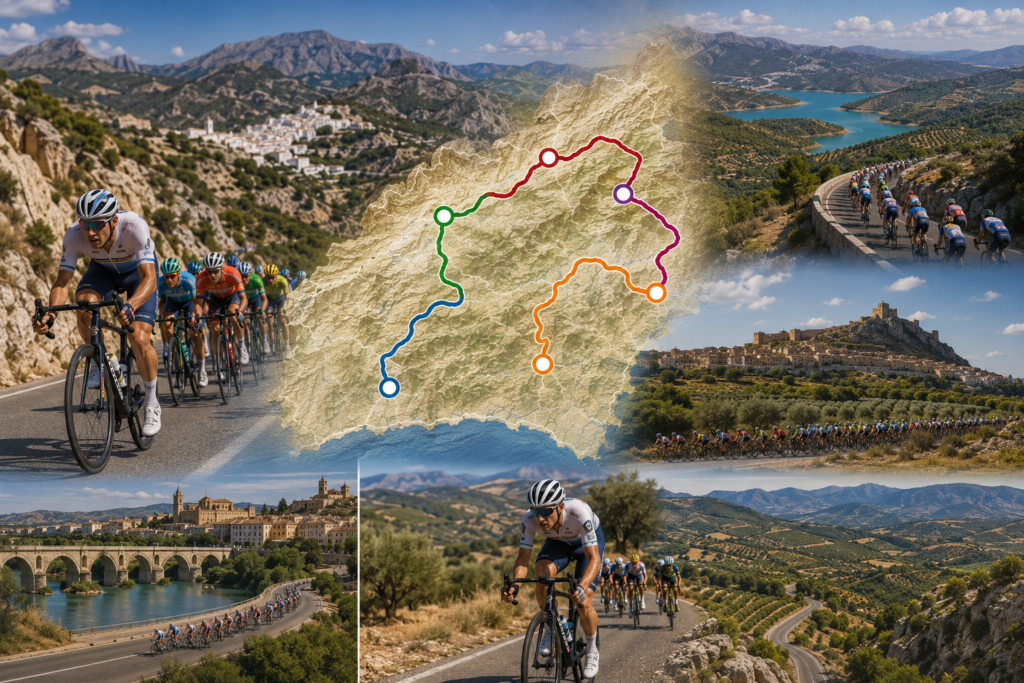
Image Credentials: Image Title: Ruta del Sol 2026 Route: Andalucía’s Rolling Roads Promise Five Days of Aggressive Racing. Source: (chatgpt.com) Date: July 2026. Attribution: This image was created using AI-generated imagery (chatgpt.com) by Open Chronicle and does not depict a real-world scene.
By Open Chronicle News Desk with Agencies
The 2026 Ruta del Sol (Vuelta a Andalucía) once again offered one of the most demanding early-season routes on the European calendar, covering approximately 800 kilometres across five days of racing through southern Spain.
Although no stage finished atop a mountain, the constant succession of climbs, technical descents and rolling terrain ensured that the race strongly favoured versatile riders capable of climbing, attacking and surviving repeated elevation changes.
From 18 to 22 February, the peloton tackled the rugged landscapes of Andalucía, where flat roads are rare, and every stage presented opportunities for breakaways and general classification battles.
A route shaped by Andalucía’s mountains
Unlike many stage races that build towards summit finishes, the 2026 Ruta del Sol relied on continuous climbing spread throughout each stage.
The organisers created a course that rewarded aggressive racing rather than defensive tactics, with every stage offering terrain capable of reshaping the general classification.
Despite the absence of uphill finishes, more than 2,000 metres of climbing featured on four of the five stages.
Stage 1 – Benahavís to Pizarra
The race opened with a demanding 150-kilometre journey from Benahavís to Pizarra.
Early in the stage, the riders crossed the spectacular Sierra de las Nieves, where two major climbs dominated the route:
- Puerto del Madroño
- Puerto del Viento
Almost all of the day’s 2,750 metres of climbing were concentrated during the opening half of the stage.
After the mountains, the peloton descended into the Guadalhorce Valley, creating an entirely different tactical challenge as teams attempted to regroup before the finish.
The varied profile offered opportunities for climbers, breakaway specialists and resilient sprinters alike.
Stage 2 – The queen stage
On paper, Stage 2 represented the toughest day of the race.
Starting in the Mediterranean resort town of Torrox, riders immediately faced the daunting Puerto de la Cabra, one of Andalucía’s longest and most demanding ascents.
Although the stage again featured approximately 2,750 metres of elevation gain, it covered around 10 kilometres less than the opening stage, making the climbing more concentrated and the racing significantly more intense.
The combination of steep gradients and reduced distance encouraged aggressive attacks from the overall contenders.
Many expected the general classification to take shape on this decisive stage.
Stage 3 – Rolling terrain to Lopera
The third stage departed from the historic city of Jaén before crossing two significant climbs:
- Alto de Santa Ana
- Puerto de Peñallana
Together, the climbs contributed to approximately 2,000 metres of elevation gain.
Rather than finishing on a steep climb, the race concluded on a long false flat into Lopera, creating an ideal finale for powerful puncheurs and reduced-group sprinters.
Positioning and timing were expected to prove just as important as climbing ability.
Stage 4 – Fast finishers get their chance
The fourth stage offered the clearest opportunity for the sprinters.
Travelling from Montoro to Pozoblanco, the route featured fewer major climbing obstacles than the previous days.
However, the finale still demanded careful energy management.
The final 2.5 kilometres gradually climbed on a false flat, making it more selective than a conventional bunch sprint.
The finish had already become familiar after Alexander Kristoff celebrated victory there the previous year.
Once again, the strongest sprinters capable of handling a slightly uphill finish were expected to battle for the stage victory.
Stage 5 – A finale built for attackers
The concluding stage covered 167.6 kilometres and included approximately 2,300 metres of climbing, ensuring the race remained open until the very end.
The decisive feature was a double ascent of the Alto de la Primera Cruz, a climb measuring:
- 2.8 kilometres
- 5.9% average gradient
Following the second ascent, riders faced a fast descent all the way to the finish line.
The combination of repeated climbing and downhill approach created multiple tactical possibilities.
Puncheurs could launch decisive attacks on the climb, while reduced groups of sprinters still had an opportunity to contest the finish if they managed to stay together over the summit.
A route encouraging constant attacks
One of the defining characteristics of the 2026 Ruta del Sol was the absence of long flat transitions.
Instead, riders encountered relentless rolling terrain from start to finish.
This type of parcours favoured:
- Aggressive breakaway specialists.
- Strong climbers.
- Puncheurs.
- Complete all-rounders.
Teams were forced to remain attentive throughout every stage, as opportunities to gain or lose time appeared repeatedly across the Andalusian landscape.
Andalucía provides the perfect early-season test
The Ruta del Sol has become one of the most respected stage races of the early European calendar thanks to its demanding terrain and unpredictable racing.
Its constantly changing profile offers an ideal preparation for the Ardennes Classics and later Grand Tours, requiring riders to demonstrate climbing ability, tactical awareness and endurance over five consecutive days.
The 2026 route continued that tradition, delivering a balanced yet challenging course that highlighted the dramatic scenery of southern Spain while promising exciting racing from the opening climb in Benahavís to the final descent into Lucena.