
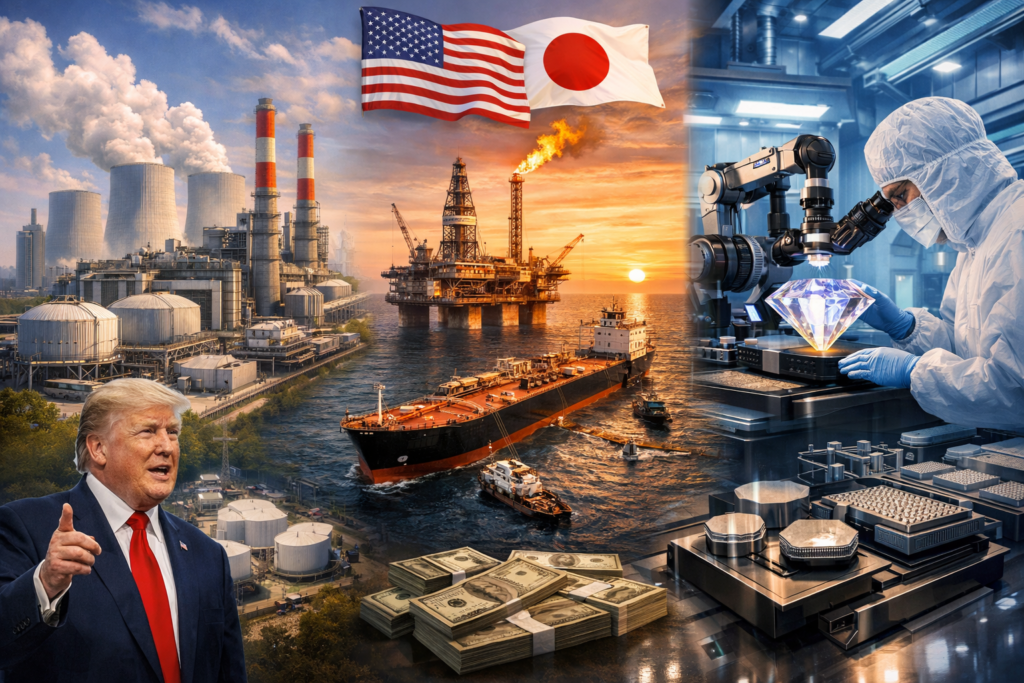
Image Credentials: Image Title: US, JAPAN LAUNCH FIRST WAVE OF HISTORIC $550B INVESTMENT DEAL. Source: (sora.openai) Date: Feb 2026. Attribution: This image was created using AI-generated imagery (sora.openai) and does not depict a real-world scene.
By Chronicle Staff with Agencies
WASHINGTON – The United States and Japan have officially inaugurated the first phase of a monumental $550 billion investment pact, marking a significant shift in the economic and industrial landscape between the two allies. On Tuesday, officials announced an initial $36 billion tranche directed toward major energy and industrial projects within the United States.
The announcement represents the first tangible step in a broader trade agreement brokered in 2025 under the administration of President Donald Trump. Tokyo’s commitment to inject over half a trillion dollars into the American economy comes as a strategic response to U.S. trade pressures, specifically aimed at securing lower tariffs on Japanese imports.
“Japan is now officially, and financially, moving forward with the FIRST set of Investments under its 550 BILLION Dollar Commitment,” President Trump stated via his Truth Social platform, attributing the scale of the deal to his administration’s use of tariffs as a negotiating lever.
Energy and Technology at the Forefront. The first $36 billion will fund three cornerstone projects designed to bolster U.S. infrastructure and economic security:
-
Natural Gas Facility (Ohio): Described by U.S. Trade Secretary Howard Lutnick as the “largest in history,” this facility is expected to generate 9.2 gigawatts of power—enough to supply roughly 7.4 million homes or several massive AI data centers.
-
Deep-Water Oil Export Facility (Gulf of Mexico): This project is projected to generate between $20 billion and $30 billion in annual crude exports, further solidifying the United States’ position as a top global energy supplier.
-
Synthetic Diamond Manufacturing: This facility aims to break China’s dominance in the sector, providing critical materials for industrial and technological use and reducing U.S. reliance on imports.
U.S.–Japan trade deal just went official 🚨
President Donald Trump announced a new agreement between the United States and Japan
And the numbers are big.
Key highlights 👇
• $550B in Japanese investment into the U.S
• Funding for an LNG facility in Texas
• Funding for a… pic.twitter.com/NnFas6WoVa
— Draxen (@Draxen_Web3) February 18, 2026
Strengthening the Alliance, Japanese Prime Minister Sanae Takaichi, scheduled to visit the White House next month, emphasized that these initiatives are about more than just capital. In a statement on X, Takaichi noted that the projects would “strengthen the Japan-US alliance” by building resilient supply chains in critical sectors like AI, data centers, and minerals.
While the headline figure of $550 billion is staggering, Japanese trade minister Ryosei Akazawa clarified that direct capital would account for only a small percentage of the total. The bulk of the investment will be facilitated through bonds, loans from the Japan Bank for International Cooperation (JBIC), and public-guaranteed credits.
A Tense Negotiating Table. The rollout comes amid high stakes for Tokyo. President Trump has recently signaled a low tolerance for delays in such agreements, having recently threatened South Korea with increased tariffs for allegedly failing to meet its own investment pledges. For Japan, these first three projects serve as a vital demonstration of good faith ahead of the March 19 summit in Washington.
U.S. Commerce Secretary Howard Lutnick hailed the development as a “MASSIVE AMERICA FIRST TRADE WIN,” noting that while Japan provides the capital, the infrastructure and jobs remain firmly on American soil.