
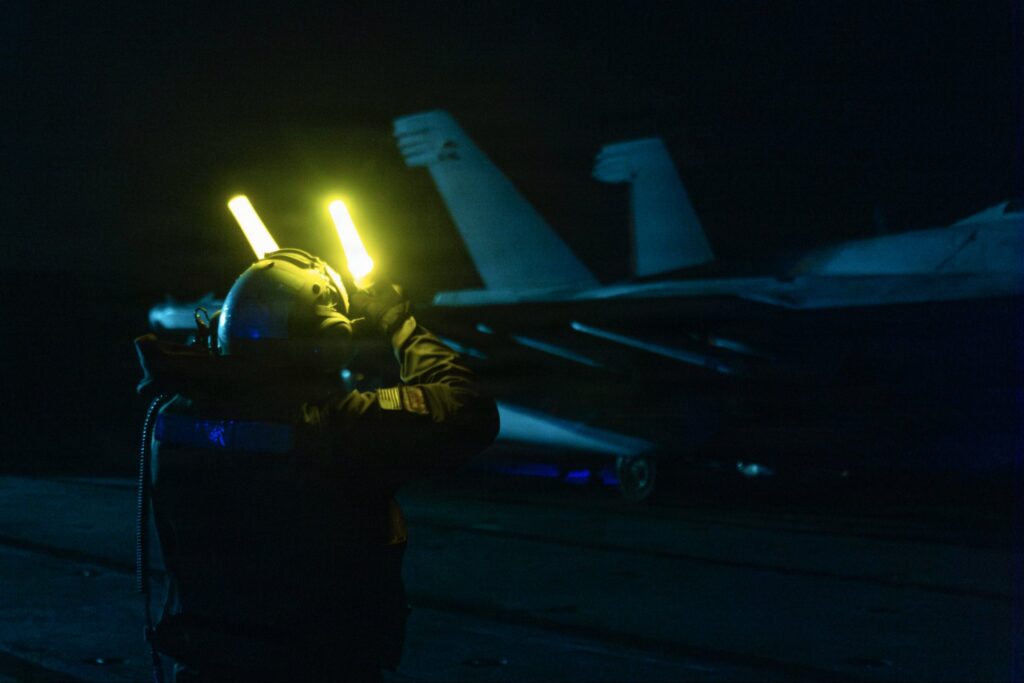
Image: from Open Source Intel X@Osint613
By Chronicle Staff Tuesday, February 17, 2026
WASHINGTON — The chessboard in the Middle East is now fully populated. In what military analysts are describing as the most significant mobilization of offensive airpower in decades, the United States has moved the “final pieces” into position for a potential sustained campaign against the Islamic Republic of Iran.
The influx of assets follows weeks of escalating rhetoric from President Donald Trump, who has repeatedly threatened military action in response to Tehran’s recent crackdowns on domestic protesters and its continued nuclear ambitions. While the White House maintains that a diplomatic “off-ramp” remains open via ongoing indirect talks in Switzerland, the sheer scale of the military buildup suggests that Washington is preparing for a scenario where words fail.
A Shield and a Sword
According to flight tracking data and defense officials, a formidable “strike package” is now coalescing across regional bases. At least a dozen F-22 Raptors—the world’s premier air-superiority fighters—departed Langley Air Force Base early Tuesday, transiting through the United Kingdom toward the Middle East. They are being joined by a massive deployment of F-16 Fighting Falcons from bases in Italy, Germany, and South Carolina.
These tactical assets augment a force already bolstered by F-35A Lightning IIs, F-15E Strike Eagles, and E/A-18G Growler electronic warfare jets. Crucially, the arrival of E-3 Sentry radar planes and U-2 Dragon Lady spy planes provides the “eyes and ears” necessary for a complex, multi-week air campaign.
“This isn’t just a symbolic show of force,” said one senior defense analyst. “These are the missing capabilities required for a high-intensity, sustained operation. They have moved from a defensive posture to a full-spectrum offensive readiness.”
Tensions at the Strait
Tehran has not remained idle. In a direct challenge to the American buildup, the Islamic Revolutionary Guard Corps (IRGC) announced the closure of the Strait of Hormuz for live-fire naval exercises. Dubbed “Smart Control of the Strait of Hormuz,” the drills include the deployment of classified strategic drones and anti-ship cruise missiles.
This marks the first time since January that Iran has restricted traffic in the vital waterway, through which 20% of the world’s oil flows. The move has sent tremors through global energy markets and raised the stakes for any potential U.S. strike.
The Shadow of ‘Midnight Hammer’
The current standoff comes less than a year after “Operation Midnight Hammer,” the June 2025 joint U.S.-Israeli strike that utilized B-2 stealth bombers to “obliterate” Iranian nuclear facilities. While that operation was a surgical strike, officials warn that a 2026 campaign could be far broader, targeting not just nuclear infrastructure but IRGC command centers, state security facilities, and economic assets.
As the Abraham Lincoln Carrier Strike Group and a dozen surface combatants patrol the Arabian Sea, the world waits to see if the “set of guiding principles” currently being drafted in Switzerland will be enough to halt the march toward a new war in the Middle East.
For now, the engines are running, and the pieces are in place.