
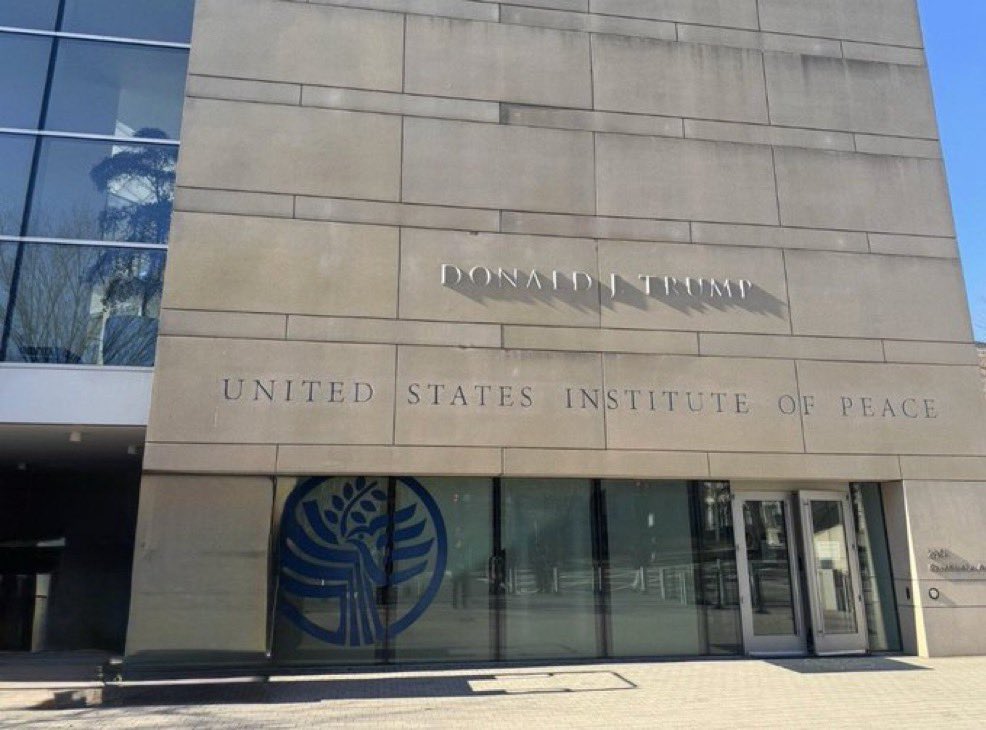
Image: from Politics & Poll Tracker X @PollTracker2024
By Open Chronicle with Agencies
WASHINGTON — In a move designed to bypass traditional multilateral diplomacy, President Donald J. Trump chaired the first formal meeting of his controversial “Board of Peace” on Thursday at the newly renamed Donald J. Trump United States Institute of Peace.
The summit, centered on a high-stakes plan for the reconstruction of post-war Gaza, serves as the operational debut of a body Trump envisions as a faster, “deal-based” alternative to the United Nations. Addressing representatives from over 45 nations, the President announced that member states have already pledged more than $5 billion toward a Gaza reconstruction fund, a figure he characterized as a “historic down payment,” though it remains a fraction of the $70 billion estimated by international observers as necessary to rebuild the decimated territory.
“The old ways were not working,” Trump told the assembly. “We have the greatest leaders in the world joining this board. It has the chance to be the most consequential board ever assembled.”
A New Security Architecture
A central pillar of the meeting was the formation of an International Stabilization Force (ISF) to maintain the fragile October ceasefire between Israel and Hamas. While the White House confirmed that several nations, including Indonesia, Kazakhstan, and Kosovo, have committed thousands of personnel to the force, the mission remains hamstrung by a critical stalemate: the disarmament of Hamas.
Israeli Prime Minister Benjamin Netanyahu, who visited Washington last week but skipped Thursday’s summit, continues to insist on full demilitarization before the ISF can deploy. Meanwhile, Hamas has signaled a refusal to hand over weaponry without greater security guarantees, leaving the “stabilization” phase in a state of diplomatic limbo.
The “Transatlantic Rift”
The summit’s guest list highlighted a deepening divide between Washington and its traditional Western allies. While Middle Eastern powers like Saudi Arabia, the UAE, Qatar, and Turkey were prominently represented, major European leaders—including those from France, Germany, and the United Kingdom, conspicuously declined their invitations.
European officials have expressed private alarm over the Board’s charter, which grants Trump the role of “Inaugural Chairman” indefinitely, even after he leaves the White House. Critics, including European Commission President Ursula von der Leyen and the Vatican, have warned that the initiative seeks to “usurp” the authority of the UN Security Council.
“There is a concern that this is less about peace and more about creating a parallel international system built on personal transactions rather than international law,” said one European diplomat speaking on the condition of anonymity.
The “Chifagate” Shadow
The ambitious agenda in Washington stands in stark contrast to the political chaos currently engulfing other regional partners. In Peru, the recent impeachment of President José Jerí over the “Chifagate” influence-peddling scandal has added another layer of volatility to a region already wary of shifting U.S. foreign policy.
As the Board of Peace concludes its first session, the world remains divided on its legitimacy. For the Trump administration, the summit is proof of “results-oriented” leadership. For its detractors, it is a high-risk gamble that may leave the United Nations—and the future of Gaza, more fractured than ever.