
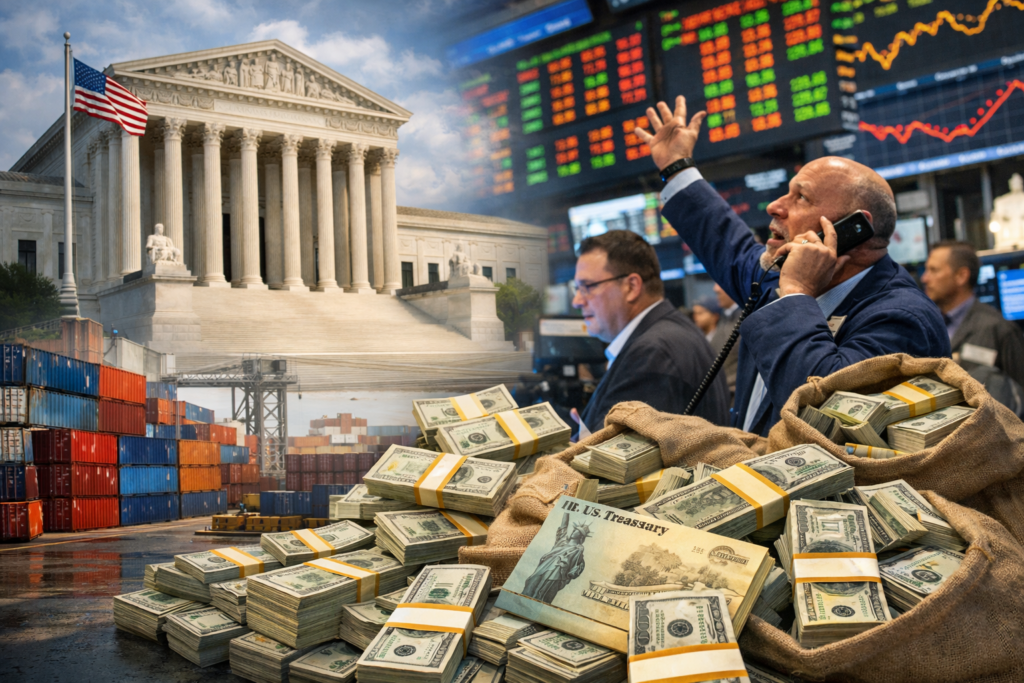
Image Credentials: Image Title: THE REFUND RUSH: U.S. FIRMS SCRAMBLE FOR BILLIONS AFTER SUPREME COURT SHATTERS TARIFF REGIME Source: (sora.openai) Date: Feb 2026. Attribution: This image was created using AI-generated imagery (sora.openai) and does not depict a real-world scene.
THE OPEN CHRONICLE | Truth through time. Integrity in every word.
By Open Chronicle Staff | United States
WASHINGTON — A wave of legal and financial chaos swept through the American private sector on Friday as thousands of businesses began the monumental task of clawing back billions of dollars in duties following the Supreme Court’s decisive strike against President Trump’s tariff authority.
With the high court ruling 6-3 that the administration’s use of the International Emergency Economic Powers Act (IEEPA) was an unconstitutional reach into Congressional territory, an estimated $175 billion in collected revenue is now effectively in legal limbo. From small-scale importers to Fortune 500 manufacturers, the scramble for “re-liquidation” has turned the U.S. Court of International Trade into the nation’s most crowded legal arena.
🚨 BREAKING
THE SUPREME COURT WON'T FORCE TRUMP TO REFUND $175 BILLION IN TARIFF REVENUE!
POLYMARKET IS PRICING ONLY A 35% CHANCE OF IT HAPPENING.
PRAYING FOR OUR BAGS 🙏 https://t.co/cMUD7TpAg3 pic.twitter.com/ZREqflG7z9
— Wimar.X (@DefiWimar) February 20, 2026
The $175 Billion Logistics Nightmare
While the Supreme Court invalidated the “Liberation Day” tariffs, it stopped short of providing a blueprint for how, or if, the Treasury must return the funds already collected. This “intentional punt” on remedies, as some legal scholars describe it, has left U.S. Customs and Border Protection (CBP) facing a logistical nightmare.
“We are looking at a process that could take years,” warned one trade attorney. “Importers who didn’t file ‘protective actions’ or whose entries have already been ‘liquidated’ may find themselves locked out of refunds, while those with active protests are first in line for what could be the largest tax-back event in American history.”
The Penn-Wharton Budget Model confirmed the stakes on Friday, estimating that the IEEPA-based collections alone total more than the combined annual budgets of the Departments of Justice and Transportation.
Corporate Giants vs. Small Business
The ruling has also sparked a debate over economic equity. Senator Elizabeth Warren and other critics noted that while large corporations with “armies of lobbyists” are well-positioned to sue for refunds, smaller businesses and everyday consumers, who ultimately paid the price through higher retail costs, may never see a dime.
“The giant corporations will pocket the money, but the families who paid $3,000 more for a car last year aren’t getting a check in the mail,” a consumer advocacy group stated.
A Fragile Fiscal Balance
For the White House, the ruling represents more than a political defeat; it is a fiscal crisis. The IEEPA tariffs were responsible for a significant portion of the administration’s deficit-reduction strategy for the 2026 fiscal year. Without this revenue, the federal budget deficit is projected to widen overnight, potentially spooking bond markets and complicating the Federal Reserve’s efforts to stabilize interest rates.
Despite the “mess” predicted by Justice Brett Kavanaugh in his dissent, the President remains undeterred. Even as firms file their refund claims, the White House has already signaled it will pivot to Section 232 national security justifications to keep as many levies in place as possible, setting the stage for a second round of high-stakes litigation.