
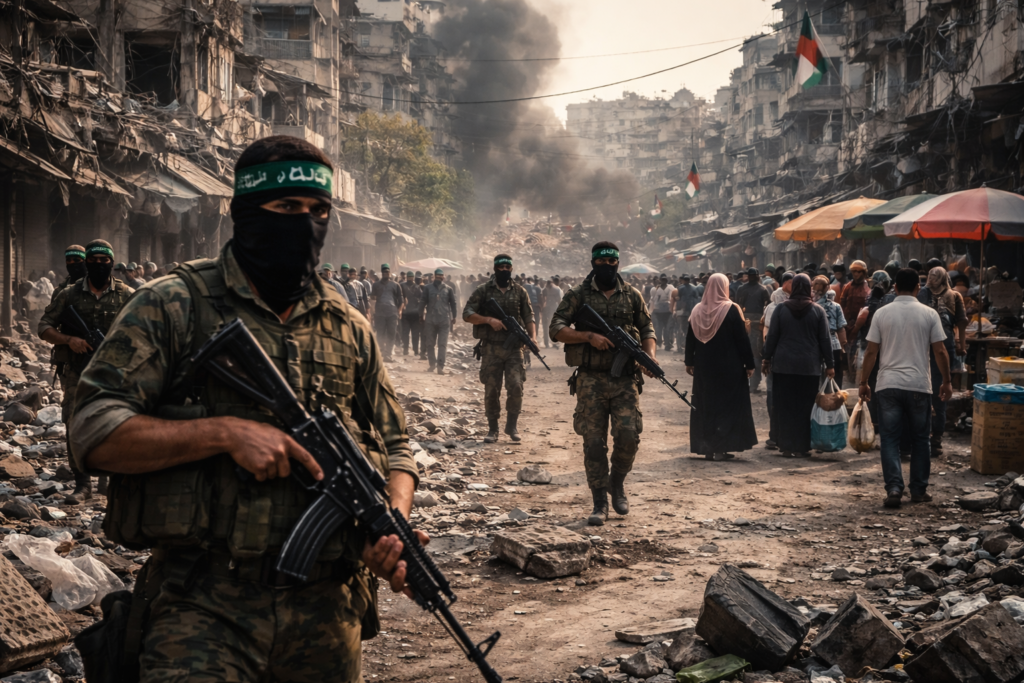
Image Credentials: Image Title: GAZA IN FLUX: HAMAS REASSERTS GRIP ON CIVILIAN LIFE AMID UNEASY CEASEFIRE Source: (sora.openai) Date: Feb 2026. Attribution: This image was created using AI-generated imagery (sora.openai) and does not depict a real-world scene.
THE OPEN CHRONICLE | Truth through time. Integrity in every word.
By Open Chronicle Staff | United States
GAZA CITY — In the vacuum left by withdrawing Israeli forces, a familiar power is re-emerging across the shattered landscape of the Gaza Strip. Despite months of conflict and international efforts to install a new governing body, Hamas has begun reasserting control over the essential levers of daily life, from market regulation to civil policing.
The resurgence comes at a delicate moment for the region. While the U.S.-sponsored ceasefire, endorsed by the UN Security Council in November, stipulates a transition to a technocratic governing committee, the reality on the ground remains firmly tethered to the existing Hamas infrastructure.
Police Return to the Streets
In Gaza City and Khan Yunis, uniformed and armed police officers have once again become a common sight at major intersections, hospital entrances, and government buildings. With many official precincts reduced to rubble by air strikes, the force has adapted, with units reportedly operating out of temporary tents to direct traffic and maintain public order.
“We are a police force that carries out the government’s instructions,” a police captain in Gaza City told reporters, speaking on the condition of anonymity. While expressing a willingness to assist any incoming government not “affiliated with the occupation,” the officer’s presence underscores a stark reality: Hamas remains the only organized entity capable of enforcing law in the immediate term.
The Economic Engine
For the more than two million Palestinians living in the territory, the return of Hamas is most visible in the marketplace. As the holy month of Ramadan begins, the Hamas-run Ministry of Economy has resumed publishing daily price lists and collecting taxes.
“The one controlling everything in Gaza’s economy is Hamas,” said Samir Abu Adnan, a 41-year-old merchant. “The police and ministries are still affiliated with them.”
This economic control presents a significant hurdle for President Trump’s “Board of Peace,” which recently announced plans for a new transitional Palestinian police force. Traders and residents alike suggest that the 15-member technocratic committee formed to handle day-to-day governance cannot function without the implicit approval or cooperation of Hamas, which still commands an estimated 20,000 fighters.
A Divided Territory
Since the ceasefire took effect on October 10, Gaza has been split by a “Yellow Line.” Israeli military forces remain in control of just over half of the territory, while Hamas manages the administration in the remaining areas.
The transition to “Phase Two” of the peace plan, which requires Hamas to disarm and hand over total administration, appears stalled. While Hamas leaders have pledged they no longer wish to administer the territory they have held for nearly two decades, they have yet to lay down their arms, insisting on terms that Israel has thus far rejected.
The Road Ahead
For the displaced families living in tent cities, the political maneuvering in Washington and Doha feels distant compared to the struggle for survival. “The committee faces a long and difficult road because Hamas controls the levers of life in Gaza,” noted Amani Ashtiwi, a teacher currently living in a tent.
As the international community pledges troops for a nascent stabilization force, the question remains whether a technocratic body can ever truly take root in soil where Hamas’s influence remains so deeply embedded.