
THE OPEN CHRONICLE | Truth through time. Integrity in every word.
By Open Chronicle Staff | United States
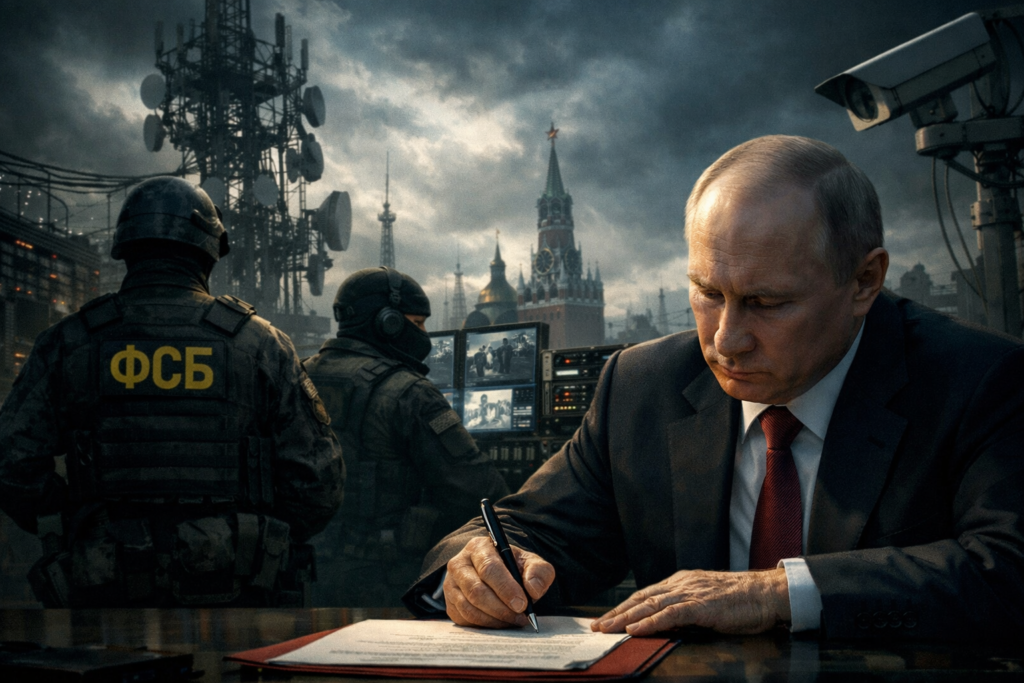
MOSCOW — In a move that legal experts say effectively places a “kill switch” on the Russian internet, President Vladimir Putin signed a sweeping new law on Friday granting the Federal Security Service (FSB) the authority to compel telecommunications operators to disconnect services on demand.
The legislation, which sailed through the State Duma earlier this week, mandates that operators must sever communication lines whenever the FSB deems it necessary for “security requirements.” Crucially, the law provides a total legal shield for these companies, stating that operators will not be held liable for outages or breaches of contract if the shutdown was ordered by the security services.
Counter-Terrorism or Total Censorship?
The Kremlin has framed the measure as an essential tool for counter-terrorism and national security. According to an explanatory note accompanying the bill, the law is intended to protect areas under the FSB’s direct responsibility and to prevent the coordination of extremist activities.
However, human rights advocates and digital privacy groups warn that the law’s vague language, leaving the specific “cases” for disconnection to be defined by future presidential regulations, opens the door for the localized or national suppression of dissent. By removing liability for operators, the state has eliminated the final commercial incentive for companies to push back against arbitrary shutdown orders.
The Growing “Digital Iron Curtain”
This move is the latest in a series of escalations aimed at tightening the Kremlin’s grip on the flow of information. It follows recent allegations by Russian officials that messaging platforms like Telegram have been used to harvest data on military and government personnel for “sabotage and terrorism.”
The law also comes at a time of increased domestic pressure. As the conflict in Ukraine drags on and international tensions with the U.S. reach a fever pitch, the ability to rapidly “black out” specific regions could be used to mask military movements or stifle the spread of information regarding civil unrest.
A Shield for the Secret Police
By institutionalizing the relationship between the FSB and private telecom firms, Putin has effectively integrated the nation’s digital infrastructure into the state’s security apparatus. Analysts suggest that the lack of operator liability is the most chilling aspect of the bill, as it ensures that the economic consequences of a digital blackout will be borne solely by the Russian citizenry and business community, rather than the providers or the state.
As the law takes effect, the international community watches with concern, noting that the “Digital Iron Curtain” descending over Russia is no longer just a metaphor, but a statutory reality.