
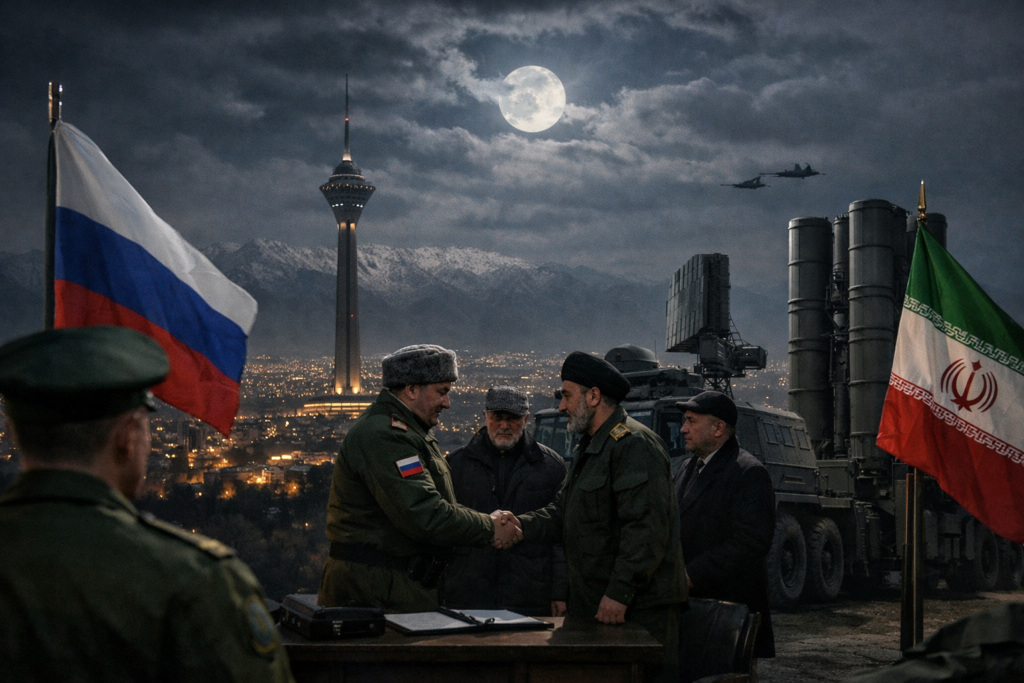
Image Credentials: Image Title: Shadows Over Tehran: Iran Inks Secret $500M Arms Pact with Moscow to Bolster Air Defenses Source: (sora.openai) Date: Feb 2026. Attribution: This image was created using AI-generated imagery (sora.openai) and does not depict a real-world scene.
By Open Chronicle Staff with Agencies
TEHRAN – In a move that signals a deepening military alliance between the Kremlin and the Islamic Republic, Iran has reportedly signed a clandestine $500 million arms agreement with Russia. The deal, aimed at urgently restoring and upgrading Iran’s aging air defense capabilities, comes amid heightened regional tensions and a shifting geopolitical landscape.
The secret contract, first brought to light by intelligence sources and regional monitors, underscores Tehran’s reliance on Russian technology to shield its critical infrastructure from potential aerial threats. While neither Moscow nor Tehran has officially confirmed the specifics of the pact, the deal is believed to focus on the procurement of advanced radar systems, surface-to-air missile components, and technical support for the existing S-300 and S-400 platforms.
A Strategic Shield
The urgency of the deal follows several high-profile security breaches and “sabotage” incidents within Iranian territory over the past year. Military analysts suggest that Iran’s current air defense grid, a patchwork of domestic systems and older Russian exports, is increasingly viewed as insufficient against the sophisticated electronic warfare and stealth capabilities of its regional adversaries.
“This is not just about hardware; it’s about survival for the Iranian military leadership,” said a Middle East security analyst who requested anonymity. “By securing a half-billion-dollar commitment from Moscow, Tehran is attempting to close the ‘open windows’ in its airspace that have left it vulnerable to precision strikes.”
Moscow’s Growing Influence
For Russia, the deal represents more than a financial windfall. In the face of Western sanctions, the Kremlin has increasingly leaned on its partnership with Iran, which has reportedly supplied Russia with “Shahed” drones for use in the conflict in Ukraine. This new arms deal appears to be a reciprocal gesture, cementing a “defense for defense” exchange that bypasses international oversight.
The infusion of Russian military technology into Iran is expected to draw sharp criticism from Washington and Brussels. Western officials have long warned that a fortified Iranian defense capability could embolden Tehran’s regional proxy activities and complicate diplomatic efforts regarding its nuclear program.
Regional Implications
The deal has already sent ripples through neighboring capitals. Intelligence reports suggest that the new equipment could be deployed near sensitive sites, including the Natanz and Fordow nuclear facilities.
While the $500 million price tag is significant, experts believe it is only the first phase of a broader multi-billion-dollar modernization program. As the components begin to arrive via Caspian Sea routes, the balance of power in Middle Eastern skies faces its most significant shift in a decade.
For now, both nations remain tight-lipped, maintaining a veil of “strategic ambiguity” as they move forward with a partnership that continues to reshape global security dynamics.