
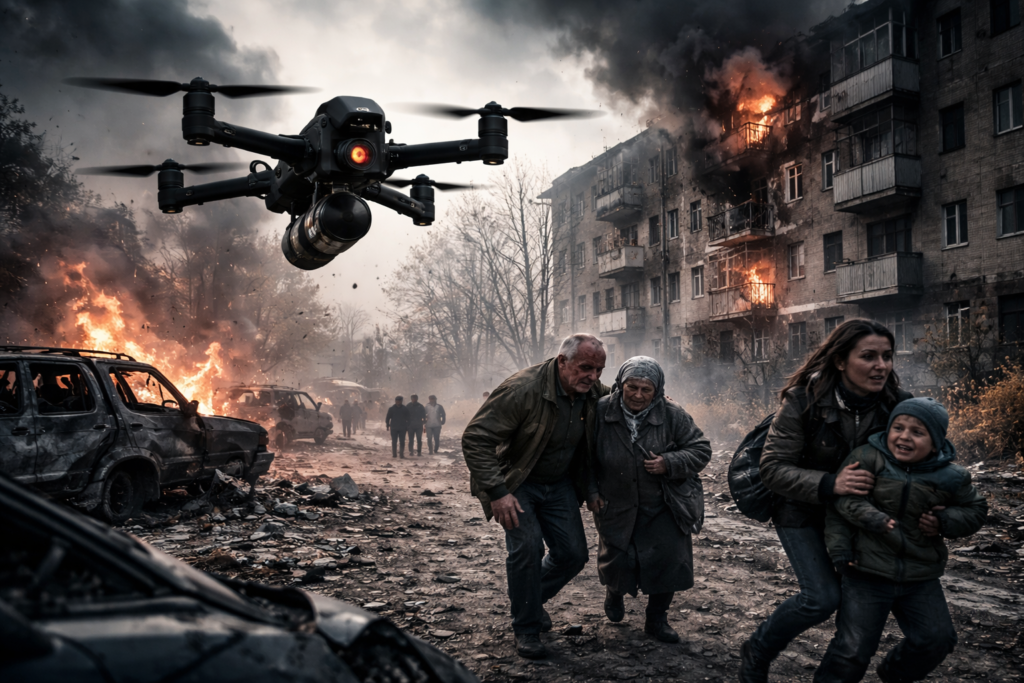
Image Credentials: Image Title: Terror from Above: The Relentless Toll of Russian ‘First-Person View’ Drones on Ukrainian Civilians Source: (sora.openai) Date: Feb 2026. Attribution: This image was created using AI-generated imagery (sora.openai) and does not depict a real-world scene.
By Open Chronicle with Agencies
KYIV — As the war in Ukraine enters its fifth year, a terrifying new evolution in aerial warfare is transforming daily life into a gauntlet of survival. Beyond the headlines of front-line maneuvers and cruise missile strikes, a more intimate and persistent threat has emerged: the First-Person View (FPV) drone.
A recent investigative report highlights a chilling shift in Russian tactics. Once used primarily for reconnaissance or targeting military hardware, these small, agile, and inexpensive drones are increasingly being deployed against non-combatants in cities and villages near the contact line.
“They Hunt Us Like Animals”
For residents in frontline regions like Kherson and Kharkiv, the buzzing of a drone is no longer a distant annoyance; it is a signal to run. Unlike traditional artillery, which is fired at coordinates, FPV drones are piloted in real-time by operators who see exactly what the drone sees through specialized goggles.
“They can see if you are a soldier or a grandmother carrying groceries,” says Olena, a resident of a village near the Dnipro River. “They hover, they wait, and then they strike. It feels personal. They hunt us like animals.”
Human rights monitors and local officials have documented numerous instances where these “kamikaze” drones have targeted civilian cars, public transport, and even individuals walking in open streets. The precision of the technology means these strikes are rarely accidental; they represent a calculated effort to demoralize the population and make life near the front untenable.
The Low-Cost Weapon of Terror
The proliferation of FPV drones is driven by their cost-effectiveness. Assembling a lethal drone can cost as little as $400, utilizing off-the-shelf components. For Russian forces, this provides a “high-precision” weapon without the price tag of a Kalibr missile.
Military analysts note that as electronic warfare systems become more prevalent on the battlefield, operators on both sides are pushed to find gaps in coverage. Tragically, these gaps are often found in residential sectors where jamming equipment is sparse. The result is a “gray zone” of terror where any movement outdoors carries the risk of a targeted explosion.
A Psychological Scar
The impact is not merely physical. Psychologists working in Ukraine describe a “perpetual state of hyper-vigilance” among survivors. The sound of a common weed-whacker or a moped can now trigger panic attacks in children and the elderly.
“The drone is a psychological weapon as much as a kinetic one,” says Dr. Viktor Pavlov, a trauma specialist. “The knowledge that someone is watching you through a camera lens before they decide to kill you creates a unique level of trauma that we will be dealing with for generations.”
As the international community debates the provision of advanced air defense systems, the people of Ukraine continue to scan the skies for a threat that is small, loud, and increasingly lethal.