
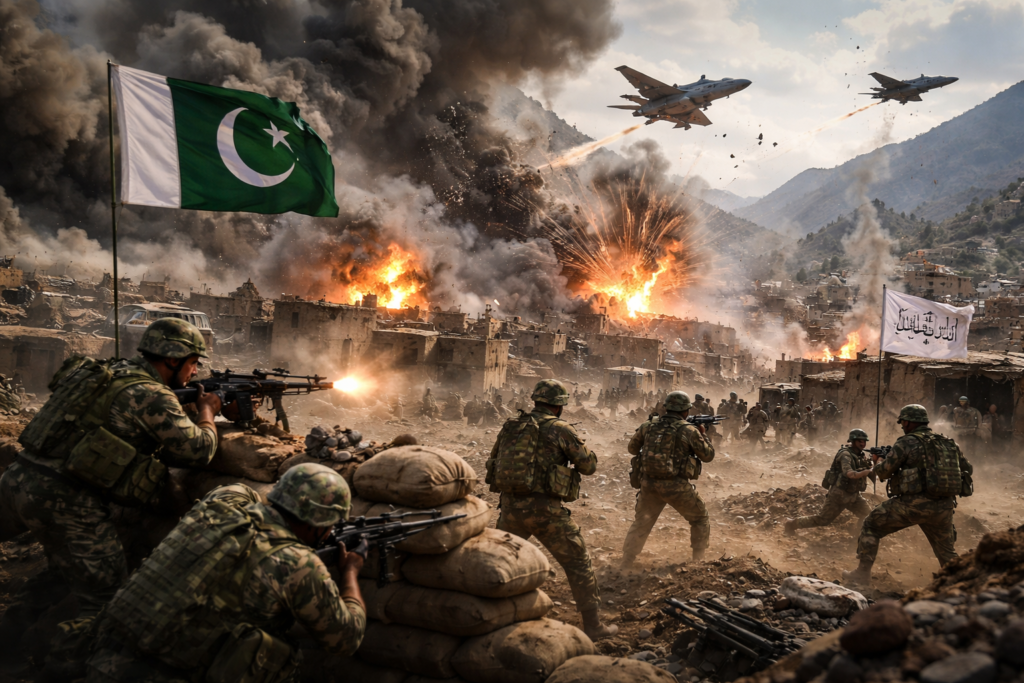
Image Credentials: Image Title: Brink of Total Conflict: Pakistan and Afghanistan Enter “Open War” After Massive Airstrikes Source: (sora.openai) Date: Feb 2026. Attribution: This image was created using AI-generated imagery (sora.openai) and does not depict a real-world scene.
By The Open Chronicle Staff with Agencies
ISLAMABAD / KABUL — The long-simmering tensions along the Durand Line have finally boiled over into what Islamabad is now officially calling a state of “open war.” In a dramatic and deadly escalation overnight, the Pakistan Air Force (PAF) launched widespread airstrikes across Afghanistan, targeting major urban centers including the capital, Kabul, and the Taliban stronghold of Kandahar.
The declaration of “Operation Ghazab Lil Haq” (Wrath for the Truth) marks a historic shift in regional dynamics, moving from decades of proxy skirmishes to direct, conventional military confrontation between the two neighbors.
Midnight Strikes and “Wrath for the Truth”
The assault began in the early hours of Friday, February 27, 2026. According to the Pakistani Ministry of Information, the operation targeted 22 high-value military installations, including brigade headquarters and ammunition depots.
“Our patience has reached its limit,” stated Pakistani Defense Minister Khawaja Asif in a stark announcement on social media. “Now it is open war between us. We will no longer tolerate the export of terrorism from Afghan soil.”
The strikes were reportedly a response to an Afghan cross-border offensive on Thursday night, which Kabul claimed was itself a retaliation for earlier Pakistani drone strikes on militant camps. Witnesses in Kabul described a night of terror as jets screamed overhead and explosions rocked the Darul Aman locality.
Conflicting Casualty Reports
As the fog of war settles, both nations have issued vastly different accounts of the devastation:
-
Pakistan’s Claims: Islamabad reports that over 270 Taliban officials and militants were killed, and nearly 30 Afghan military posts were destroyed or captured. They acknowledge the loss of 12 Pakistani soldiers.
-
Afghanistan’s Claims: The Taliban government’s spokesperson, Zabihullah Mujahid, dismissed Pakistan’s figures as “false propaganda.” Kabul claims its forces killed 55 Pakistani soldiers and captured several alive, while reporting only 13 of its own soldiers and 13 civilians killed in the airstrikes.
A Region on the Edge
The conflict stems from Islamabad’s long-standing accusation that the Afghan Taliban provides sanctuary to the Tehreek-e-Taliban Pakistan (TTP), a militant group responsible for a recent surge of suicide bombings in Pakistani cities. Kabul has consistently denied these allegations, calling the TTP a “homegrown Pakistani problem.”
International reaction has been swift and filled with alarm. The UN Secretary-General has called for an immediate cessation of hostilities, while regional powers like Saudi Arabia and Qatar are reportedly working behind the scenes to broker an emergency ceasefire.
With both nations possessing significant conventional firepower—and Pakistan being a nuclear-armed state, the stakes for the “open war” could not be higher. For now, the “Great Game” has turned into a bloody reality for millions living on either side of the border.