
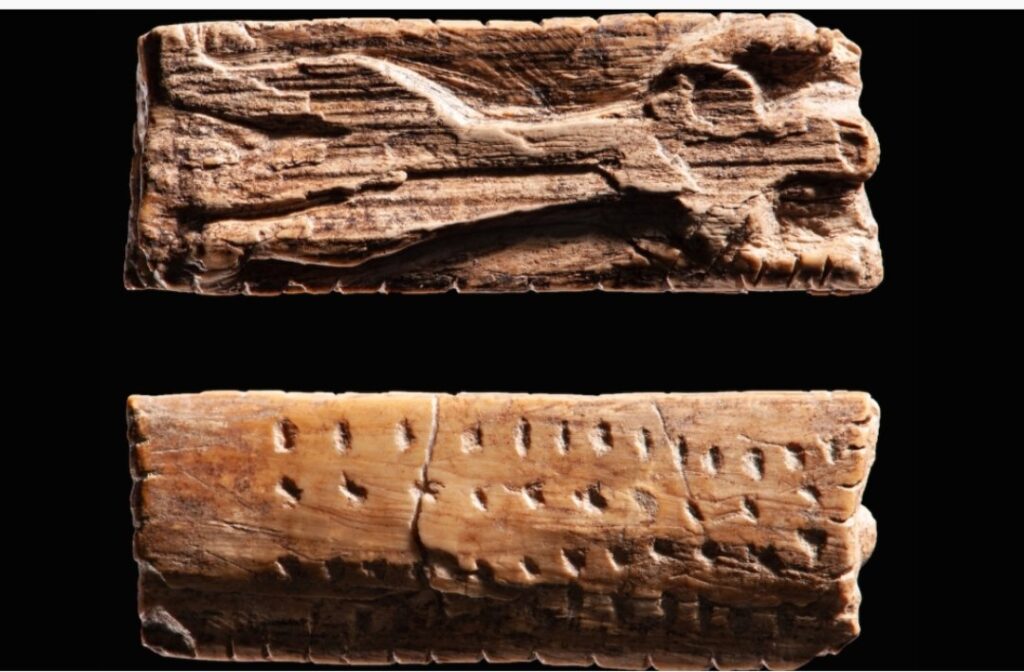
Image: from Bruce R. Fenton X @GenomicSETI
By The Open Chronicle History
ARCHAEOLOGY DESK — For decades, the history of human civilization has been anchored to a specific milestone: the emergence of cuneiform script in Mesopotamia around 3,200 BCE. However, a groundbreaking perspective on human cognitive evolution is shifting that timeline by tens of millennia. New research suggests that the fundamental “blueprints” of writing, structured sequences of symbols used to convey meaning, may actually date back as far as 40,000 years.
The focal point of this revelation is “The Adorant,” a 38,000-year-old ivory plaque discovered in Germany. While long admired as a piece of Paleolithic art depicting a lion-human hybrid, closer inspection has revealed something more profound: a series of intentional notches and dots.
38,000-year old proto-writing, contrasted with proto-cuneiform, has been identified on the Adorant figurine from Geißenklösterle Cave.
This small ivory artefact with a lion-man figure includes multiple sequences of notches and dots, claimed to be a primitive system of notation. pic.twitter.com/ZFDjhOC3DB
— Bruce R. Fenton (@GenomicSETI) February 24, 2026
According to experts, these markings are not merely decorative. They represent a sophisticated attempt by early humans to record information, possibly tracking lunar cycles, hunting tallies, or social rituals.
“Even if we don’t know exactly what they meant, we know they had meaning for those who made them,” researchers noted. This distinction is critical; it suggests that the cognitive leap required for writing, the ability to represent abstract thought through physical symbols, was made by our ancestors during the Ice Age, long before the rise of the first cities.
While these ancient markings do not constitute a “complete” writing system like the alphabet we use today, they are now being recognized as “proto-writing.” These systems provided the essential mathematical and symbolic foundation upon which the Sumerians eventually built their scripts.
As we look at the notches on a piece of ivory from 40,000 years ago, we aren’t just looking at art; we are looking at the very first pages of human history.