
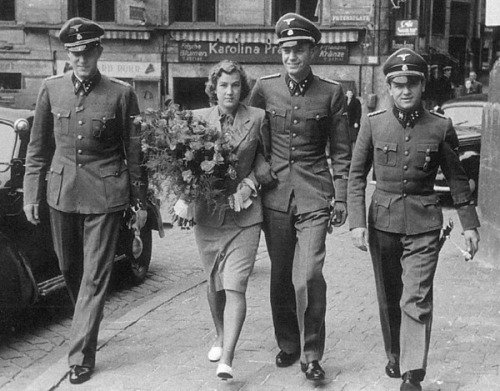
Image: from Historia Fotografią Pisana X @Jan34733995
By Open Chronicle History Desk
BERLIN — History remembers Adolf Hitler as the architect of the 20th century’s greatest horrors. Yet, for nearly sixty years, a different, more unsettlingly “human” portrait of the dictator remained locked away in the memory of a woman who sat just feet away from him as the Third Reich crumbled.
Traudl Junge, who became Hitler’s youngest private secretary at age 22, was the woman tasked with typing his final will in the suffocating depths of the Führerbunker. Before she died in 2002, her memoirs and interviews revealed a side of Hitler that few had ever seen, a “pleasant boss” and “fatherly friend” whose mundane domesticity served as a chilling mask for his monstrous deeds.
09.06.1945 r. – zostaje aresztowana przez Sowietów Gertruda "Traudl" Junge, z domu Humps, sekretarka w Osobistej Adiutanturze Führera od 1942 do 1945.
Nigdy nie zostały jej postawione żadne zarzuty. pic.twitter.com/XXKJkKAIDr
— Historia Fotografią Pisana (@Jan34733995) June 9, 2024
The “Bourgeois” Dictator
Junge’s most striking revelations centered on the bizarrely ordinary nature of Hitler’s private life. Behind the fiery orator was a man of rigid, almost boring habits.
-
The Night Owl: Hitler kept a “vampire-like” schedule, often sleeping until noon and forcing his staff to stay awake until 2:00 or 3:00 AM for nightly tea parties.
-
The Vegetarian Preacher: A strict vegetarian, Hitler often spent mealtimes recounting gruesome stories from abattoirs to discourage his guests from eating meat.
-
The “Corpse” Aversion: Junge noted that Hitler disliked cut flowers, famously stating he did not want to be “surrounded by corpses.”
-
Paternal Charm: To his immediate staff, he was often kind and soft-spoken. He even acted as a matchmaker, encouraging Junge to marry SS officer Hans Hermann Junge in 1943.
Blindness in the Gilded Bubble
One of the most controversial aspects of Junge’s testimony was her claim of total ignorance regarding the Holocaust while working at the heart of the Nazi regime. She described her life as living in a “gilded bubble” where the word “Jew” was practically never mentioned in her presence.
“I admit, I was fascinated by Adolf Hitler,” she confessed in her later years. “He was a pleasant boss… I deliberately ignored all the warning voices inside me.” This “blind spot” became the title of a famous documentary about her life, highlighting the terrifying ease with which charisma can mask systemic evil.
The Final Act: Typing the End
In late April 1945, as Soviet shells thundered above the Berlin bunker, Hitler summoned Junge to type his final political and private testament. She recalled a man who had become a “pasty creature,” his hands trembling and his speech faltering.
While the world above burned, Hitler remained obsessed with his legacy, using his final document to blame “international Jewry” for the war and to denounce his closest allies, Himmler and Göring, as traitors. Shortly after the typing was complete, Hitler and his new wife, Eva Braun, committed suicide. Junge was one of the last to see their bodies before they were burned in the Chancellery garden.
A Legacy of Guilt
Traudl Junge spent the final decades of her life grappling with a profound sense of “unforgiving compunction.” Unlike many who claimed they were merely “following orders,” Junge’s later reflections were marked by a refusal to indulge in self-pity.
“Now that I’ve let go of my story, I can let go of my life,” she told filmmakers just hours before passing away from cancer at age 81. Her story remains a vital, haunting reminder that the greatest villains of history do not always appear as monsters in their own hallways.
Timeline: The Secretary’s Journey
-
1942: Traudl (then Gertraud Humps) is hired at the Wolf’s Lair.
-
1943: Marries Hans Hermann Junge at Hitler’s encouragement.
-
April 29, 1945: Types Hitler’s last will.
-
1947: Writes her initial memoirs (not published until 2002).
-
2002: The documentary Blind Spot premieres; Junge dies in Munich.
References
- Junge, Traudl, and Melissa Müller. Until the Final Hour: Hitler’s Last Secretary. Edited by Melissa Müller. Translated by Anthea Bell. London: Weidenfeld & Nicolson, 2002.
- Heller, André, and Othmar Schmiderer, dirs. Blind Spot: Hitler’s Secretary (Im toten Winkel). Sony Pictures Classics, 2002. Film.
- The Guardian. “Traudl Junge: Obituary and Final Interview Highlights.” February 14, 2002. https://www.theguardian.com/news/2002/feb/14/guardianobituaries.humanities.
- Cheema, Rayyan. “What Were the Secrets of Hitler That Were Revealed by His Secretary After His Death?” Quora, 2025. https://www.quora.com/profile/Rayyan-Cheema-6/What-were-the-secrets-of-Hitler-that-were-revealed-by-his-secretary-after-his-death.