
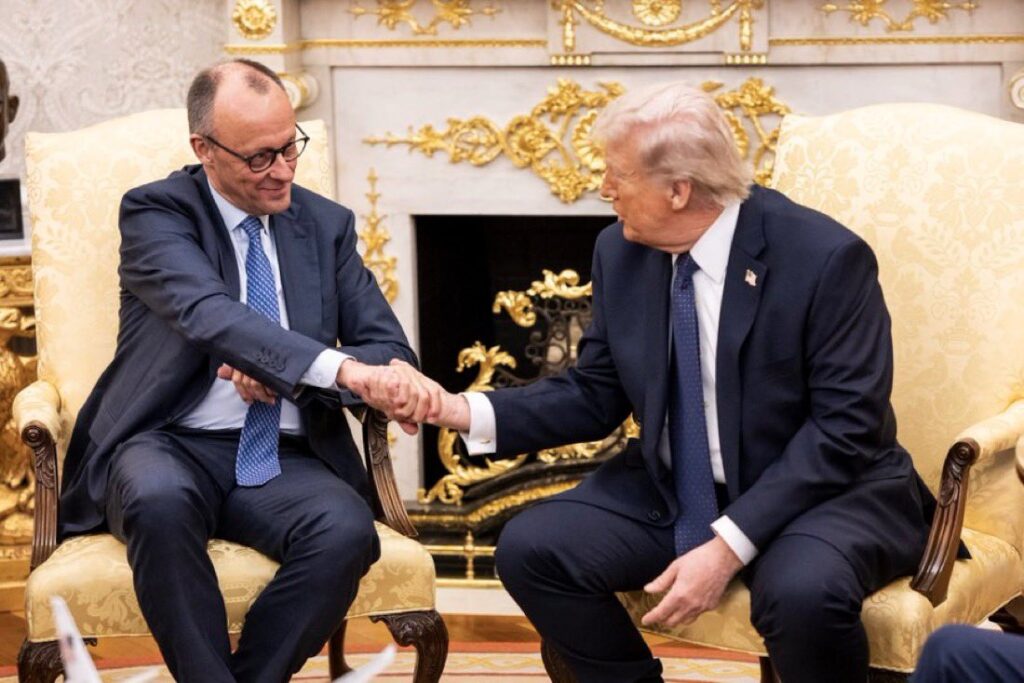
Image: from MünzenMeister X @MuenzenMeister
WASHINGTON D.C. — German Chancellor Friedrich Merz arrived at the White House on Tuesday with a heavy economic agenda, seeking to de-escalate the burgeoning conflict in the Middle East and find relief from the aggressive tariff policies of the Trump administration.
The meeting in the Oval Office took place against a backdrop of global market instability. Following U.S.-Israeli airstrikes on Iran that began Saturday, retaliatory strikes have effectively shuttered the Strait of Hormuz, a critical artery for global energy. The resulting supply shock triggered the largest one-day spike in U.S. oil prices since 2005, sending stock markets into a tailspin.
The Toll of the “Strait Stalemate”
Chancellor Merz expressed grave concerns over the mounting cost of the war, noting that the economic ripples are being felt acutely across Europe and the Atlantic.
“This is true for the oil prices, and this is true for the gas prices, as well,” Merz told reporters, emphasizing the need for the conflict to conclude “soon” to stabilize the global economy.
President Trump, however, remained optimistic that the market volatility is a short-term hurdle. “As soon as this ends, those prices are going to drop, I believe, lower than even before,” the President countered, suggesting that a decisive conclusion to the military action would eventually lead to an energy surplus.
German Chancellor Merz flies to meet Trump
He is worried that the Iran war will cut off most oil and gas supplies to Germany and divert attention from the Ukraine war?
Possible pic.twitter.com/qvX7g5fPUp
— Lord Bebo (@MyLordBebo) March 2, 2026
Tariffs and the “Rich” Nation Doctrine
Beyond the immediate threat of war, Merz entered the meeting hoping to leverage a recent U.S. Supreme Court ruling against the administration’s sweeping tariffs to gain breathing room for German industry. Sources close to the Chancellor indicated that easing trade pressure on Germany was a top priority, alongside pressuring Washington for tougher sanctions on Russia to force an end to the war in Ukraine.
The President showed little sign of pivoting on his “America First” trade stance. Boasting that “tariffs have made our country very rich,” Trump openly admitted to hitting Germany “very, very hard” with import duties.
A New Trade Front: Spain
The summit also served as the stage for a dramatic shift in Mediterranean diplomacy. Citing Spain’s refusal to support U.S. military operations against Iran, President Trump announced a total severance of economic ties.
“I have instructed Treasury Secretary Scott Bessent to cut off all trade with Spain,” Trump stated, confirming a move that effectively isolates a key NATO ally. “We don’t want anything to do with Spain.”
The announcement leaves European leaders, including Merz, in a precarious position as they attempt to balance traditional alliances with the reality of an increasingly transactional U.S. foreign policy.