
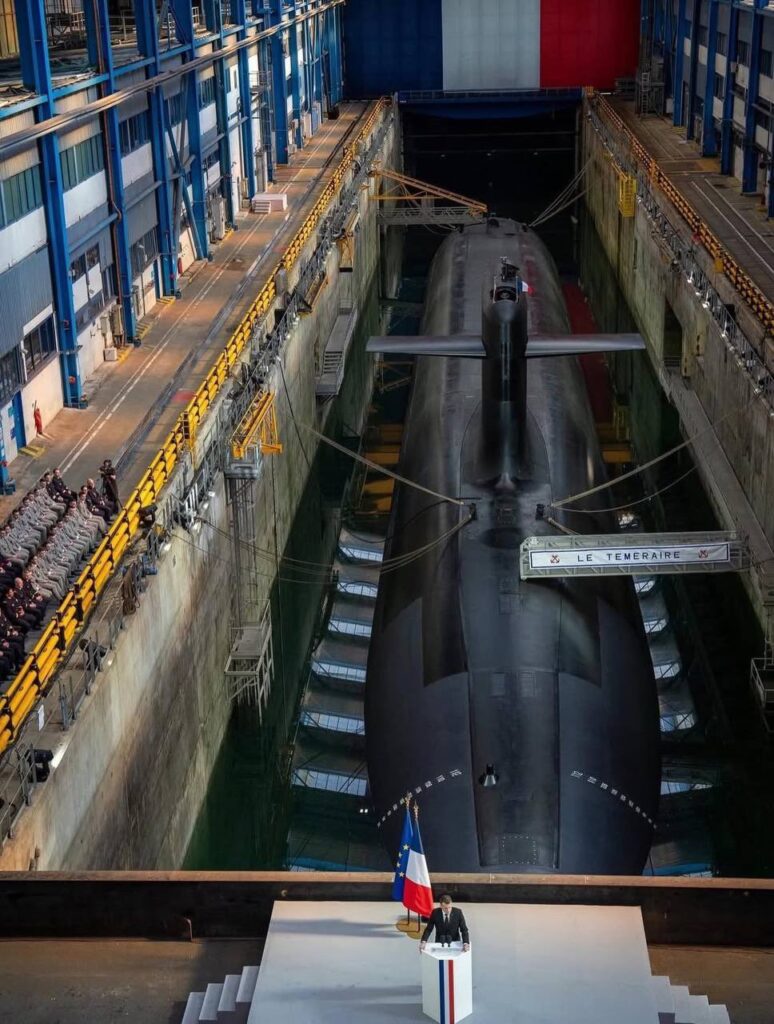
Image: from Prime X@nucleusprime
By Open Chronicle Staff with Agencies
Escalating military action in the Middle East is intensifying regional instability, as Israel launches new airstrikes on Tehran, a drone attack targets the US Embassy in Saudi Arabia, and Washington signals its campaign against Iran could last longer than initially projected. In Europe, France has announced a major shift in its nuclear posture.
Israeli Army Launches New Wave of Strikes in Tehran
The Israeli military announced a fresh wave of airstrikes targeting Iran’s capital, Tehran, striking multiple locations in the city center.
Among the reported targets were the site of the former parliament building and the complex of Iran’s state broadcaster. Before the attacks, Israeli forces warned residents of the Evin neighborhood to evacuate, particularly areas surrounding the state radio and television headquarters.
The escalation follows earlier joint US-Israeli operations against Iran’s nuclear infrastructure, including reported strikes on the Natanz facility, according to Iranian authorities.
Drone Attack Targets US Embassy in Riyadh
🚨 BREAKING: The US Embassy in Riyadh, Saudi Arabia was struck by TWO Iranian drones, but because it had already been evacuated, there were ZERO casuaIties
Another L for the Iranian regime. pic.twitter.com/73IZ0TnbPd
— Nick Sortor (@nicksortor) March 3, 2026
Saudi Arabia’s Defense Ministry said the US Embassy in Riyadh was struck by two drones, causing a limited fire and minor structural damage. No casualties were reported.
The attack comes amid ongoing Iranian missile and drone operations targeting US and allied assets across the Gulf in response to the initial US-Israeli offensive. Regional governments have heightened security as hostilities expand.
Trump Says Iran Operation Could Extend Beyond Initial Timeline
US President Donald Trump said the military campaign against Iran is expected to last four to five weeks but could continue longer if necessary.
Speaking at a White House event marking Operation Epic Fury, Trump said the duration of the offensive would depend on dismantling Iran’s conventional missile infrastructure, which he described as a rapidly growing threat.
The United States Central Command reported that six US service members have been killed in action since joint strikes began, while also acknowledging that three F 15E Strike Eagles were mistakenly shot down by Kuwaiti air defenses.
Macron Orders Expansion of France’s Nuclear Arsenal
🇫🇷 French President Macron:
"I have ordered an increase in the number of nuclear warheads in our arsenal. We will no longer disclose information about the size of our nuclear arsenal." pic.twitter.com/4suzA1DyNh
— Sprinter Press (@SprinterPress) March 2, 2026
French President Emmanuel Macron announced an increase in the number of nuclear warheads in France’s arsenal and said Paris will no longer publicly disclose the size of its stockpile.
Speaking at the Île Longue naval base, Macron described the move as part of a shift toward what he called advanced deterrence, arguing that a deteriorating global security climate requires a strengthened nuclear posture.
Regional Fallout Widens
Iran’s Islamic Revolutionary Guard Corps claimed the Strait of Hormuz has been closed to transit and warned that vessels attempting to cross could be attacked, raising alarm in global energy markets.
The IRGC also said it targeted US naval assets in Bahrain, Al Minhad Air Base in the United Arab Emirates, and a US base in Kuwait.
In Lebanon, at least 52 people were killed, and 154 were injured in Israeli airstrikes in Beirut and southern regions, according to authorities. Lebanese Prime Minister Nawaf Salam said his government has banned Hezbollah’s military and security activities and ordered the army to enforce state control over weapons north of the Litani River.
Turkish President Recep Tayyip Erdogan expressed sorrow over civilian suffering in Iran and said Türkiye would intensify diplomatic efforts for a ceasefire. He also discussed developments with NATO Secretary General Mark Rutte.
British Prime Minister Keir Starmer reiterated his decision not to involve the UK in bombing raids on Iran. China reaffirmed support for Tehran during a call between foreign ministers.
Israeli authorities kept Ben Gurion Airport closed and maintained restrictions on public gatherings as missile exchanges continued.
Business and Economic Impact
QatarEnergy suspended liquefied natural gas production after drone strikes targeted facilities in Mesaieed and Ras Laffan. Qatar’s Defense Ministry said two drones launched from Iran struck a water tank at a power plant and an energy installation belonging to QatarEnergy. No casualties were reported.
The disruption raises concerns about global LNG supply as tensions threaten shipping lanes and production infrastructure.
Separately, the Turkish Statistical Institute reported that Türkiye’s economy grew by 3.6 percent in 2025, with GDP reaching 63 trillion liras, or approximately 1.59 trillion dollars. Growth in the fourth quarter was recorded at 3.4 percent, reflecting steady expansion despite global uncertainty.
Rising Uncertainty
With escalating strikes, mounting casualties, and disruptions to critical energy infrastructure, the conflict between Iran and US-Israeli forces is reshaping regional alliances and global markets. As diplomatic efforts struggle to gain traction, the trajectory of the crisis remains uncertain, with security, economic, and geopolitical consequences unfolding rapidly.