
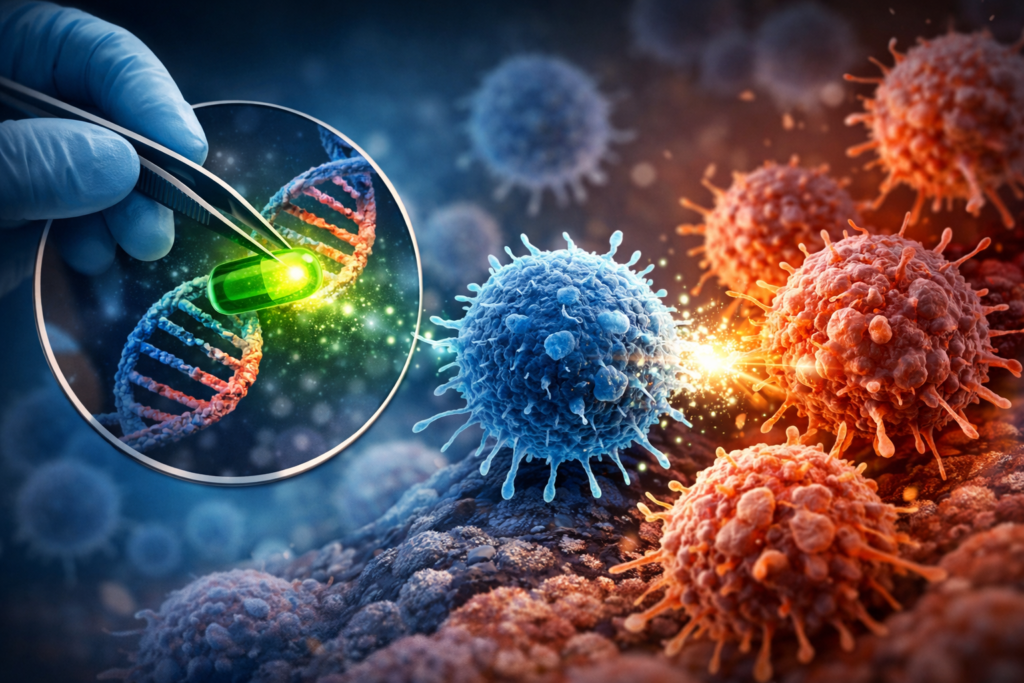
Image Credentials: Image Title: Scientists discover genetic switch that restores cancer-fighting power of immune cells Source: (sora.openai) Date: March 2026. Attribution: This image was created using AI-generated imagery (sora.openai) and does not depict a real-world scene.
By Open Chronicle Staff
Researchers have identified key genetic mechanisms that determine whether the immune system’s “killer” T cells remain powerful defenders against disease or become exhausted and ineffective. The discovery could open new pathways for improving cancer immunotherapy and treatments for chronic infections.
The study, published in the journal Nature, was led by scientists from the Salk Institute for Biological Studies in collaboration with the UNC Lineberger Comprehensive Cancer Center and the University of California, San Diego.
Mapping how immune cells lose their strength
The research focused on CD8 “killer” T cells, a crucial component of the immune system responsible for detecting and destroying virus-infected cells and cancer cells.
Under normal circumstances, these cells can provide long-term immune protection by remembering previous threats. However, during persistent infections or in the presence of tumors, they can gradually lose their effectiveness and enter a weakened state known as T cell exhaustion.
Once exhausted, the cells struggle to attack disease targets effectively, limiting the success of many immunotherapies.
To better understand how this process occurs, scientists built a detailed genetic “atlas” mapping different states of CD8 T cells. The atlas tracks how these immune cells move along a spectrum, ranging from highly protective cells to severely impaired ones.
Genetic switches that control immune cell fate
Using advanced laboratory techniques, genetic tools, mouse models, and computational analysis, researchers studied nine distinct CD8 T cell states.
Their analysis revealed several transcription factors, proteins that regulate gene activity, which function as molecular switches guiding T cells toward either sustained activity or exhaustion.
Among these regulators, scientists identified two genes that had not previously been linked to immune exhaustion: ZSCAN20 and JDP2.
When the researchers disabled these genes in laboratory experiments, exhausted T cells regained their ability to destroy tumors while still maintaining long-term immune memory.
The results challenge the long-standing assumption that immune exhaustion is an unavoidable consequence of prolonged immune activity.
A potential breakthrough for cancer immunotherapy
The findings could have major implications for treatments such as CAR T-cell therapy and Adoptive Cell Transfer, which rely on modifying immune cells to fight cancer more effectively.
Scientists say the genetic atlas developed in the study provides a roadmap that could help researchers design stronger and longer-lasting immune cells for therapy.
This may be particularly important for treating solid tumors, where immune exhaustion often reduces the effectiveness of current treatments.
AI could help design next-generation immune cells
The research team plans to combine experimental biology with artificial intelligence-driven computational modeling to better understand the complex genetic networks that control immune cell behavior.
By identifying additional molecular “recipes” for guiding T cells into specific functional states, scientists hope to develop more precise cellular therapies that remain effective for longer periods.
The discovery represents a step toward a future in which immune responses can be deliberately engineered, allowing researchers to prevent immune cells from burning out while preserving their ability to fight cancer and infection over the long term.
Story Source:
Materials provided by Salk Institute. Note: Content may be edited for style and length.
Journal Reference:
- H. Kay Chung, Cong Liu, Anamika Battu, Alexander N. Jambor, Brandon M. Pratt, Fucong Xie, Brian P. Riesenberg, Eduardo Casillas, Ming Sun, Elisa Landoni, Yanpei Li, Qidang Ye, Daniel Joo, Jarred Green, Zaid Syed, Nolan J. Brown, Matthew Smith, Shixin Ma, Shirong Tan, Brent Chick, Victoria Tripple, Z. Audrey Wang, Jun Wang, Bryan Mcdonald, Peixiang He, Qiyuan Yang, Timothy Chen, Siva Karthik Varanasi, Michael LaPorte, Thomas H. Mann, Dan Chen, Filipe Hoffmann, Josephine Ho, Jennifer Modliszewski, April Williams, Yusha Liu, Zhen Wang, Jieyuan Liu, Yiming Gao, Zhiting Hu, Ukrae H. Cho, Longwei Liu, Yingxiao Wang, Diana C. Hargreaves, Gianpietro Dotti, Barbara Savoldo, Jessica E. Thaxton, J. Justin Milner, Susan M. Kaech, Wei Wang. Atlas-guided discovery of transcription factors for T cell programming. Nature, 2026; DOI: 10.1038/s41586-025-09989-7