
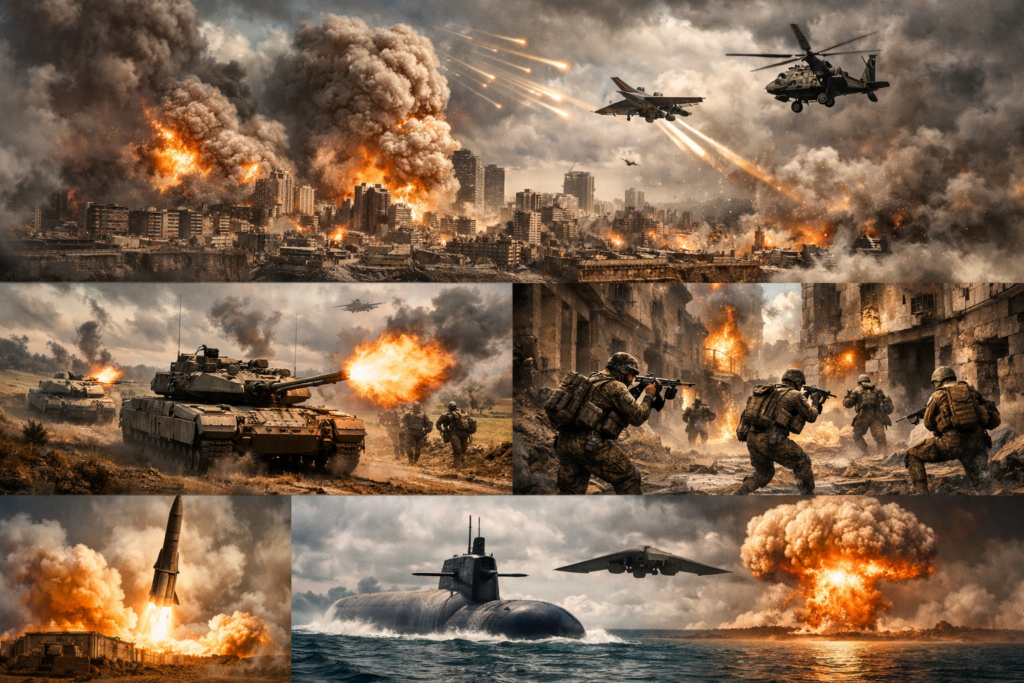
Image Credentials: Image Title: One Week of Fury: Overwhelming Force, Vanishing Endgames Source: (sora.openai) Date: March 2026. Attribution: This image was created using AI-generated imagery (sora.openai) and does not depict a real-world scene.
By Open Chronicle Staff
The first seven days of the joint U.S.-Israeli military campaign against Iran have delivered a masterclass in modern kinetic warfare, paired with a profound lesson in the limits of decapitation strategies. While the coalition has successfully leveled the upper echelons of Iranian power, including the killing of Supreme Leader Ayatollah Ali Khamenei, the absence of a coherent political “exit ramp” has left the region bracing for a prolonged and unpredictable conflagration.
The war began with a surgical strike on a government compound in central Tehran that fundamentally altered the Persian Gulf’s geopolitical landscape. The blasts eliminated not only the hardline clerical leadership but also a subset of pragmatic officials whom the White House had privately identified as potential peace brokers. This “success” has ironically left the Trump administration with no one to talk to.
A Campaign of Contradictions
President Trump’s rhetoric throughout the week has shifted as rapidly as the flight paths of the F-35s over Tehran. After initially calling for a popular uprising that failed to materialize, the President pivoted to suggesting he would personally hand-pick Iran’s next leader. By Saturday, his tone darkened further, warning on social media that “areas and groups of people” that had previously been off-limits could soon be targeted.
This shifting narrative has “whipsawed” a skeptical American public. Domestic polls indicate broad opposition to the conflict, fueled by a 27-cent jump in gas prices following Iranian strikes on regional energy infrastructure.
The Military Toll
The Pentagon reports the first week’s price tag at approximately $6 billion. Despite the cost, military officials tout overwhelming results:
-
Targeting: Over 4,000 strikes have been conducted using AI-assisted target selection.
-
Neutralization: Iran’s ballistic missile launches are down 90%, and drone activity has dropped by 83%.
-
Naval Dominance: Much of the Iranian Navy has been neutralized, including a historic submarine torpedo strike on an enemy vessel.
However, the human cost has been stark. A strike on an elementary school in Minab killed 175 people, mostly children. While no party has claimed responsibility, independent analysis points toward American munitions.
“Operation Madman”
Tehran’s response has followed a pre-planned contingency known as “Operation Madman.” Designed by the late Ayatollah Khamenei to be triggered upon his death, the strategy seeks to set the Middle East “aflame.”
By targeting the Strait of Hormuz and energy hubs in Qatar and Saudi Arabia, Iran has successfully weaponized global markets. Proxies like Hezbollah have joined the fray, though reports from Beirut suggest the Lebanese public is increasingly weary of a war that offers them nothing but displacement.
The Power Vacuum
Inside the White House, the mood is one of “scrambling.” With the intended “negotiating partners” dead in the initial salvos, the administration is now demanding an “unconditional surrender” from a government that, while battered, remains defiant.
“The attack was so successful it knocked out most of the candidates,” President Trump remarked Sunday, acknowledging the unintended consequence of his own military’s efficiency. As the second week begins, the question remains: Can a war be won if there is no one left to sign the surrender?