
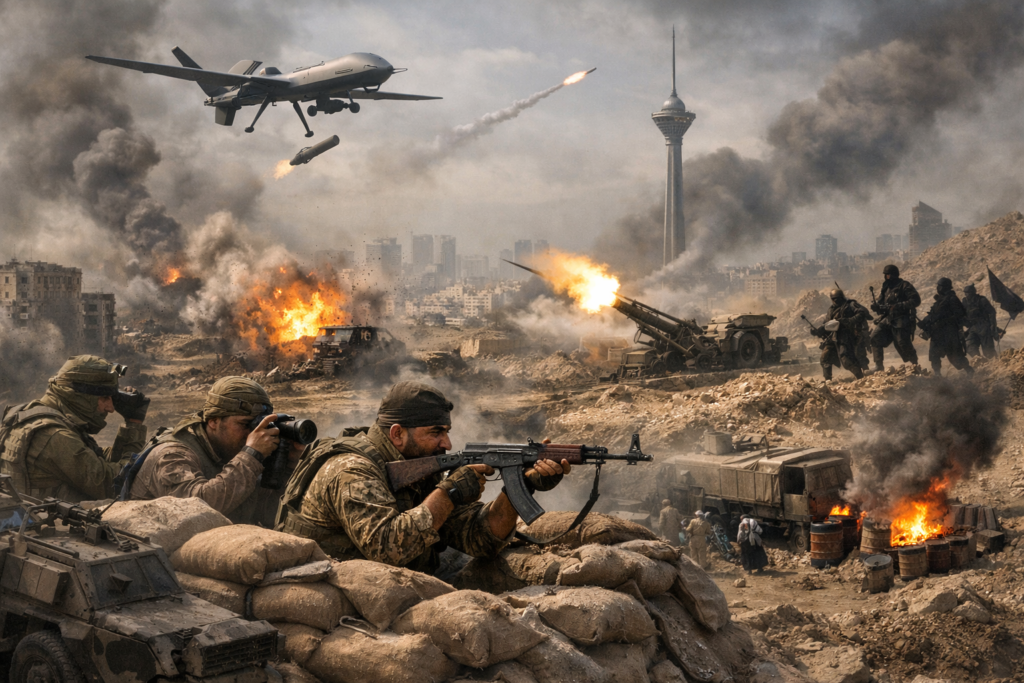
Image Credentials: Image Title: ENDURANCE OVER ENGINES: TEHRAN PIVOTS TO ‘WAR OF ATTRITION’ ON MULTIPLE FRONTS Source: (sora.openai) Date: March 2026. Attribution: This image was created using AI-generated imagery (sora.openai) and does not depict a real-world scene.
By Open Chronicle Staff with Agencies | March 11, 2026
PARIS / TEHRAN — As the conflict sparked by “Operation Epic Fury” enters its second week, military analysts and European observers warn that Iran has moved past the initial shock of its leadership losses and is now settling into a calculated strategy of a “war of attrition” designed to bleed the resources and political resolve of the West.
Reports from France 24 suggest that while the U.S. and Israel possess overwhelming conventional superiority, the Iranian military apparatus is intentionally shifting the battlefield toward asymmetric and economic pressure points. This strategy seeks to draw Washington and its allies into a prolonged, costly struggle that erodes political capital and destabilizes global markets.
THE GEOGRAPHIC SPREAD
Tehran’s “several fronts” strategy is becoming increasingly visible across the region:
-
The Maritime Front: The continued closure of the Strait of Hormuz has essentially held 20% of the world’s oil supply hostage. The recent strikes on cargo vessels by “unknown projectiles” serve as a constant reminder that Iran can maintain a high-cost blockade with relatively low-cost munitions.
-
The Proxy Front: In Iraq and Syria, groups like Saraya Awliya al-Dam are intensifying drone and missile strikes on U.S. assets. By outsourcing the fighting to local militias, Tehran forces the U.S. to expend expensive interceptors (costing millions per shot) to down drones that cost as little as $20,000.
-
The Regional Front: Retaliatory strikes on infrastructure in Gulf states, Azerbaijan, and Turkey are intended to isolate the U.S. from its regional partners, forcing those nations to choose between supporting Washington or protecting their own critical industries.
A TEST OF POLITICAL WILL
Experts speaking to France 24 emphasize that Iran is playing a “long game” based on the assumption that the West has a lower threshold for sustained conflict. “Tehran is cognizant of its inability to win a conventional war,” noted a recent security briefing. “Instead, they rely on cost asymmetry, making the conflict last long enough that the economic fallout and rising casualty counts force a domestic political retreat in the United States.”
This pivot comes as internal rifts grow in the U.S. Congress. While the administration continues to project strength, the lack of a clear “off-ramp” and the soaring price of oil, which peaked at $120 earlier this week, are beginning to strain the public’s appetite for what is increasingly being labeled a “new forever war.”
EUROPEAN VULNERABILITIES
The attrition strategy is also taking a toll on Europe. Beyond the energy crisis, European leaders are grappling with the “spillover risk” of a protracted war. French and British assets in the Mediterranean have already been put on high alert following nearby strikes, and the strain on military stockpiles, already depleted by the ongoing war in Ukraine, is becoming a primary concern in Brussels.
For the new Supreme Leader, Mojtaba Khamenei, the goal appears to be survival through exhaustion. If the Islamic Republic can withstand the current bombardment and keep the global economy in a state of high-fever volatility, they believe the strategic balance will eventually tilt back in their favor.