
By José Carlos Palma | The Grand Strategy Institute
In modern warfare, the most decisive battlegrounds are not always cities or frontlines. Sometimes they are narrow maritime corridors, pipelines or remote islands that quietly sustain entire economies. In the escalating confrontation between the United States, Israel, and Iran, one such place has emerged as a silent center of gravity: Kharg Island.
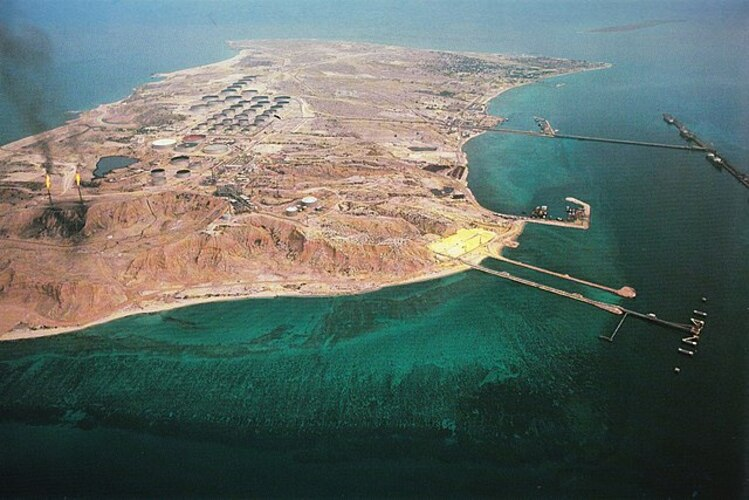
Barely 22 square kilometers in size, the island sits in the northeastern waters of the Arabian Gulf. Yet it functions as the heart of Iran’s energy lifeline. Roughly 90 percent of the country’s crude oil exports pass through its terminals, pipelines, and storage facilities. If the current conflict is partly about power, deterrence, and economic pressure, Kharg Island represents the intersection of all three.
So far, the expanding US-Israeli air campaign has avoided the island. This restraint is not accidental. It reflects a calculation that attacking Iran’s main oil export hub could unleash consequences far beyond the battlefield.
Oil markets remain highly sensitive to geopolitical shocks. A direct strike on Kharg could instantly disrupt millions of barrels per day of supply. With shipping routes already strained around the Strait of Hormuz, the risk of a broader energy crisis would increase dramatically.
Military planners in Washington understand this dilemma. According to reports, US officials have considered multiple scenarios for escalating pressure on Iran, including the possibility of seizing the island. The idea illustrates how economic warfare increasingly overlaps with traditional military strategy.
For US President Donald Trump, who has hinted that military operations could expand beyond nuclear and defense sites, Kharg represents a powerful lever. Controlling or neutralizing the island could weaken Iran’s economy without requiring a full-scale ground invasion.
Yet it is precisely this leverage that makes the island so dangerous to target.
Kharg Island is not just a loading terminal. It is a sophisticated export network connecting Iranian oil fields to global markets. Pipelines from major production areas converge there, allowing tankers to load up to seven million barrels of oil per day.
Massive storage facilities capable of holding around thirty million barrels provide a buffer that allows exports to continue even during logistical disruptions. Maritime infrastructure on the island can simultaneously handle multiple tankers, while offshore transfers allow additional shipments.
These capabilities make Kharg indispensable to Iran’s economy. Oil revenues remain one of the state’s primary financial pillars, funding everything from domestic programs to regional influence.
If the island were incapacitated, Iran would face a severe economic shock almost overnight.
Despite its strategic importance, striking Kharg carries enormous risks. Iran would almost certainly interpret such an attack as economic warfare aimed at crippling the state rather than weakening its military capabilities.
Tehran’s response could extend far beyond direct retaliation. Iran has repeatedly demonstrated its ability to threaten energy infrastructure across the Gulf. Facilities in neighboring states, shipping lanes, and offshore installations could all become targets.
Such escalation would transform a regional conflict into a global energy crisis.
Analysts estimate that even a temporary disruption of Kharg’s operations could push oil prices up by ten to twelve dollars per barrel. That increase might seem modest in isolation, but it would arrive on top of existing volatility tied to the war and tensions in global shipping routes.
In short, the island is not just a military target. It is a trigger point for global economic instability.
Kharg Island illustrates a broader truth about contemporary conflicts. In an interconnected global economy, strategic assets often carry more weight than territory itself.
Energy infrastructure, ports, digital networks, and supply chains increasingly determine the real balance of power in wartime. Destroying them can be more impactful than capturing cities.
This is why Kharg has become a focal point of international analysis. Western media, economic observers, and military strategists all recognize that the island’s fate could influence the trajectory of the war.
If it remains untouched, it suggests that both sides are still trying to contain the conflict’s economic fallout. If it becomes a target, the war will likely enter a far more dangerous phase.
For now, Kharg Island continues to operate, tankers still load crude, and Iran’s oil exports continue to flow into global markets. But the island’s strategic significance means it will remain under intense scrutiny.
The real question is not whether Kharg matters. That is already clear.
The question is whether the war will eventually reach the point where economic pressure outweighs the risks of global disruption.
If that moment arrives, the fate of a small island in the Arabian Gulf could reshape the geopolitical and economic landscape far beyond the Middle East.
The Grand Strategy Institute
Continue Exploring Strategic Analysis
Return to The Grand Strategy Institute for strategic assessments, long-form analysis and research examining geopolitics, military affairs, international security, emerging technologies and the changing international order.
← Back to The Grand Strategy Institute