
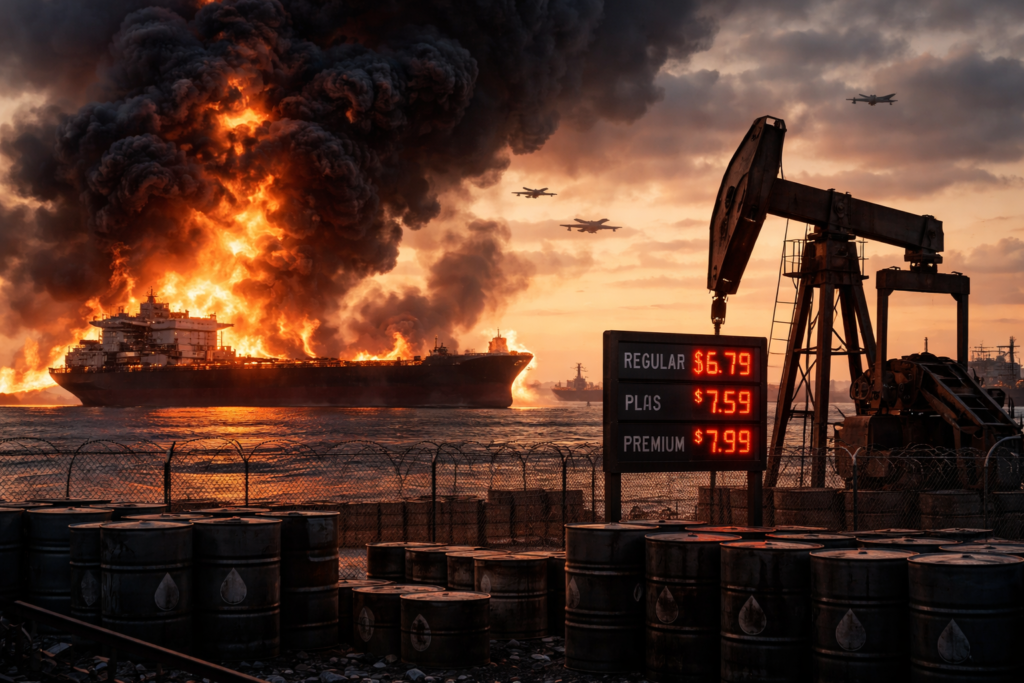
Image Credentials: Image Title: Global Energy Crisis Deepens as Oil Surpasses $100 Amid Gulf Tanker Attacks Source: (sora.openai) Date: March 2026. Attribution: This image was created using AI-generated imagery (sora.openai) and does not depict a real-world scene.
By Open Chronicle Staff with Agencies
LONDON — Global energy markets were plunged into chaos Thursday as Brent crude surged past $100 a barrel, following a series of aggressive maritime attacks in the Strait of Hormuz and the Gulf. The escalation marks the most significant disruption to the global oil supply in history, according to the International Energy Agency (IEA).
At least six tankers were confirmed hit in the strategic waterway, through which a third of the world’s seaborne oil passes. The attacks are part of a widening regional conflict that now pits a U.S.-Israeli coalition against Iran and its regional proxies in a high-stakes “war on Iran.”
“Finish the Job”: Washington and Tehran Trade Threats
The geopolitical temperature reached a boiling point this morning as world leaders reacted to the maritime strikes. U.S. President Donald Trump signaled a further intensification of military action, stating that the United States needs to “finish the job.” The rhetoric follows reports that the U.S. administration has discussed the possibility of seizing Kharg Island, a critical Iranian energy hub that processes nearly 90% of the country’s crude exports. Iranian Parliament Speaker Mohammad Baqer Qalibaf issued a chilling warning on X (formerly Twitter), stating that any aggression against Iranian islands would force Tehran to “abandon all restraint.”
Lebanon offensive Expands
The maritime conflict is mirrored by a devastating land war. Israeli Defence Minister Israel Katz confirmed that the military is preparing to expand operations in Lebanon. The offensive, which began on March 2 following the killing of Iran’s Supreme Leader, has already claimed over 600 lives and displaced 800,000 people in Lebanon.
Overnight, Hezbollah retaliated by launching over 100 rockets into northern Israel, triggering sirens in Tel Aviv. Meanwhile, Israeli airstrikes continued to batter Beirut’s southern suburbs, lighting the skyline in a grim display of the conflict’s intensity.
The Human and Economic Cost
The ripple effects of the war are being felt far beyond the Middle East:
-
India’s Water Crisis: Rising oil prices have caused a 50% spike in polymer costs, threatening India’s $5 billion bottled water market. With 70% of groundwater contaminated, the surge in plastic bottle costs comes just as the nation enters a sweltering summer.
-
Energy Rationing: In Indian kitchens, cooking gas shortages are forcing families to abandon hot meals and tea in favor of fast food and lemon water.
-
Diplomatic Exodus: Australia has joined a growing list of nations ordering “non-essential” diplomats to evacuate Israel and the UAE.
-
Banking Shutdowns: Citibank has shuttered branches across the UAE, while HSBC has closed all operations in Qatar, citing safety concerns for staff.
IEA Orders Record Reserves Release
In a desperate bid to stabilize the market, the IEA has recommended a record release of strategic oil reserves. Gulf nations have already cut production by 10 million barrels per dayroughly 10% of global demand, due to the hostilities.
“Upstream production will take weeks, and in some cases months, to return to pre-crisis levels,” the IEA warned in its latest report. For now, the world remains on edge as the Strait of Hormuz—the world’s most important energy chokepoint—becomes a frontline in an undeclared global war.