
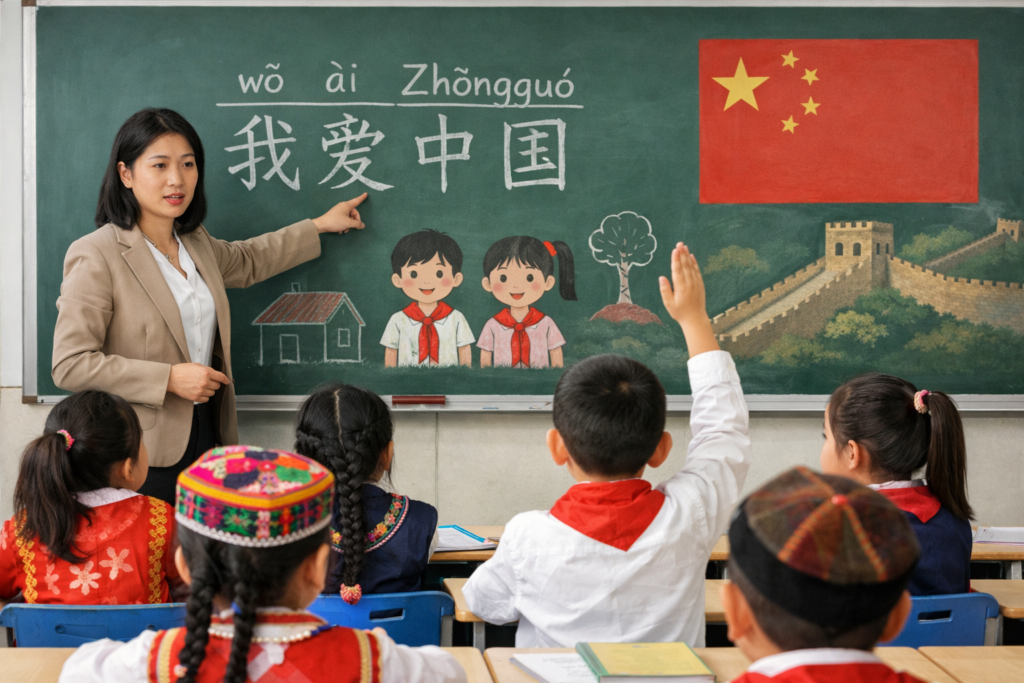
Image Credentials: Image Title: China Codifies “Ethnic Unity” Law, Mandating Mandarin from Preschool. Source: (sora.openai) Date: March 2026. Attribution: This image was created using AI-generated imagery (sora.openai) and does not depict a real-world scene.
By Open Chronicle Staff with Agencies
By Open Chronicle Staff
BEIJING – In a move that legal experts say represents the final nail in the coffin for regional ethnic autonomy, the National People’s Congress (NPC) yesterday approved the Law on Promoting Ethnic Unity and Progress. The sweeping legislation, passed during the closing session of the annual parliament, mandates the use of Mandarin Chinese in nearly all aspects of public life, starting with children as young as three.
The law is the culmination of President Xi Jinping’s “Sinicization” campaign, shifting the state’s approach from recognizing ethnic diversity to enforcing a singular, Han-centric national identity.
Mandarin for the Next Generation
The most significant provision of the law, Article 15, mandates that Mandarin Chinese (Putonghua) be the primary language of instruction for all children. Key requirements include:
-
Mandatory Preschool Mandarin: Proficiency in Mandarin is now a requirement before a child enters kindergarten.
-
Curriculum Dominance: All core subjects in primary and secondary schools must be taught in Mandarin, effectively ending the “bilingual education” models previously used in Tibet, Xinjiang, and Inner Mongolia.
-
Minority Languages Relegated: While the law technically allows for the study of minority languages, they are now treated as elective “foreign language” subjects, often limited to just one hour of instruction per day.
By the Numbers: China’s Demographic Landscape
According to 2020 census data and recent 2025 demographic projections, the law affects a significant portion of China’s frontier regions:
-
Han Chinese: Comprise approximately 91.5% of the 1.4 billion population.
-
Minority Groups: 55 officially recognized groups totaling roughly 120 million people (8.5%).
-
Zhuang: The largest minority at 19.6 million.
-
Uyghurs: Approximately 11.6 million, primarily in Xinjiang.
-
Tibetans: Approximately 7 million.
-
Mongolians: Approximately 6.3 million.
Prosecution for “Detrimental” Parenting
Critics are particularly alarmed by clauses that extend the law into the private home. The legislation provides a legal basis to prosecute parents or guardians who instill “detrimental views” in children—a term analysts fear will be used to target families who prioritize their native culture or religion over state-mandated “ethnic harmony.”
Furthermore, the law calls for “mutually embedded community environments,” which scholars believe will lead to the forced relocation of Han Chinese into minority-heavy neighborhoods to dilute local cultural concentrations.
International Reaction
The United Nations and human rights organizations have reacted with “deep concern.” A January 2026 UN report highlighted that Xinjiang’s current five-year plan projects 13.75 million instances of labor transfers, while an estimated 3.36 million Tibetans have been relocated through government programs since 2000.
“The children of the next generation are now isolated and brutally forced to forget their own language,” said Magnus Fiskesjö, an associate professor at Cornell University. Beijing, however, maintains that the law is a tool for “modernization” and that Mandarin proficiency is essential for the economic advancement of minority citizens.