
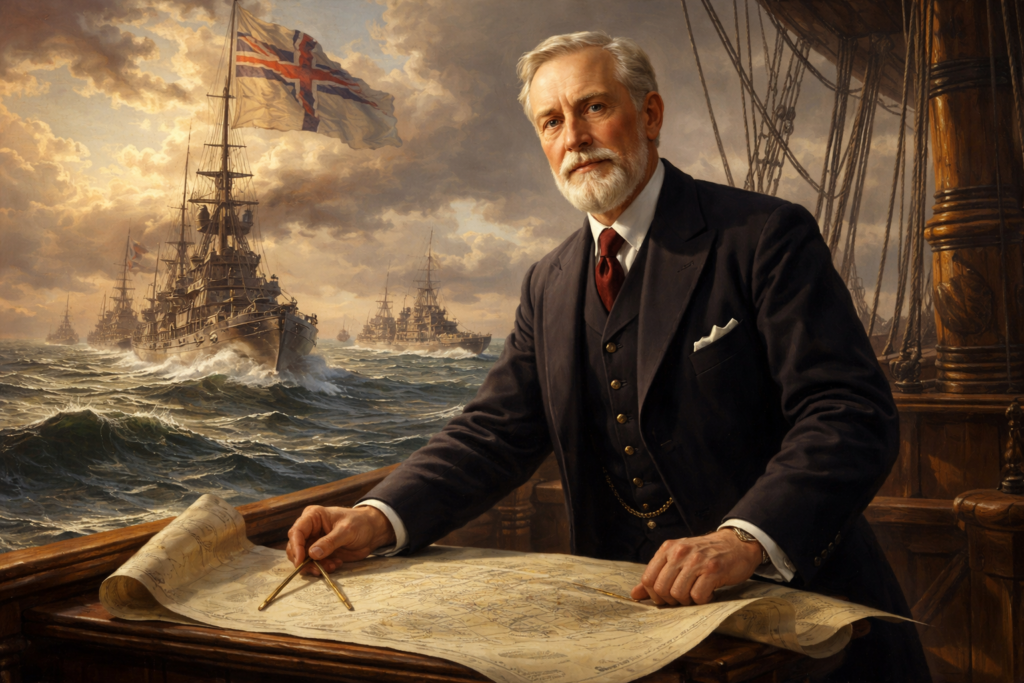
Image Credentials: Image Title: THE ARCHITECT OF THE WAVES: SIR JULIAN CORBETT AND THE EVOLUTION OF MARITIME STRATEGY Source: (sora.openai) Date: March 2026. Attribution: This image was created using AI-generated imagery (sora.openai) and does not depict a real-world scene.
By The Open Chronicle History Desk
While the American Captain Alfred Thayer Mahan was busy preaching the gospel of “decisive battle” and the absolute annihilation of enemy fleets, a quiet, legally trained Englishman was crafting a far more nuanced vision of the sea. Sir Julian Stafford Corbett (1854–1922) did not begin his career in the salt-spray of a quarterdeck, but in the hushed libraries of Cambridge and the Middle Temple. Yet, it was this civilian perspective, analytical, historical, and deeply political, that would eventually redefine how the British Empire, and later the world, understood the power of the ocean.
The Accidental Strategist
Born into a prosperous London family, Corbett initially pursued the law, practicing as a barrister before turning to his true passion: literature and history. He spent his early writing years penning historical novels and traveling as a correspondent. It wasn’t until the mid-1890s, when he was invited to edit documents for the Navy Records Society, that his “metier” became clear.
Corbett’s genius lay in his ability to look past the tactical “how” of naval combat to the strategic “why.” Influenced heavily by the Prussian theorist Carl von Clausewitz, Corbett argued that naval strategy was not an end in itself but a subset of national policy. In his view, a navy existed to serve the state’s political objectives, primarily by controlling maritime communications.
Command vs. Control
In his 1911 masterpiece, Some Principles of Maritime Strategy, Corbett introduced a radical distinction between “command of the sea” and the “exercise of command.” While his contemporaries were obsessed with finding and sinking the enemy’s main fleet (the “Trafalgar complex”), Corbett suggested that such a feat was often impossible or unnecessary.
He argued that because the sea is a “common” rather than a territory, it cannot be “conquered” in the way land can. Instead, the goal is to control the lines of communication, the trade routes, and troop transport lanes, while denying them to the enemy. This led to his controversial, yet enduring, support for “limited war,” where a maritime power uses its fleet to isolate a specific objective while avoiding the exhaustion of a total continental struggle.
The British Way of War
Corbett worked closely with Admiral Sir John “Jacky” Fisher, the reformist First Sea Lord, to modernize the Royal Navy before the First World War. He championed the idea of “Joint Operations”—the seamless integration of land and sea power. He famously noted that “Naval strategy is but that part of [maritime strategy] which determines the movement of the fleet… it is almost impossible that a war can be decided by naval action alone.”
During World War I, Corbett was tasked with writing the official history of naval operations. He remained a fierce intellectual independent, even when his findings, such as his critical analysis of the Battle of Jutland, clashed with the egos of high-ranking admirals and politicians like Winston Churchill. He refused to sanitize the record, believing that history’s only value was in its brutal honesty.
Legacy and Modern Relevance
Corbett died in 1922, literally working himself to death while documenting the Great War. For decades, his theories were overshadowed by the “big gun” school of thought, but the late 20th and early 21st centuries have seen a “Corbettian Renaissance.” In an era of “gray zone” conflict and global trade dependence, his focus on protecting commerce and using the sea for political leverage remains more relevant than Mahan’s vision of grand fleet clashes.
Bibliography
- Corbett, Julian S. Some Principles of Maritime Strategy. London: Longmans, Green and Co., 1911.
- ———. Naval Operations: History of the Great War Based on Official Documents. 5 vols. London: Longmans, Green and Co., 1920–1923.
- Lambert, Andrew. The British Way of War: Julian Corbett and the Battle for a National Strategy. New Haven: Yale University Press, 2021.
- Moffat, Ian. “Corbett: A Man Before His Time.” Journal of Military and Strategic Studies 7, no. 1 (2004).
- Schurman, Donald M. Julian S. Corbett, 1854–1922: Historian of British Maritime Policy from Drake to Jellicoe. London: Royal Historical Society, 1981.
- Smith, James W. E. “Expanding the Margins for Success: Corbett’s Maritime Strategy Theories and the United States Since 1945.” Texas National Security Review 6, no. 2 (2023).