
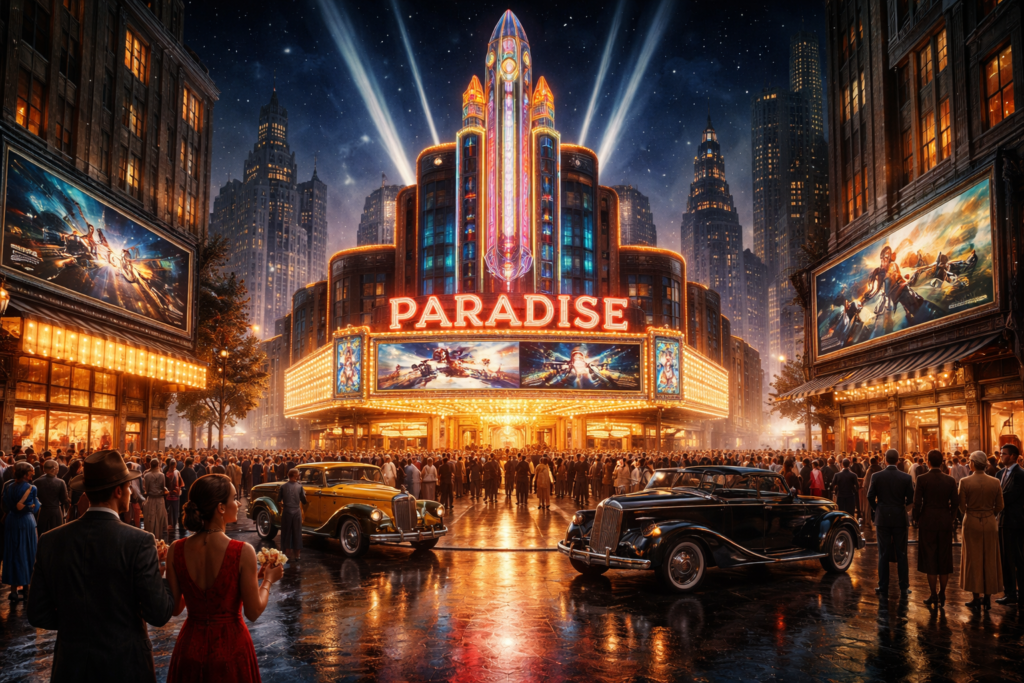
Image Credentials: Image Title: THE BIRTH OF MODERN ENTERTAINMENT Source: (sora.openai) Date: March 2026. Attribution: This image was created using AI-generated imagery (sora.openai) and does not depict a real-world scene.
By The Open Chronicle History Desk
For centuries, entertainment was a fleeting, communal experience. If you wanted to hear music, you went to a tavern or a church; if you wanted to see a drama, you sat in a crowded theater. But at the turn of the 20th century, a silent revolution began, one that would move the stage into the living room and turn the world into a global audience. The “Entertainment Revolution” was not just about new gadgets; it was about the democratization of culture.
The Death of Distance: The Phonograph and Radio
The first tremor of this revolution was the ability to capture sound. Before Thomas Edison’s phonograph and the subsequent refinement of the gramophone, music existed only in the moment of its performance. By the 1920s, the “talking machine” had turned the home into a concert hall.
Close on its heels came the radio. Unlike the phonograph, which required the purchase of individual discs, the radio provided a continuous stream of information and art for free (after the initial cost of the receiver). It created a “simultaneous experience”, millions of people across a continent listening to the same jazz program or news bulletin at the same moment.
The Silver Screen and the Living Room Box
While sound was being conquered, the image was being set in motion. The cinema began as a fairground attraction but rapidly evolved into a sophisticated narrative art form. By the 1930s, the “Golden Age of Hollywood” provided an escape from the harsh realities of the Great Depression.
However, the true “revolution” occurred when the spectacle of the cinema was shrunk down to fit inside a wooden cabinet in the suburban parlor. Television combined the intimacy of the radio with the visual power of the movies. By the 1950s, the TV set became the focal point of the modern home, fundamentally altering domestic architecture and family schedules.
From Mass Media to Personal Choice
The latter half of the 20th century saw the revolution shift from mass consumption to individual control. The introduction of the VCR in the 1970s meant that the “broadcaster” no longer dictated the schedule; the viewer did. This trajectory continued through the digital age, moving from physical media (CDs and DVDs) to the ephemeral cloud of streaming services.
Today, we live in the zenith of this revolution. Entertainment is no longer a destination we travel to; it is an atmosphere we inhabit. The barrier between the creator and the consumer has collapsed, allowing anyone with a smartphone to join the ranks of the “entertainment revolutionaries.”
Bibliography
- Barnouw, Erik. Tube of Plenty: The Evolution of American Television. New York: Oxford University Press, 1990.
- Ewen, David. History of Popular Music. New York: Barnes & Noble, 1991.
- Gitelman, Lisa. Scripts, Grooves, and Writing Machines: Representing Technology in the Edison Era. Stanford: Stanford University Press, 1999.
- Hark, Ina Rae. American Cinema of the 1930s: Themes and Variations. New Brunswick: Rutgers University Press, 2007.
- RGS History. “The Entertainment Revolution.” Accessed May 22, 2024. https://rgshistory.com/entertainment-revolution/.
- Wu, Tim. The Attention Merchants: The Epic Scramble to Get Inside Our Heads. New York: Alfred A. Knopf, 2016.