
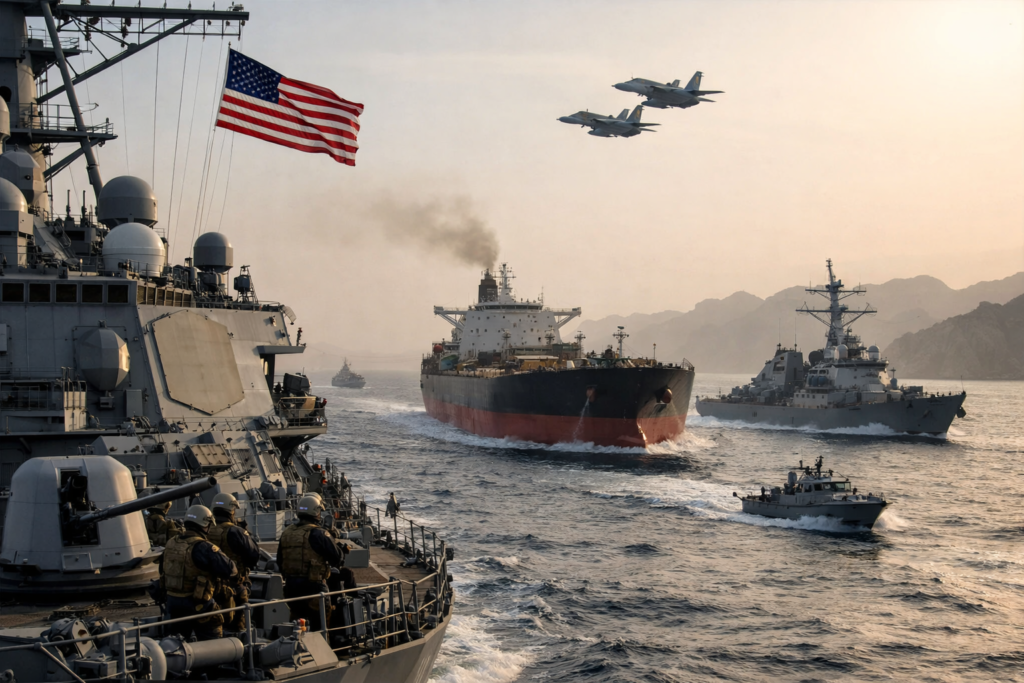
Image Credentials: Image Title: U.S. Treasury Signals Naval Escorts for Hormuz as Regional Conflict Intensifies Source: (sora.openai) Date: March 2026. Attribution: This image was created using AI-generated imagery (sora.openai) and does not depict a real-world scene.
Open Chronicle | Independent Reporting for a Global Community
By Staff | Thursday, March 12, 2026
WASHINGTON — In a move signaling a potential escalation of American involvement in the Persian Gulf, U.S. Treasury Secretary Scott Bessent announced Thursday that the United States Navy is prepared to begin escorting commercial vessels through the Strait of Hormuz. The operation, which may involve an international coalition, is expected to commence as soon as strategic military conditions are met.
Speaking in an interview with Sky News, Bessent outlined the administration’s stance on the increasingly volatile waterway, which has seen shipping paralyzed following a series of military exchanges between U.S.-Israeli forces and Tehran.
🚨 BREAKING: Treasury Sec. Scott Bessent reveals that the Navy — and potentially other countries — will ESCORT vessels through the Strait of Hormuz as soon as possible
Bessent says they’ve been planning this for MONTHS.
Trump’s team has a plan! 🇺🇸 pic.twitter.com/1TcvJxUwCi
— John John Jnr (@kikolara23) March 12, 2026
“My belief [is] that as soon as it is militarily possible, the U.S. Navy, perhaps with an international coalition, will be escorting vessels through,” Bessent stated. He clarified that the initiation of these escorts is contingent upon the U.S. achieving “complete control of the skies” and ensuring that Iran’s missile-rebuilding capabilities are “completely degraded.”
The Strait of Hormuz, a vital chokepoint through which roughly 20% of the world’s oil and liquefied natural gas (LNG) flows, has become the center of a brewing global economic crisis. Recent strikes on Iranian territory have prompted the Islamic Revolutionary Guard Corps (IRGC) to threaten a total blockade of the Gulf unless military actions against the country cease.
The disruption has already sent energy prices surging globally, adding pressure to an international community already wary of a full-scale regional war. Despite the tension, Bessent noted that the straits are not yet fully closed or mined, observing that some Iranian and Chinese-flagged tankers continue to navigate the passage.
Critics and regional analysts have warned that the introduction of naval escorts could lead to confrontations between U.S. warships and IRGC fast-attack boats, further narrowing the window for a diplomatic resolution. However, the administration appears focused on restoring the “freedom of navigation” that underpins global energy security.
As the U.S. and its allies weigh the risks, the global markets remain on edge, waiting to see if the proposed naval “shield” can stabilize prices or if it will serve as the spark for a wider conflagration in the Middle East.