
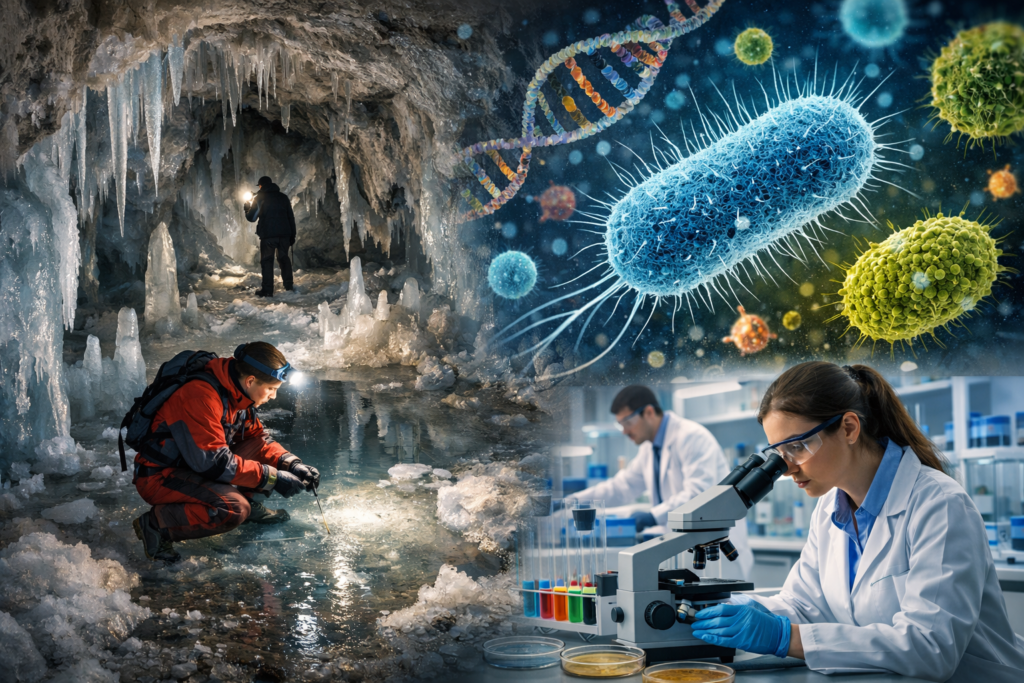
Image Credentials: Image Title: Ancient Secrets in Modern Times: 5,000-Year-Old Ice Cave Bacterium Reveals Antibiotic Resistance Source: (sora.openai) Date: March 2026. Attribution: This image was created using AI-generated imagery (sora.openai) and does not depict a real-world scene.
By Open Chronicle Science Staff
In a discovery that bridges the distant past with modern medical challenges, scientists have uncovered a startling secret hidden deep within a Romanian ice cave. Locked away in a layer of ice dating back 5,000 years, a newly analyzed bacterium has demonstrated resistance to several modern antibiotics, providing a sobering reminder that the genetic blueprints for drug resistance existed long before the dawn of modern medicine.
The research, recently highlighted by Frontiers in Microbiology, focused on a specific bacterial strain trapped in the subterranean depths of the Scărișoara Ice Cave. The microbe, identified as Psychrobacter SC65A.3, belongs to a genus of cold-adapted bacteria known as “psychrophiles.” While many members of this group are being explored for beneficial roles in biotechnology, this particular strain has caught the attention of the global scientific community for a more concerning reason.
A Natural Reservoir of Resistance
Laboratory testing revealed that Psychrobacter SC65A.3 is resistant to several key antibiotics, including trimethoprim, clindamycin, and metronidazole. These are drugs commonly used today to treat a wide array of human ailments, from urinary tract infections (UTIs) and skin conditions to infections of the lungs, bloodstream, and reproductive system.
The fact that these resistance traits were present in a microbe that has been isolated from the world for five millennia suggests that “resistance genes” are a natural part of the bacterial toolkit. These segments of DNA likely evolved as survival mechanisms in harsh, competitive environments long before humans began mass-producing antibiotic drugs.
Risks and Opportunities
This discovery highlights two critical points for the future of global health:
-
Reservoirs of Resistance: Frozen environments like glaciers and ice caves act as vast, unexplored libraries of genetic material. As the climate warms and these ancient ice layers melt, there is a potential for these “dormant” resistance genes to be reintroduced into modern ecosystems or transferred to contemporary pathogens.
-
Biotechnological Potential: Despite the risks, these ancient microbes are also treasure troves for science. Because they are adapted to extreme cold and low-nutrient environments, they may possess unique enzymes or metabolic pathways that could lead to breakthroughs in green chemistry, food preservation, or even the development of new classes of medicines.
As researchers continue to probe the depths of our planet’s cryosphere, the story of Psychrobacter SC65A.3 serves as a call for increased vigilance and a deeper understanding of the “resistome”the collection of all resistance genes in the environment.
Story Source:
Materials provided by Frontiers. Note: Content may be edited for style and length.
Journal Reference:
- Victoria Ioana Paun, Corina Itcus, Paris Lavin, Mariana Carmen Chifiriuc, Cristina Purcarea. First genome sequence and functional profiling of Psychrobacter SC65A.3 preserved in 5,000-year-old cave ice: insights into ancient resistome, antimicrobial potential, and enzymatic activities. Frontiers in Microbiology, 2026; 16 DOI: 10.3389/fmicb.2025.1713017