
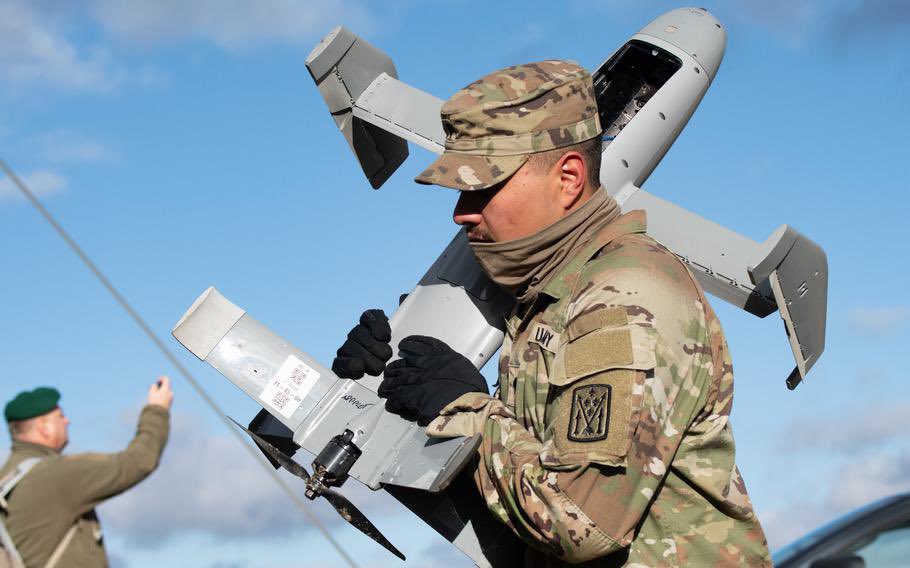
Image: from OSINTdefender X @sentdefender
By Open Chronicle with Agencies
WASHINGTON/HOUSTON — In a massive expansion of its aerial defense strategy, the U.S. Army has deployed approximately 10,000 AI-powered interceptor drones to the Middle East. The move, reported by ABC News and confirmed by Army Secretary Dan Driscoll, aims to counter the relentless waves of Iranian “suicide drones” that have characterized the opening weeks of Operation Epic Fury.
The systems, known as Merops, were developed by Perennial Autonomy, a defense venture backed by former Google CEO Eric Schmidt. Originally combat-tested in Ukraine against Russian Geran-2 (Shahed-type) drones, the Merops units are specifically designed to hunt and neutralize enemy UAVs using advanced artificial intelligence that remains functional even when GPS or communication signals are jammed.
A “Math Problem” Solved
The deployment addresses what lawmakers and Pentagon officials have called a “math problem” in modern warfare. Until now, U.S. and Israeli forces have relied heavily on Patriot and THAAD missile systems to down incoming threats. However, using a $4 million interceptor missile to destroy a $20,000 Iranian Shahed drone is economically unsustainable.
| System | Estimated Cost per Unit | Primary Function |
| Merops AI Drone | $14,000 – $15,000* | AI-driven drone interception |
| Shahed-136 (Iran) | $20,000 – $50,000 | One-way “Suicide” attack |
| Patriot Missile | $4,000,000+ | Ballistic/Cruise missile defense |
*Driscoll noted that mass production could eventually drop Merops’ cost to as low as $3,000 per unit.
Strategic Context
Operation Epic Fury, which launched on February 28, 2026, began with massive joint U.S.-Israeli strikes that reportedly killed several high-ranking Iranian officials. Iran has since retaliated by launching thousands of drones and missiles across the region, targeting U.S. bases in Kuwait, Qatar, and the UAE, as well as civilian infrastructure like Dubai International Airport.
Secretary of War Pete Hegseth stated that the Pentagon has “pushed every counter-UAS (Unmanned Aircraft System) system possible forward” to protect U.S. assets. The Merops drones are portable enough to be launched from the back of a pickup truck and are being positioned at various sites, including locations where there is no permanent U.S. military presence.
Tension with Ukraine
The deployment comes amid a complex diplomatic backdrop. While the Merops technology was perfected on Ukrainian battlefields, President Donald Trump has recently rebuffed offers of direct drone-defense assistance from Ukrainian President Volodymyr Zelenskyy, insisting that the U.S. does not need external help to manage the Iranian threat.
Despite the political friction, military analysts agree that the lessons learned from the war in Ukraine have been essential in preparing the U.S. for the current “drone war” in the Middle East.