
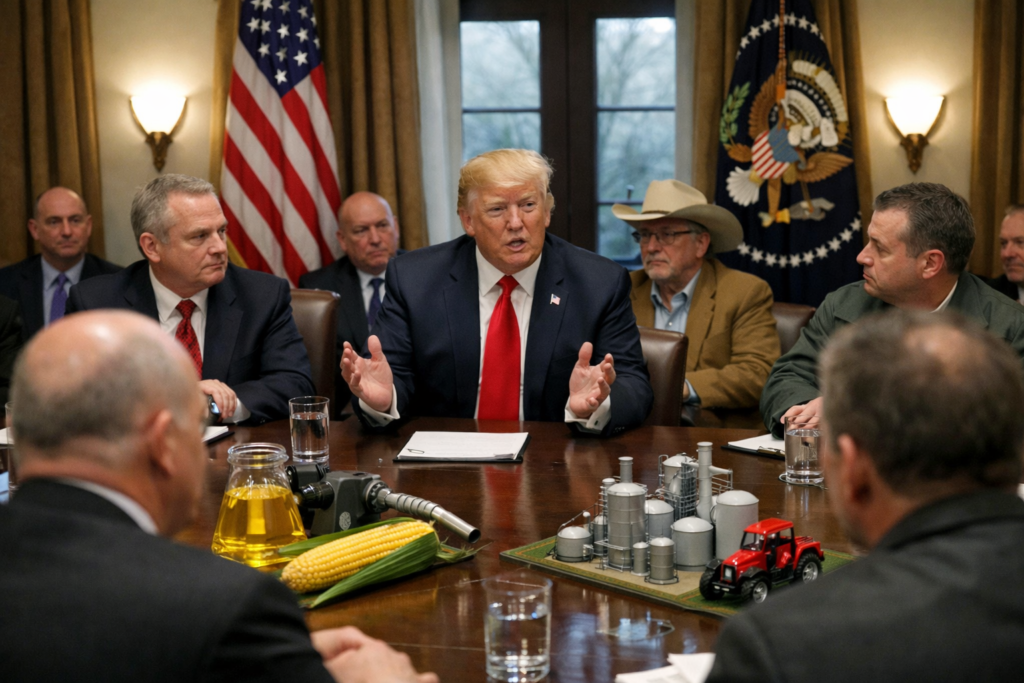
Image Credentials: Image Title: Iran : BIOFUEL BATTLE: TRUMP HOSTS WHITE HOUSE SUMMIT ON EPA MANDATES Source: (sora.openai) Date: March 2026. Attribution: This image was created using AI-generated imagery
PRESIDENT ATTEMPTS TO BRIDGE DIVIDE BETWEEN RUST BELT FARMERS AND OIL REFINERY GIANTS
By OPEN CHRONICLE STAFF with Agencies
WASHINGTON — Seeking to solidify his “America First” energy coalition, President Donald Trump hosted a high-stakes summit at the White House on Monday to address the growing friction over federal biofuel mandates. The event, held in the East Room before a crowd of corn growers and oil executives, served as the backdrop for a critical decision regarding the Environmental Protection Agency’s (EPA) Renewable Fuel Standard (RFS).
The meeting comes at a pivotal moment for the administration, as two of its most loyal constituencies, the agricultural heartland and the domestic energy sector, find themselves at loggerheads over how much ethanol and biodiesel must be blended into the nation’s fuel supply.
A “Win-Win” or a Zero-Sum Game?
For decades, the RFS has been a cornerstone of rural economics, guaranteeing a market for billions of bushels of corn. However, small oil refineries have long argued that the costs of complying with these mandates, specifically the purchase of blending credits known as RINs, are driving them toward bankruptcy.
“We’re going to take care of our farmers, and we’re going to take care of our refineries,” President Trump told the assembled crowd. “We want energy dominance, and that means using every tool we have, from the cornfields of Iowa to the rigs in Pennsylvania.”
While the President promised a “fair deal for everyone,” the underlying tension was palpable. Behind the scenes, the EPA has been weighing a massive increase in “hardship waivers” for small refineries, a move that farm groups warn would “demand-destruct” the ethanol market and crater corn prices.
The Political Stakes of the Heartland
The summit is widely viewed as a preemptive strike to shore up support in the “Blue Wall” states of the Midwest ahead of the 2026 midterm elections. Farmers in states like Iowa, Nebraska, and Illinois have grown increasingly vocal about their dissatisfaction with the administration’s trade policies and the perceived favoritism toward the oil lobby.
“The President knows he can’t win without the farmer,” said Sarah Henderson, a lobbyist for a major corn growers association. “But he also knows the ‘forgotten man’ in the refinery towns is just as important. He’s trying to walk a tightrope that might not even exist.”
The “RFS Overhaul” Proposal
Internal memos leaked ahead of the summit suggest the administration is considering a “grand bargain”: expanding the year-round sale of E15 (fuel containing 15% ethanol) in exchange for capping the price of RIN credits for refineries.
While the oil industry has expressed cautious optimism about a price cap, biofuel advocates argue that such a move would undermine the very purpose of the mandate. Environmental groups have also weighed in, noting that the focus on corn-based ethanol ignores the broader shift toward electrification in the transport sector, a shift the Trump administration has notably de-emphasized.
Industry Reactions
The White House event featured testimonials from several industry leaders. “We just want a level playing field,” said one refinery CEO who attended the meeting. “The current system is broken and rewards Wall Street speculators over actual fuel producers.”
Conversely, a representative from the National Farmers Union warned that any retreat from the biofuel mandates would be seen as a “betrayal of the promises made on the campaign trail.”
As the summit concluded, no formal executive order was signed, but the President indicated that a “final, beautiful decision” from the EPA would be announced by the end of the week. With gas prices already a sensitive topic for the administration, the outcome of this biofuel balancing act will likely resonate from the gas pump to the ballot box.