
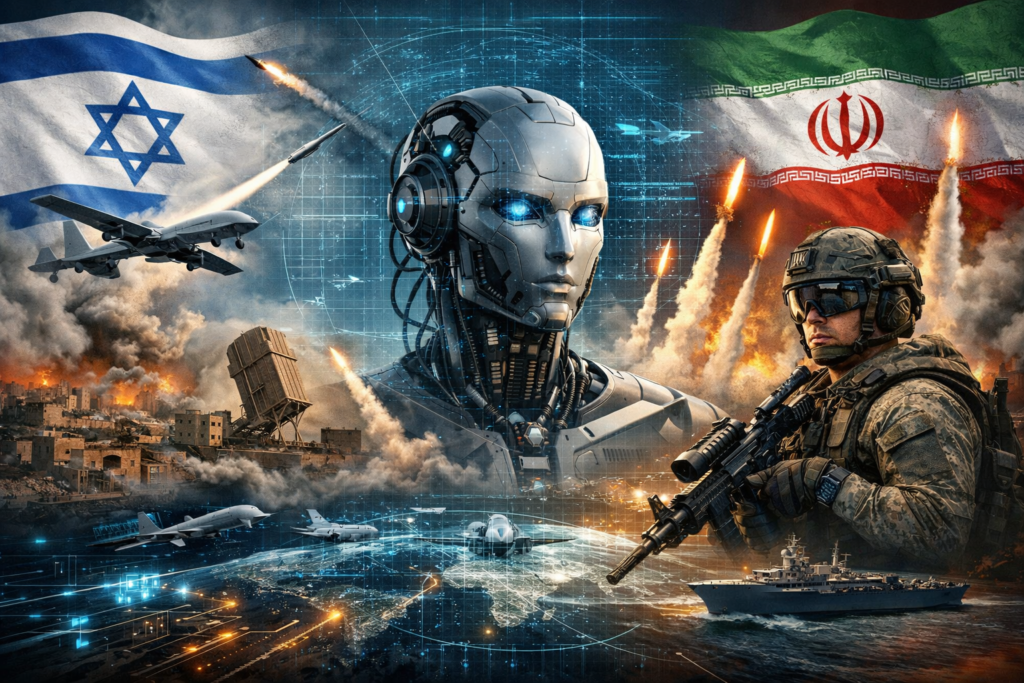
Image Credentials: Image Title: THE SILICON FRONTLINE: HOW AI IS REWRITING THE RULES OF THE ISRAEL-IRAN-US CONFLICT Source: (sora.openai) Date: March 2026. Attribution: This image was created using AI-generated imagery
By OPEN CHRONICLE STAFF with Agencies
JERUSALEM — As tensions between Israel, Iran, and the United States reach a fever pitch, the theater of war is shifting from traditional physical maneuvers to a high-speed, invisible landscape governed by Artificial Intelligence. Military experts and geopolitical analysts warn that AI is no longer a peripheral tool but the central nervous system of the modern conflict, shaping both the lethality of the battlefield and the very reality of the global narrative.
In a conflict increasingly defined by “asymmetric innovation,” all three nations are deploying AI-driven systems to outpace, outthink, and out-influence their adversaries, creating a “triple-threat” environment where human decision-making is struggling to keep pace with machine-learning algorithms.
The Kinetic Edge: Predictive Lethality
On the physical battlefield, Israel’s “Gospel” system, an AI-driven target-generation platform, has become a cornerstone of IDF operations. By processing vast amounts of intelligence data in seconds, the system can identify targets at a rate far exceeding human capacity.
“We are seeing a shift from ‘intelligence-led’ warfare to ‘algorithm-driven’ warfare,” says Dr. Arash Mansour, a defense analyst. “The speed of identification and engagement has reduced the window for de-escalation to almost zero.”
Simultaneously, Iran has integrated AI into its drone swarms, allowing unmanned aerial vehicles (UAVs) to communicate and coordinate in mid-air without direct human control. These “loitering munitions” use computer vision to navigate complex air defense grids, presenting a significant challenge to U.S. and Israeli naval assets in the Red Sea and Persian Gulf.
The Narrative War: Deepfakes and Perception Management
Beyond the exchange of fire, a more insidious war is being waged in the digital “infosphere.” The conflict has seen an unprecedented surge in AI-generated content designed to manipulate public opinion and sow domestic discord.
The U.S. State Department recently flagged a series of highly sophisticated “deepfake” videos appearing to show high-ranking Israeli officials making inflammatory statements. Similarly, Iranian social media has been flooded with AI-authored bot accounts that mimic the “organic” outrage of Western activists, a tactic known as “computational propaganda.”
“The goal isn’t just to make you believe a lie,” says Sarah Chen, a specialist in digital disinformation. “The goal is to make you doubt that anything is true. When the public can no longer trust their own eyes and ears, the narrative becomes whatever the strongest algorithm says it is.”
The “OODA Loop” and the Risk of Escalation
The greatest fear among strategists is the “flash war”, a scenario where AI systems on both sides interact in ways their creators didn’t intend, leading to an accidental escalation. In military terms, the “OODA loop” (Observe, Orient, Decide, Act) is being compressed by AI to such an extent that humans are being moved “out of the loop” and into a “on the loop” supervisory role.
The U.S. military’s “Project Maven” and other AI initiatives are working to maintain a “competitive advantage,” but officials admit that the lack of international norms regarding AI in warfare creates a dangerous vacuum. Unlike nuclear weapons, there are no treaties governing the use of autonomous targeting or algorithmic psychological operations.
A Tri-Polar Arms Race
As Washington, Jerusalem, and Tehran continue to pour billions into AI research and development, the conflict is serving as a real-world laboratory for the future of human struggle. The Israel-Iran-US triangle is no longer just a clash of ideologies or territories; it is a race for “algorithmic sovereignty.”
In this new era, the victor may not be the one with the most tanks or missiles, but the one whose code can most effectively mask the truth while uncovering the enemy’s secrets. As the sun sets over the Middle East, the glow of the data center is becoming just as significant as the flash of the explosion.